
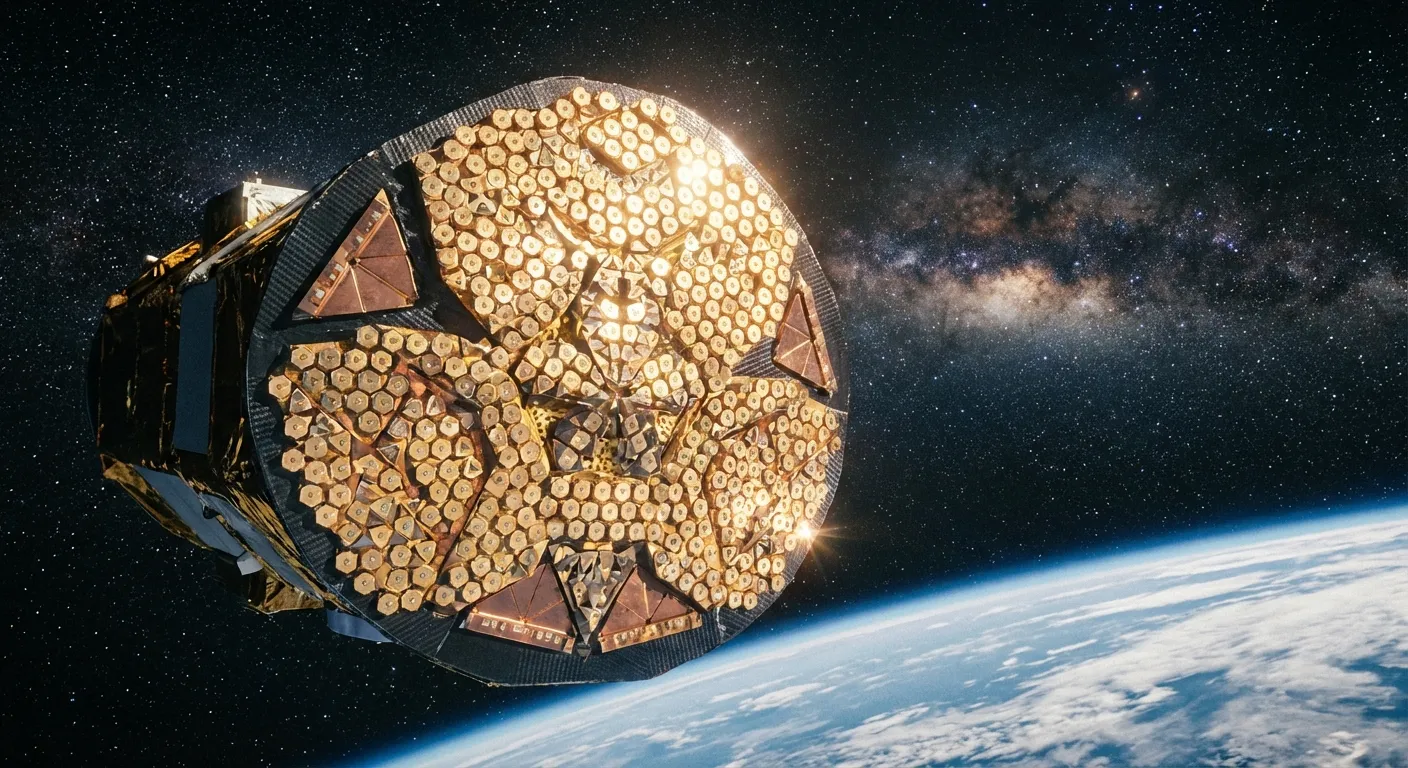
CesiumAstro just pulled off something that most space startups only dream about: a $470 million funding round that brings together defense capital, commercial investors, and government-backed financing in a single deal. The Austin, Texas-based company, which builds phased array communication systems for satellites, announced its Series C on February 2, positioning itself for what CEO Shey Sabripour calls a "scale moment" in the rapidly expanding market for satellite connectivity.
The round breaks down into $270 million in equity funding led by Trousdale Ventures, plus $200 million in a financing package from the Export-Import Bank of the United States (EXIM) and J.P. Morgan. The investor list reads like a geopolitical strategy document: Toyota's growth fund Woven Capital, Airbus Ventures, the Development Bank of Japan, Janus Henderson Group, MESH Ventures, and NewSpace Capital all participated. When a Japanese automaker, a European aerospace giant, and the U.S. government's export bank all write checks for the same company, something significant is happening.
That something is the convergence of commercial and military demand for space-based communications. Every modern military operation depends on satellite connectivity, and the commercial sector is increasingly building applications that require the same capabilities. CesiumAstro sits at that intersection, manufacturing the antenna systems that allow satellites to communicate with ground stations, aircraft, ships, and each other.
The Phased Array Advantage
To understand why investors are this enthusiastic, you need to understand what CesiumAstro actually builds. Phased array antennas are the technological backbone of modern satellite communications. Unlike traditional dish antennas that physically point at a target, phased arrays use hundreds or thousands of tiny transmitting elements that can electronically steer their signal in any direction, almost instantaneously, without moving parts.
This matters enormously for both military and commercial applications. A phased array antenna on a satellite can simultaneously communicate with multiple ground stations, track moving targets, and switch between tasks in milliseconds. For a military drone operator who needs continuous high-bandwidth connectivity, or a commercial airline offering passenger Wi-Fi, or a maritime shipping company tracking its fleet in real time, phased arrays are the enabling technology.
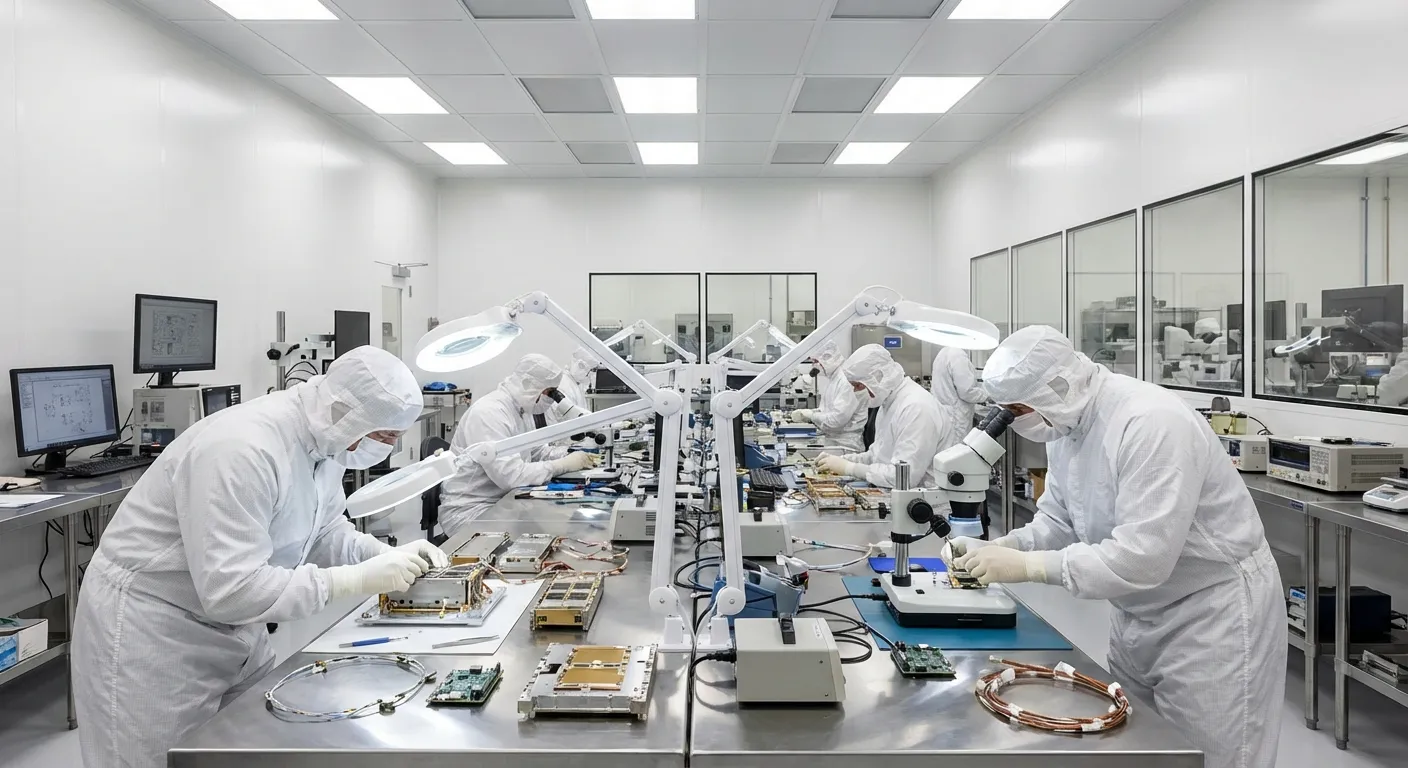
CesiumAstro's competitive advantage is vertical integration. The company designs, manufactures, and tests its hardware and software platforms entirely in-house, meeting AS9100D and ISO 9001:2015 quality standards. That end-to-end control means faster iteration cycles, tighter quality assurance, and the ability to customize products for specific customer requirements without depending on third-party suppliers.
Sabripour told Via Satellite that the funding represents a validation of CesiumAstro's approach to the market. "This is a scale moment," he said, emphasizing that the capital would accelerate the transition from building individual systems to mass-producing them for a growing customer base. The company has already secured contracts with the Space Development Agency, one of the Pentagon's primary organizations for developing next-generation military satellite constellations.
Building the Factory
The most tangible outcome of the $470 million will be a new 270,000-square-foot headquarters facility in Texas. The site will consolidate CesiumAstro's design, assembly, integration, and testing functions into a single U.S.-based operation, with construction projected to begin in early 2027. Texas Governor Greg Abbott welcomed the investment, which is expected to create hundreds of manufacturing jobs in the Austin area.
The manufacturing scale-up is critical because demand for satellite communication systems is accelerating faster than most suppliers can build them. The Space Development Agency alone is deploying hundreds of satellites in low Earth orbit for military communications and missile tracking, and each satellite needs communication payloads. Commercial constellation operators, from Starlink to OneWeb to Amazon's Kuiper, have similar needs at even larger volumes.

CesiumAstro's expansion fits a broader pattern of space manufacturing returning to American soil. After decades of offshoring production, national security concerns and supply chain disruptions have prompted both government and commercial customers to demand domestically manufactured satellite components. The EXIM Bank's participation in the financing reflects this priority: the agency exists specifically to support American exports and manufacturing competitiveness.
SpaceNews reported that the funding includes both equity and debt components, giving CesiumAstro financial flexibility. The equity portion funds growth and R&D, while the debt financing from EXIM and J.P. Morgan supports the capital-intensive manufacturing buildout. This structure is common in defense-adjacent companies that need to make large upfront investments in facilities and equipment before revenue catches up.
The Dual-Use Market Opportunity
CesiumAstro's market straddles the line between defense and commercial applications, a position that has become increasingly valuable as both sectors converge. The company's Element satellite platform, unveiled in late 2024, was specifically designed as a dual-use system that serves both military and commercial customers from the same hardware architecture.
This dual-use approach has strategic implications beyond business efficiency. Defense customers benefit from commercial-volume pricing and faster innovation cycles. Commercial customers benefit from the reliability and performance standards that military applications demand. The result is a virtuous cycle where each market subsidizes improvements that benefit the other.
The Space Development Agency's Proliferated Warfighter Space Architecture, which envisions hundreds of interconnected satellites providing communications, navigation, and missile warning capabilities, represents one of CesiumAstro's largest potential revenue streams. The agency has awarded multiple contracts for communication payloads, and CesiumAstro has positioned itself as a key supplier for the constellation's evolving needs.
On the commercial side, the explosion of satellite-based services creates demand that barely existed five years ago. Direct-to-device satellite connectivity, where smartphones communicate directly with orbiting satellites, is moving from novelty to necessity. Autonomous vehicles, remote industrial operations, and disaster response all require satellite communications that can handle increasing bandwidth requirements. CesiumAstro's AI-enabled systems, which can optimize their own signal processing in real time, are designed for exactly these demanding applications.
Space Tech's Funding Moment
CesiumAstro's $470 million sits within a broader resurgence in space technology investment. After a correction in 2023 and 2024, when several high-profile space SPACs collapsed and investor enthusiasm cooled, capital is flowing back into the sector with more discipline and focus on companies with actual revenue and government contracts.
The difference between this funding cycle and the previous one is maturity. Investors like Trousdale Ventures, Airbus Ventures, and Woven Capital aren't speculating on space tourism or asteroid mining. They're backing a company that builds proven hardware for customers with large budgets and multi-year procurement cycles. That's a fundamentally different risk profile than the one that characterized the 2021 space SPAC boom.

Aviation Week reported that CesiumAstro's round is one of the largest for a private space communications company, reflecting both the market opportunity and the capital intensity of hardware manufacturing. Unlike software companies that can scale with minimal infrastructure investment, satellite hardware companies need factories, testing equipment, and supply chain partnerships that require significant upfront capital.
The investor composition also signals something about where the satellite industry is heading. Toyota's involvement through Woven Capital suggests that automotive companies see satellite connectivity as critical infrastructure for autonomous driving. Airbus Ventures' participation indicates that the European aerospace giant views CesiumAstro's technology as complementary to its own satellite programs. The Development Bank of Japan's investment reflects Japan's strategic interest in space communications as a component of national security.
What Changes
CesiumAstro's $470 million round validates a thesis that has been building for years: the next layer of global connectivity will be built in space, and the companies that manufacture the enabling hardware will capture enormous value. The combination of defense demand, commercial applications, and government support creates a market environment where well-positioned companies can scale rapidly.
For the broader space industry, the round signals that sophisticated investors are willing to write large checks for companies with proven technology and clear paths to revenue. That's encouraging for the sector's long-term health, even as it raises the bar for startups still in the early stages. The era of funding space companies based on compelling PowerPoint presentations has given way to one where investors demand real hardware, real customers, and real revenue trajectories.
CesiumAstro's challenge now is execution. Building a 270,000-square-foot manufacturing facility, scaling production to meet demand from both the Pentagon and commercial customers, and maintaining quality standards while growing rapidly is enormously difficult. But with $470 million in the bank and a customer base that includes some of the world's most demanding buyers, the company has the resources to attempt it. Whether they succeed will help determine how the next chapter of satellite communications gets written.
Sources
- CesiumAstro Closes $470M in Series C Capital for Rapid U.S. Growth in 2026 - BusinessWire
- CesiumAstro Raises $470M in Growth Capital, CEO Sabripour Calls It a 'Scale Moment' - Via Satellite
- CesiumAstro to scale operations with $470 million in equity and debt financing - SpaceNews
- CesiumAstro Closes $470 Million Series C Round - Aviation Week
- Governor Abbott Welcomes CesiumAstro Investment in Texas - Office of the Texas Governor