

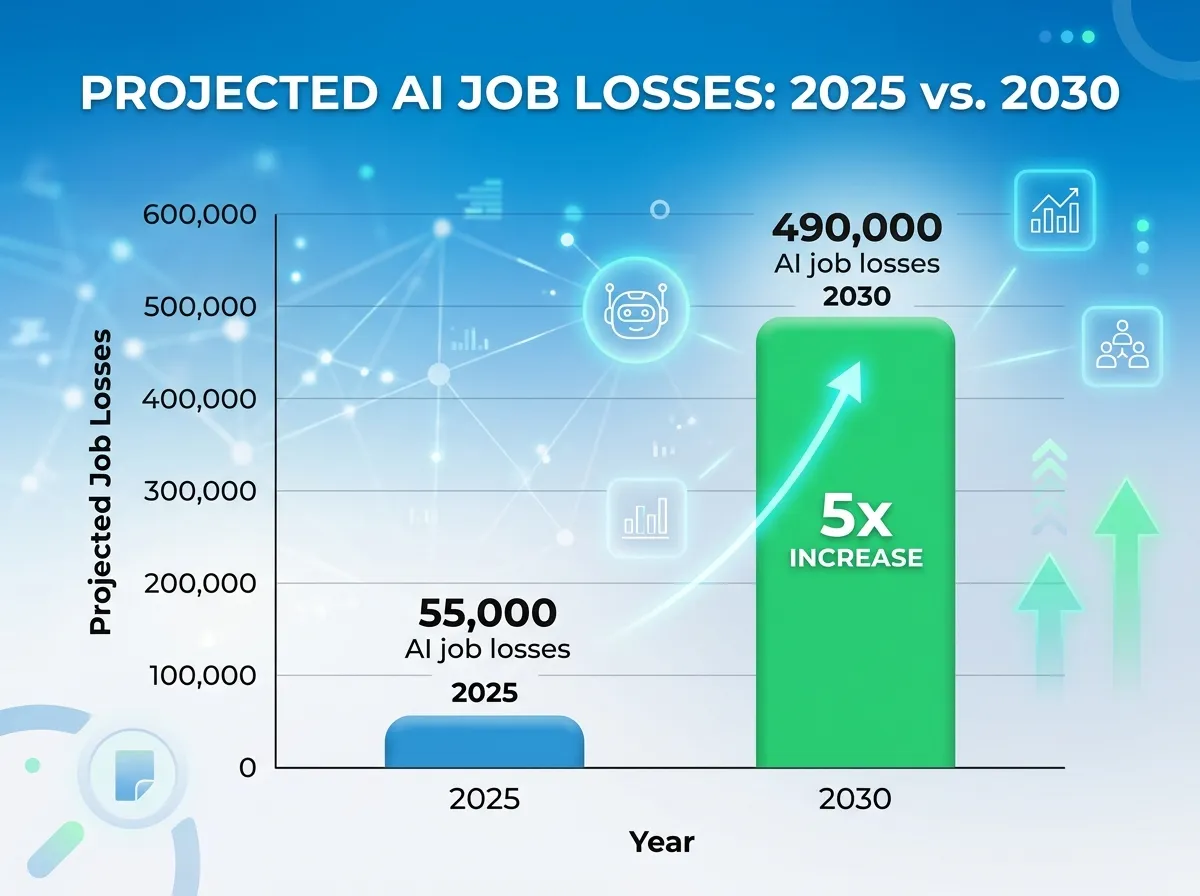
Behind closed doors, America's chief financial officers are telling a different story about AI than the one you hear in earnings calls. In a new National Bureau of Economic Research working paper based on surveys of 750 CFOs, nearly half admit they're planning AI-related job cuts this year. The projected number: roughly 502,000 roles, a ninefold increase from the 55,000 positions attributed to AI in 2025.
But before you update your resume in a panic, the full picture is considerably more complicated. That half-million figure is just 0.4% of the 125 million jobs across surveyed firms. And the same executives planning cuts are simultaneously pouring record budgets into technology they haven't yet figured out how to monetize.
The Numbers Behind the Headlines
The survey, conducted jointly by the Duke CFO Survey and the Federal Reserve Banks of Atlanta and Richmond, offers the most granular look yet at how corporate America is actually deploying AI against its workforce. Of the 750 CFOs surveyed, 44% said they plan some form of AI-related job reduction in 2026.
The breakdown tells a specific story. Roughly 250,000 of those projected losses fall in white-collar positions, the administrative, analytical, and middle-management roles that large language models can most directly replicate. That's not a rounding error, but it's also not the apocalypse. For context, the U.S. economy recorded 92,000 job losses last month alone through normal churn, and unemployment sits at 4.4%.
"It's not the doomsday job scenario that you might sometimes see in the headlines," said John Graham, director of the Duke CFO Survey. The data suggests a workforce in transition, not in collapse.
The Companies Already Making Moves
Several high-profile firms aren't waiting for year-end to act. Block, the payments company led by Jack Dorsey, has cut more than 4,000 employees, roughly 40% of its workforce. Atlassian trimmed 10% of staff. Meta is reportedly planning cuts as deep as 20%.
These aren't struggling companies shedding dead weight. They're profitable firms making a calculated bet that agentic AI systems can handle work that previously required human judgment. Block's internal messaging has been blunt: the company believes AI agents can replace entire workflow layers, from customer service escalation to fraud review.
What's notable is the candor. A year ago, most executives framed AI layoffs as "restructuring" or "realignment." Now, CFOs are attributing cuts directly to AI capability, suggesting they've moved past the experimentation phase and into replacement planning.
The Chief Executive Financial Performance Benchmark Report paints a similar picture from a broader lens. According to its January 2026 survey, 31% of companies are already using AI to reduce headcount, even as 53% plan to expand their overall workforce this year. The contradiction isn't confusion. It's companies hiring in growth areas while automating away administrative roles.
The Productivity Paradox Nobody Wants to Discuss
Here's where the story gets uncomfortable for the AI-will-save-everything crowd. Despite massive investment, most companies can't yet point to meaningful revenue gains from their AI spending.
Graham put it plainly: "Companies have invested and they're realizing all these kind of cool things...but it's not really showing up yet in revenue."
This echoes a pattern economists have seen before. In 1987, Nobel laureate Robert Solow observed that "you can see the computer age everywhere but in the productivity statistics." Nearly four decades later, Solow's Paradox has a sequel. AI tools are everywhere in the corporate stack, from code generation to customer chatbots to financial modeling, yet aggregate productivity metrics remain stubbornly flat.
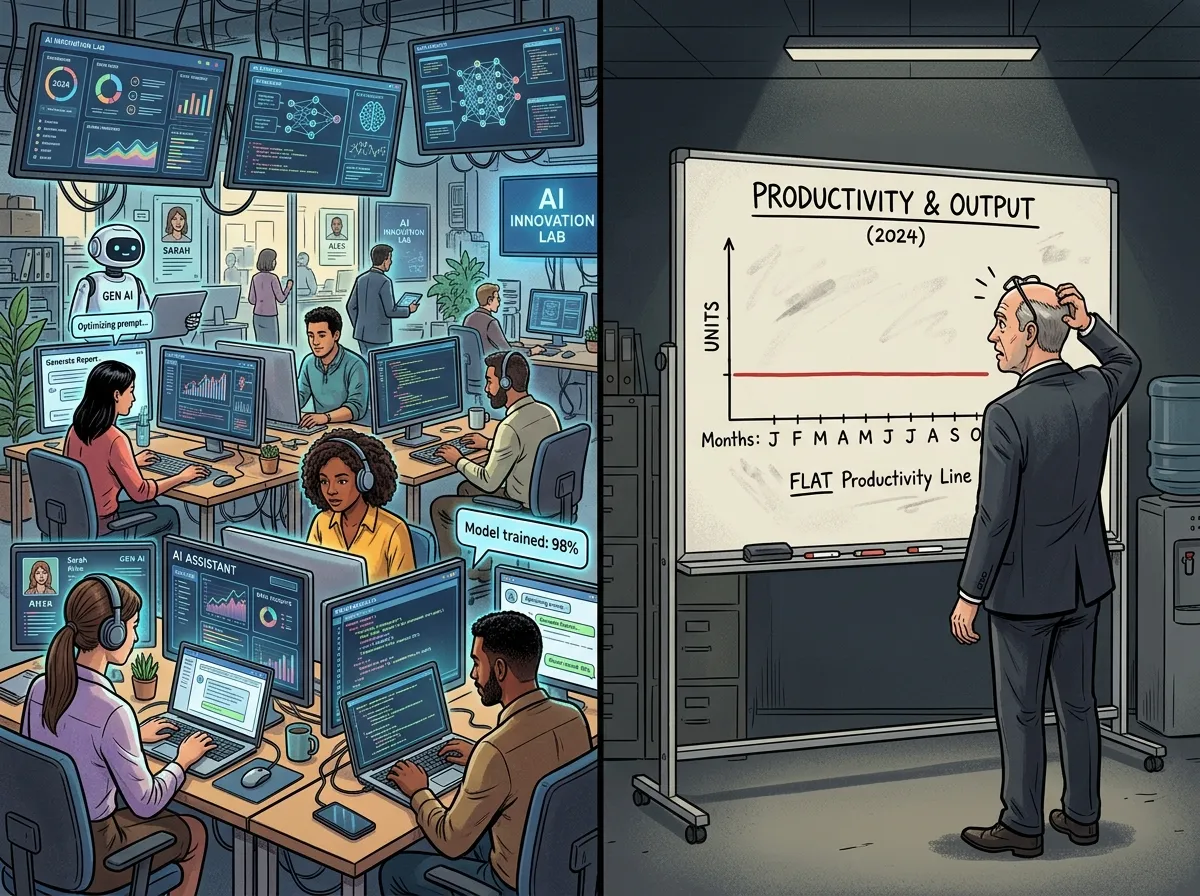
The gap between perceived and realized AI gains matters because it shapes what happens next. CFOs are spending aggressively, with 75% increasing technology budgets and 48% planning double-digit increases, according to data from The CFO. But there's a hidden cost multiplier: for every dollar spent on AI tools, companies are discovering they need roughly $20 in data architecture improvements to make those tools actually work.
That 20-to-1 ratio explains why the productivity payoff keeps getting pushed out. Companies bought the AI. Now they're realizing they need to rebuild the plumbing.
What's Actually Being Created
The job destruction story is real, but it's only half the ledger. According to a PYMNTS survey, 50% of CFOs say AI will create entirely new roles requiring new skill sets. The rise of the Chief AI Officer is just the most visible example of a broader pattern.
The emerging roles fall into predictable categories: AI trainers who teach models company-specific knowledge, prompt engineers who bridge the gap between business needs and model capabilities, and oversight specialists who audit AI output for accuracy and bias. Less predictably, companies are also hiring "AI translators," people who can explain to non-technical executives what their AI systems are actually doing and, just as importantly, what they're getting wrong.
Small firms present an interesting counterpoint to the overall trend. While large companies lead in AI-driven headcount reduction, smaller firms are actually planning to increase hiring in technical roles. The dynamic mirrors earlier technology waves: big companies automate to cut costs, while smaller competitors hire specialists to compete.
Gartner's numbers quantify the broader slowdown. Average HR budget growth is expected to drop from 2.4% in 2025 to just 0.7% in 2026, with AI efficiency gains cited as the primary driver. Headcount growth expectations have collapsed from 6% to 2%. Companies aren't panicking, but they're clearly tightening.
Who Gets Hurt, and Who Doesn't
The distribution of pain matters as much as the total. Administrative roles face the steepest risk, which tracks with AI's current strengths in document processing, scheduling, data entry, and routine analysis. If your job involves following a predictable workflow with clear inputs and outputs, the automation timeline just accelerated.
Mid-career professionals in these roles face a particular bind. They're too experienced to retrain cheaply but not senior enough to move into strategy or oversight positions. A 2025 survey found that 64% of finance leaders are now promoting internally rather than hiring externally, a shift that rewards institutional knowledge but potentially locks out displaced workers from adjacent industries.
The workers most insulated from AI displacement share a common thread: their jobs require navigating ambiguity, managing relationships, or making judgment calls where the cost of error is high. Sales, complex negotiations, creative strategy, and hands-on skilled trades remain firmly in human territory, at least for this cycle.

The Bigger Story
The 9x headline is designed to alarm, and it should get your attention. But the underlying data reveals something more nuanced than mass displacement: a corporate sector that is simultaneously cutting administrative roles, investing heavily in technology it can't yet profit from, and creating new positions it didn't know it needed a year ago.
The real risk isn't that AI eliminates half a million jobs. In an economy that creates and destroys millions of positions annually, that's manageable. The risk is the mismatch, that the workers losing administrative roles aren't the same people filling AI specialist positions, and that the transition happens faster than retraining programs can keep up.
Graham's survey captures a workforce at an inflection point. CFOs have moved from asking "should we invest in AI?" to "how many people can AI replace?" That shift in framing, from exploration to substitution, is the real news buried in the data. The 502,000 number will change. The strategic mindset behind it won't.