
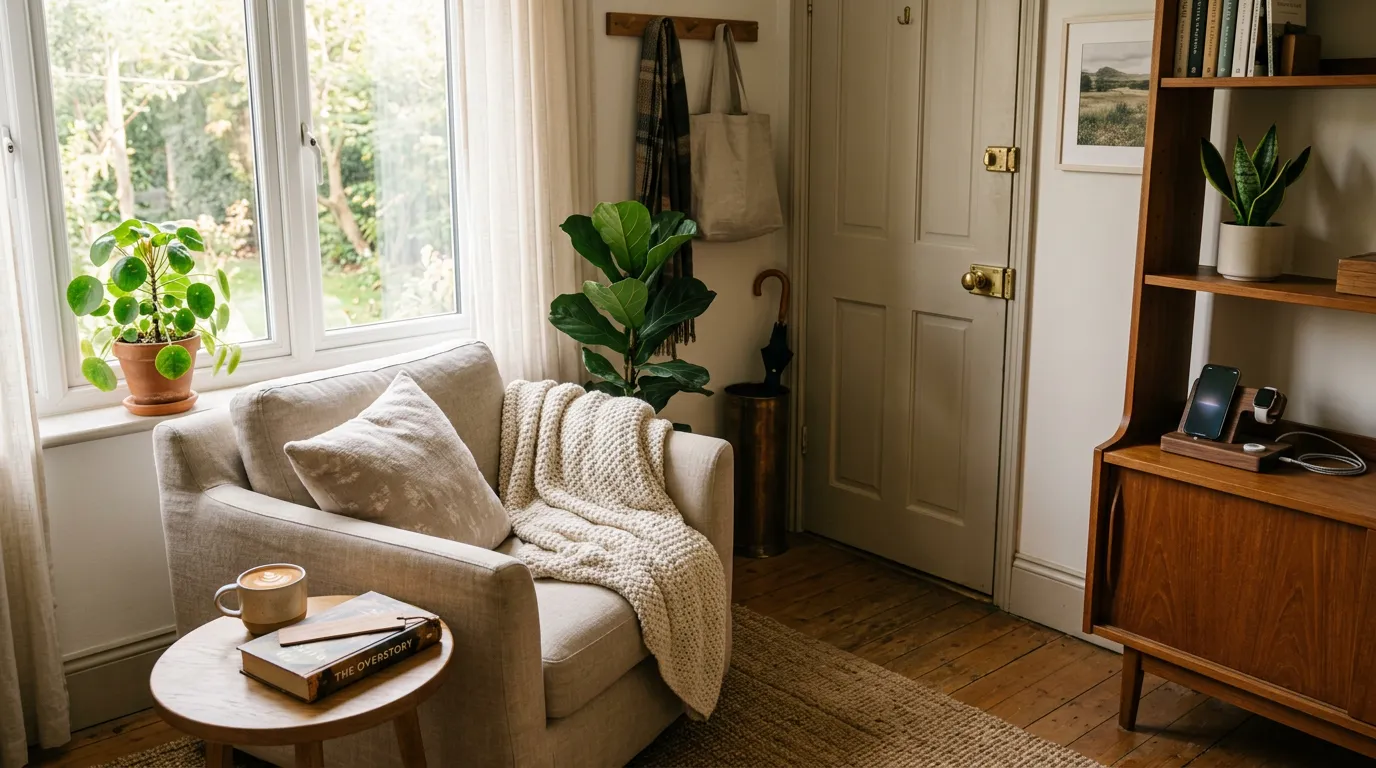
You sit down to read. Within four minutes, you've picked up your phone. You didn't plan to. You didn't even want to. But the phone was on the arm of the chair, right there, and your hand reached for it the way your hand reaches for a light switch when you walk into a dark room. Not a decision. A reflex shaped by placement.
Now consider a different version of the same evening. The phone is in the kitchen, plugged into a charger by the door. The book is on the chair where you always sit. You read for 40 minutes before you even think about checking anything. Same person. Same willpower. Same book. The only thing that changed was where you put objects in a room.
This is not a productivity hack. It is one of the most replicated findings in behavioral science: the physical environment you live in shapes your behavior more powerfully than your motivation, your goals, or your intentions. And most people never think about it at all.
The Science of Default Choices
In the early 2000s, behavioral economist Richard Thaler and legal scholar Cass Sunstein began documenting what they called "choice architecture," the idea that how options are presented determines which options people choose. Their research, which eventually became the book Nudge, demonstrated that default settings, the thing that happens when you don't actively choose, drive the majority of human decisions.
The most famous example is organ donation. Countries that require people to opt out of organ donation have participation rates above 90%. Countries that require people to opt in hover around 15%. The difference is not cultural. It is not about values or education. It is about which box comes pre-checked on a form. People overwhelmingly accept the default, whatever it is.
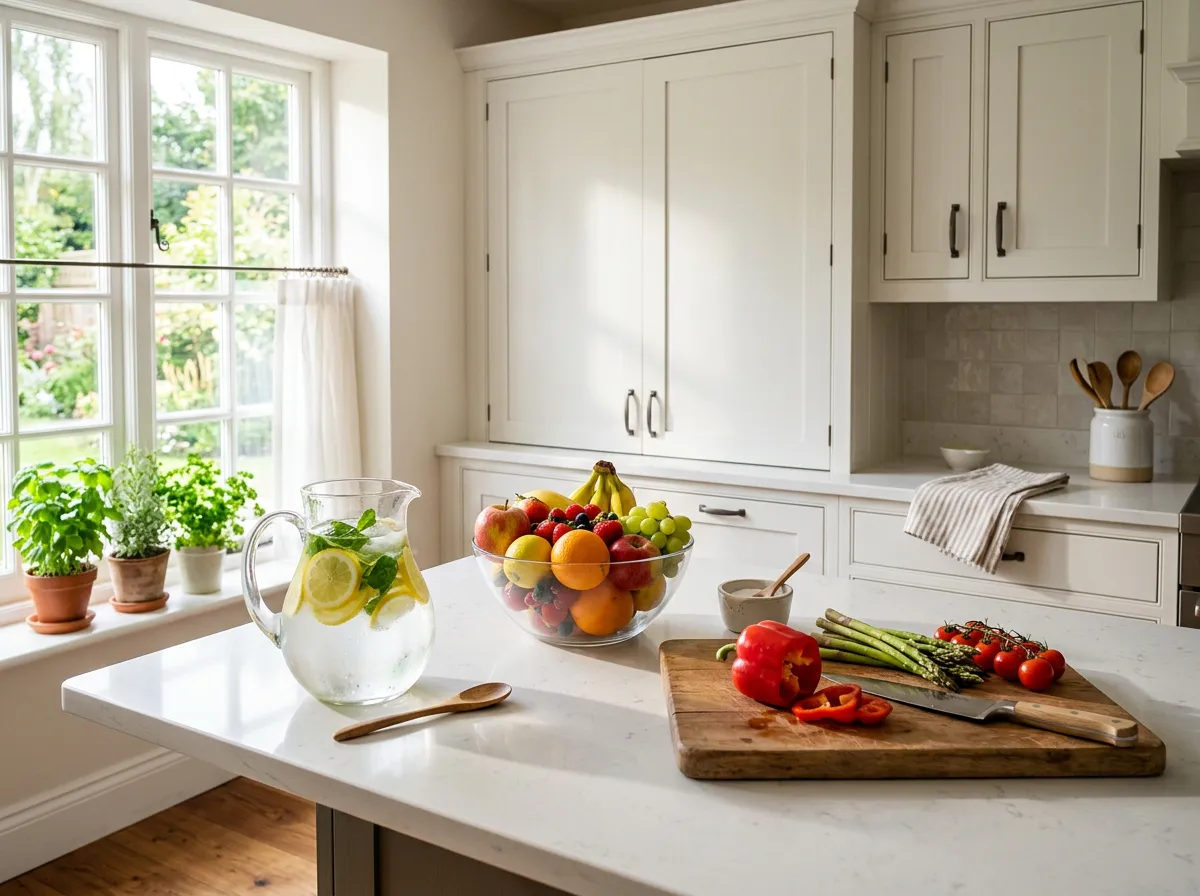
Your home works the same way. The food on your counter is the food you eat first. The device closest to your hand is the device you reach for. The chair that faces the television is where you sit. Every room has default behaviors embedded in its layout, and those defaults run your evenings, your mornings, and your weekends far more than your intentions do.
Wendy Wood, a psychologist at the University of Southern California whose research has focused on habit formation for over 30 years, found that approximately 43% of daily actions are performed habitually, triggered by environmental cues rather than conscious decisions. Her book Good Habits, Bad Habits documents how the physical environment acts as a constant, invisible prompt. "People think they're making choices all day," Wood has said. "Mostly, they're responding to the environment they built yesterday."
Why Willpower Is the Wrong Variable
Here is where most self-improvement advice goes wrong. It tells you to be more disciplined. Wake up earlier. Resist temptation. Try harder. And the advice feels true because effort does matter, at least temporarily. You can white-knuckle your way through a week of better choices. But willpower is a finite resource that depletes under stress, fatigue, and decision load, which means the strategy of "try harder" fails precisely when you need it most: at the end of a long day, during a stressful week, or in the months after the initial excitement of a new goal fades.
Roy Baumeister's research on ego depletion, while debated in its specifics, pointed to a finding that has been replicated in broader terms: self-control is harder to sustain when cognitive resources are taxed. A 2019 meta-analysis published in Psychological Bulletin examined 198 studies and found that while the "willpower as a muscle" metaphor is oversimplified, the core observation holds. People who rely on conscious self-control to maintain behaviors fail more often than people who design environments that make the desired behavior automatic.
The practical implication is radical. Instead of building more willpower, build a better room. Instead of resisting the cookie on the counter, put the cookie in a cabinet you can't see from the kitchen doorway. Instead of telling yourself to exercise in the morning, put your workout clothes next to your bed the night before and move the coffee maker to a room you have to walk past the treadmill to reach.
This is not laziness. It is an honest reckoning with how human cognition actually works. Your conscious mind handles roughly 50 bits of information per second. Your unconscious mind processes roughly 11 million. The environment talks to the 11 million, and the 11 million runs the show.
Redesigning Your Space Without Renovating
The good news is that environmental redesign does not require new furniture, a bigger apartment, or a Pinterest-worthy aesthetic. It requires attention to three things: visibility, proximity, and friction.
Visibility determines what you think about. Brian Wansink's research at Cornell's Food and Brand Lab, before his later academic controversies, generated one finding that has been consistently replicated by other labs: people eat approximately 70% more food when it is left visible on a counter versus stored in a closed cabinet. The same principle applies to every object in your home. If your guitar is in a closet, you won't play it. If it's on a stand in the living room, you'll pick it up while waiting for dinner to cook. The behavior you want should be the behavior you see.
Proximity determines what you do first. James Clear, whose work on habits built on B.J. Fogg's behavioral model, calls this the "two-minute rule": if a behavior takes more than two minutes to start, you're far less likely to do it. But the deeper principle is spatial proximity. The closer a behavior's tools are to where you already are, the more likely you are to engage. Move the journal to the nightstand. Put the meditation cushion where you drink coffee. Place the running shoes by the door you leave through, not in a closet down the hall.
Friction determines what you avoid. Every additional step between you and a behavior reduces the likelihood you'll do it. Want to scroll less at night? Charge your phone in a different room. Want to cook more? Pre-chop vegetables on Sunday so that Wednesday's dinner requires opening a container, not washing, peeling, and cutting. Want to spend less money online? Remove saved credit card information so that every purchase requires getting up, finding your wallet, and typing 16 digits. The behavior doesn't need to be impossible. It needs to be slightly harder.

The Room You're In Is the Life You're Living
There is a deeper point here that goes beyond productivity or habit formation. The spaces we inhabit reflect and reinforce who we are becoming. A home filled with unfinished projects tells a story about overwhelm. A workspace cluttered with objects from the last five tasks tells a story about fragmented attention. A bedroom that doubles as an office tells a story about boundaries that don't exist.
Environmental psychologist Sally Augustin has documented the relationship between physical spaces and emotional states for over two decades. Her research shows that visual clutter increases cortisol levels and reduces the ability to focus, while natural elements like plants, natural light, and organic textures produce measurable reductions in stress. This is not aesthetic preference. It is physiology. Your nervous system responds to spatial cues the way your immune system responds to pathogens: automatically and without your permission.
The invitation is not to obsess over your environment, which would just be another thing to over-optimize. It is to pay attention, once, with genuine curiosity, to what your space is asking you to do. Walk through your home as if you've never seen it. Notice what's at eye level, what's within arm's reach, what requires effort to access. The behaviors your space makes easy are the behaviors that will dominate your days. If those behaviors aren't the ones you want, the solution is not more discipline. It's a different arrangement.
Start Here
You don't need to redesign your entire home this weekend. Start with one room and one behavior. The research consistently shows that small environmental changes produce outsized behavioral shifts, precisely because they bypass the conscious effort that most self-improvement demands.
Pick the behavior you most want to change. Then ask three questions: Is the thing I need for that behavior visible? Is it close to where I already am? Have I removed the friction that makes it harder than it needs to be? Change one of those three variables tonight. Not all three. Not in every room. Just one change, in one space, for one behavior you've been struggling with.
You might be surprised by what happens when you stop fighting yourself and start redesigning the room instead. Discipline gets all the credit, but your environment has been doing the actual work all along. Might as well put it to work in your favor.
Sources
- Wendy Wood, *Good Habits, Bad Habits* (Farrar, Straus and Giroux, 2019)
- Richard Thaler and Cass Sunstein, *Nudge: Improving Decisions About Health, Wealth, and Happiness* (Penguin, 2008)
- James Clear, *Atomic Habits* (Avery, 2018)
- Hagger, M. S. et al., "A Multilab Preregistered Replication of the Ego-Depletion Effect," *Psychological Bulletin*, 2019