

The meeting has been going for 35 minutes. Two people have done 80% of the talking. They've proposed ideas quickly, debated loudly, and reached a conclusion that feels decisive. The quietest person in the room, the one who has been listening carefully and taking notes, has a perspective that would change the direction of the conversation. They don't share it. Not because they lack confidence, but because the room wasn't built for the way they think.
This scenario plays out in conference rooms and video calls thousands of times a day. And the loss is not just personal. Organizations that systematically undervalue introverted contributions are making a structural error that costs them in innovation, decision quality, and employee retention. The research on this has been accumulating for over a decade, and the conclusion is becoming difficult to ignore: the traits associated with introversion, including deep listening, careful deliberation, and the ability to focus for extended periods, are increasingly the skills that modern work demands most.
What Introversion Actually Is (and Isn't)
The most common misconception about introversion is that it's the same as shyness. It's not. Shyness is fear of social judgment. Introversion is a preference for less stimulation. An introvert can be perfectly comfortable in social situations and still need time alone afterward to recharge. The distinction matters because organizations often conflate quietness with disengagement, which leads them to overlook their most thoughtful contributors.
Susan Cain, whose book Quiet: The Power of Introverts in a World That Can't Stop Talking brought introversion research into mainstream conversation, draws on decades of personality psychology to make a distinction between temperament and behavior. Roughly one-third to one-half of the population falls on the introverted end of the spectrum, according to research using the Big Five personality model. These are not people who lack social skills. They are people whose cognitive processing favors depth over speed, reflection over reaction, and substance over presentation.
The neuroscience supports this framework. Research by Michael Cohen at the University of Amsterdam, using fMRI imaging, has shown that introverts' brains process information through longer, more complex neural pathways that involve areas associated with internal thought, memory, and planning. Extroverts process through shorter pathways more heavily weighted toward sensory experience and immediate reward. Neither pathway is superior. But they produce different cognitive strengths, and those strengths have different values depending on the task.

The Open Office Mistake
The past two decades of workplace design have been, in many ways, an accidental experiment in penalizing introverted work styles. The shift to open-plan offices, which accelerated in the 2010s and remains dominant despite widespread complaints, was driven by the assumption that more collaboration produces better results. The research says otherwise.
A landmark study by Ethan Bernstein and Stephen Turban at Harvard Business School, published in Philosophical Transactions of the Royal Society, found that the transition to open offices reduced face-to-face interaction by approximately 70% while increasing email and messaging volume. People didn't collaborate more. They retreated into digital communication to escape the constant stimulation of the open floor.
For introverts, who need periods of low stimulation to do their best thinking, open offices represent a cognitive tax that accumulates throughout the day. Gloria Mark, a professor of informatics at the University of California, Irvine, found that the average office worker is interrupted every 3 minutes and 5 seconds, and that it takes an average of 23 minutes to return to focused work after an interruption. For introverts, who reach deep work states more readily but are also more disrupted by external stimulation, these interruptions are not minor annoyances. They represent a fundamental mismatch between the environment and their cognitive strengths.
The companies getting this right are the ones that have moved toward what workplace researchers call "activity-based working," providing a variety of spaces designed for different types of tasks. Quiet rooms for focused work. Small meeting rooms for two-to-four-person conversations. Larger spaces for collaborative sessions. The goal is not to eliminate collaboration but to stop treating it as the only valuable mode of work.
Introverted Leadership Is Not an Oxymoron
Perhaps the most damaging myth about introversion in the workplace is that leadership requires extroversion. The "charismatic leader" archetype, built on confidence, energy, and the ability to command a room, has dominated management culture for generations. But the research on leadership effectiveness tells a more nuanced story.
Adam Grant, a professor of organizational psychology at Wharton, published a study in the Academy of Management Journal that produced a counterintuitive finding: introverted leaders outperformed extroverted leaders when managing proactive employees. The mechanism was straightforward. Extroverted leaders tended to feel threatened by employees who brought strong ideas, sometimes competing with them for attention. Introverted leaders, by contrast, listened more carefully, gave team members more room to develop their contributions, and created conditions where the best ideas surfaced regardless of who proposed them.
Grant's finding explains why some of the most effective leaders in business history have been introverts. Bill Gates, Warren Buffett, and former PepsiCo CEO Indra Nooyi have all described themselves as introverted. Their leadership styles share common traits: deep preparation, careful listening, a preference for written communication, and a willingness to let others take the spotlight. These are not weaknesses compensated for by other strengths. They are strengths, specifically suited to complex organizations where the leader's job is to make good decisions, not to be the most impressive person in the room.
The emerging data on remote and hybrid work reinforces this. In distributed teams where communication happens primarily through writing, the introverted communication style, thoughtful, structured, and detailed, often produces clearer direction than the extroverted style of spontaneous verbal communication. Several tech companies have adopted "document-first" cultures where proposals are written and read before being discussed, a format that levels the playing field between those who think by talking and those who think before talking.
What Introverts Can Do Differently (and What Organizations Must)
If you're an introvert who has spent your career feeling like the workplace wasn't designed for you, that feeling is accurate. It wasn't. But the research suggests that the mismatch is a feature of outdated organizational design, not a limitation of your temperament.
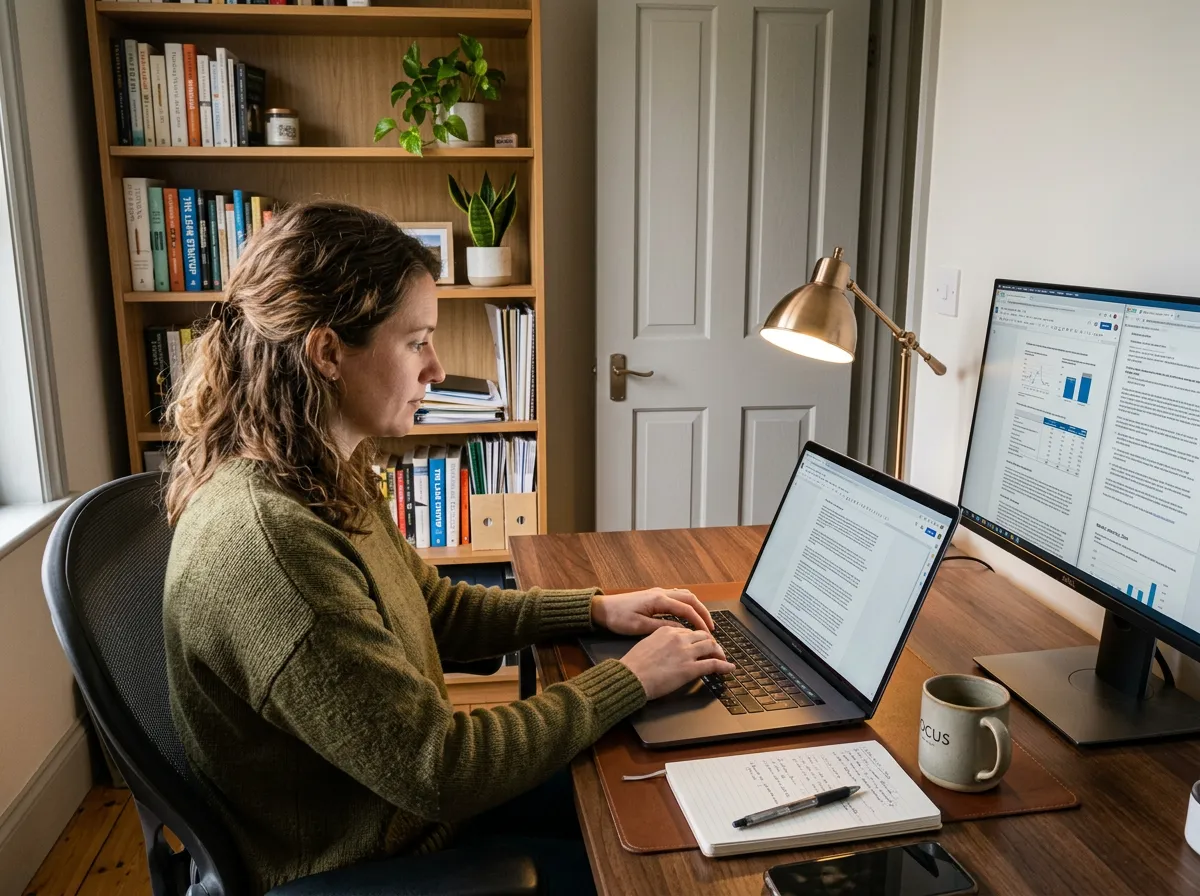
There are practical adjustments that work within existing structures. Requesting agendas before meetings gives you time to prepare thoughts rather than generating them on the spot. Following up meetings with written summaries allows you to contribute ideas that didn't emerge in the conversation. Scheduling focused work blocks, and protecting them from interruptions, is not antisocial. It is how your brain produces its best output.
The harder adjustment is internal. Many introverts have internalized the extrovert ideal so deeply that they experience their own temperament as a problem to be fixed. The constant self-monitoring, "Am I talking enough? Am I being visible enough? Am I networking enough?", creates a kind of performance anxiety that has nothing to do with ability and everything to do with a mismatch between who you are and who you think you're supposed to be.
Susan Cain calls this "the extrovert ideal," and her research suggests that it costs introverts not just energy but effectiveness. When introverts force themselves into extroverted patterns, they don't become better versions of themselves. They become exhausted versions who are operating outside their zone of competence. The better approach, which Cain's work and Grant's research both support, is to work within your strengths while strategically stretching beyond them when the situation genuinely requires it.
Organizations have a responsibility here too. Meeting structures that reward speed of speech over quality of thought systematically disadvantage introverts. Performance reviews that weight "executive presence" and "visibility" over results and emotional intelligence encode the extrovert ideal into promotion criteria. The companies that will attract and retain the best talent in the coming decade are those that evaluate what people produce, not how loudly they produce it.
The Shift
The workplace is changing, and the change favors the quiet. The rise of asynchronous communication, document-first decision-making, and distributed teams has created conditions where introverted strengths, depth, focus, careful thought, and written clarity, are not just valued but necessary. The shift is not complete, and many organizations remain stuck in the "loudest voice wins" model. But the direction is clear.
If you've spent your career feeling like you need to become louder to be taken seriously, consider the possibility that the world is moving toward you. The skills that felt like liabilities in a conference room, the careful listening, the reluctance to speak before thinking, the preference for one-on-one conversation over group performance, are the skills that complex, distributed, information-heavy work actually requires. You don't need to change your temperament. You might just need to find, or build, the environment that lets it work.
Sources
- Susan Cain, *Quiet: The Power of Introverts in a World That Can't Stop Talking* (Crown, 2012)
- Grant, A. M., Gino, F., & Hofmann, D. A., "Reversing the Extraverted Leadership Advantage," *Academy of Management Journal*, 2011
- Bernstein, E. & Turban, S., "The Impact of the Open Workspace on Human Collaboration," *Philosophical Transactions of the Royal Society B*, 2018
- Mark, G., Gudith, D., & Klocke, U., "The Cost of Interrupted Work," *Proceedings of CHI*, 2008