

More than 71,000 tech workers lost their jobs in the first three months of 2026, and virtually every company that swung the axe pointed at the same culprit: artificial intelligence. Oracle cut 30,000 positions. Amazon eliminated 16,000 across cloud, retail, and advertising. Atlassian shed 1,600 in a reorganization built around "AI and enterprise growth." The narrative from boardrooms was remarkably consistent: AI is here, and it can do your job now.
There's just one problem with that story. According to a survey of more than 1,000 global executives published by Harvard Business Review, only 2% of companies that cut headcount did so based on actual, measurable AI implementation results. The rest were betting on a future that hasn't arrived yet.
The Q1 Scoreboard
The scale of Q1 2026 layoffs is difficult to overstate. More than 80 technology companies reduced headcount between January and March, pushing the total past 71,447 eliminated positions, according to tracking data compiled by BusinessToday and Crunchbase. That number already exceeds the first-half totals of both 2024 and 2025.
Oracle's 30,000-person cut was the largest single action, with roughly 12,000 of those positions based in India. The company's new CFO, Hilary Maxson, was brought in with a $950,000 base salary and $2.5 million performance bonus, her mandate clear: trim up to $1 billion in operating costs. Amazon followed with 16,000 cuts across multiple divisions, plus another 100 roles in its robotics unit. Block Inc. eliminated approximately 4,000 positions. Ericsson cut 1,600 jobs in Sweden alone.
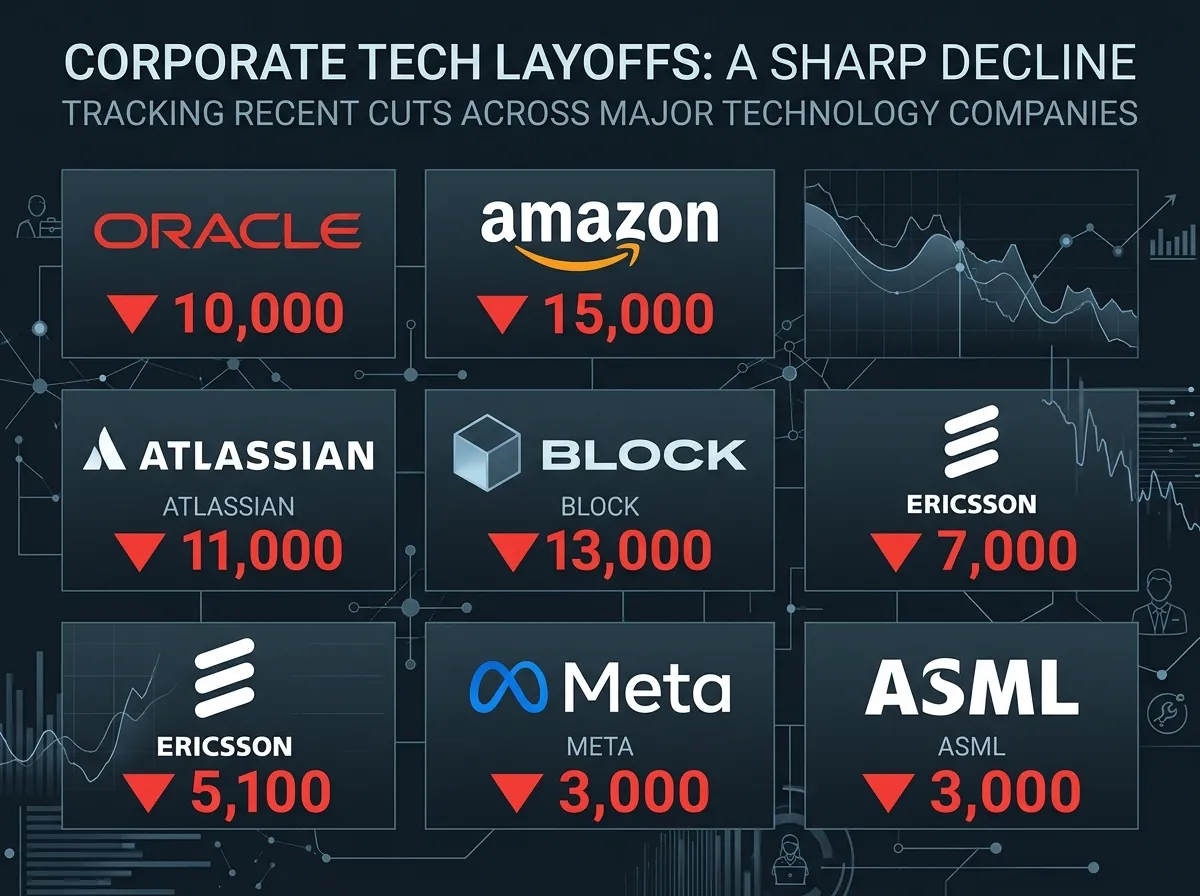
Even the companies that made smaller cuts are telling. Meta trimmed about 1,500 roles in January. Semiconductor equipment maker ASML eliminated 1,700 positions. Livspace, the home design platform, cut 1,000 employees, roughly 12% of its workforce, and announced it was transitioning to an "AI-native" organization. Each press release carried the same phrase in different packaging: we're investing in AI, and that means fewer humans.
The 2% Problem
The gap between what companies say and what data supports is the most important and least discussed dimension of the layoff wave. Thomas H. Davenport of Babson College and Laks Srinivasan of the Return on AI Institute surveyed 1,006 global executives in December 2025. Their findings, published in Harvard Business Review, paint a picture of an industry cutting on faith rather than evidence.
Sixty percent of executives said they had made or planned headcount reductions in anticipation of AI capabilities. Twenty-nine percent said they were slowing hiring based on future expected benefits. But when asked how many had cut jobs based on demonstrated, measurable AI performance gains, the number collapsed to 2%. Nearly one in ten executives weren't even sure why their companies were reducing headcount.
The productivity gains that do exist are real but narrow. Programming tasks show 10-15% efficiency improvements with AI coding assistants. Customer service chatbots handle more routine queries than they did a year ago. But as Davenport and Srinivasan note, "AI typically performs specific tasks and not entire jobs." The radiologist example is instructive: in 2016, prominent AI researchers predicted the technology would surpass radiologists within five years. Nearly a decade later, no radiologists have been displaced, radiologist shortages persist, and the profession's scope turned out to be far broader than reading scans.

What CEOs Are Actually Admitting
Salesforce CEO Marc Benioff, speaking on Matt Berman's show The Future Live, broke from the industry script earlier this month. "It's too easy to basically take AI and make it the scapegoat," Benioff said. "For some CEOs, it's the lazy way out."
Benioff argued the real drivers are messier and less flattering: pandemic-era over-hiring that inflated headcounts by 20-40% at many companies, mounting cost pressure from investors demanding margin improvement, and massive financial commitments to AI data centers that need to be funded with savings from somewhere. Salesforce itself kept engineering hiring flat while expanding its sales force by nearly 20%, a strategy that quietly acknowledges AI isn't actually replacing its engineers.
The Klarna cautionary tale reinforces the point. The fintech company reduced its workforce by 40% between 2022 and 2024 through a hiring freeze and attrition, explicitly crediting AI. Then it quietly rehired 20 customer service representatives after discovering the cost-cutting had degraded service quality. The AI could handle volume, but not nuance.
A CFO survey from late March found that finance leaders plan AI-related job cuts at nine times the rate of the previous year, suggesting the layoff wave is accelerating on momentum rather than evidence. The pattern is self-reinforcing: one company announces AI-driven cuts, its stock rises, competitors follow, and the narrative hardens into consensus regardless of whether the underlying automation actually works.
The US-China Divergence
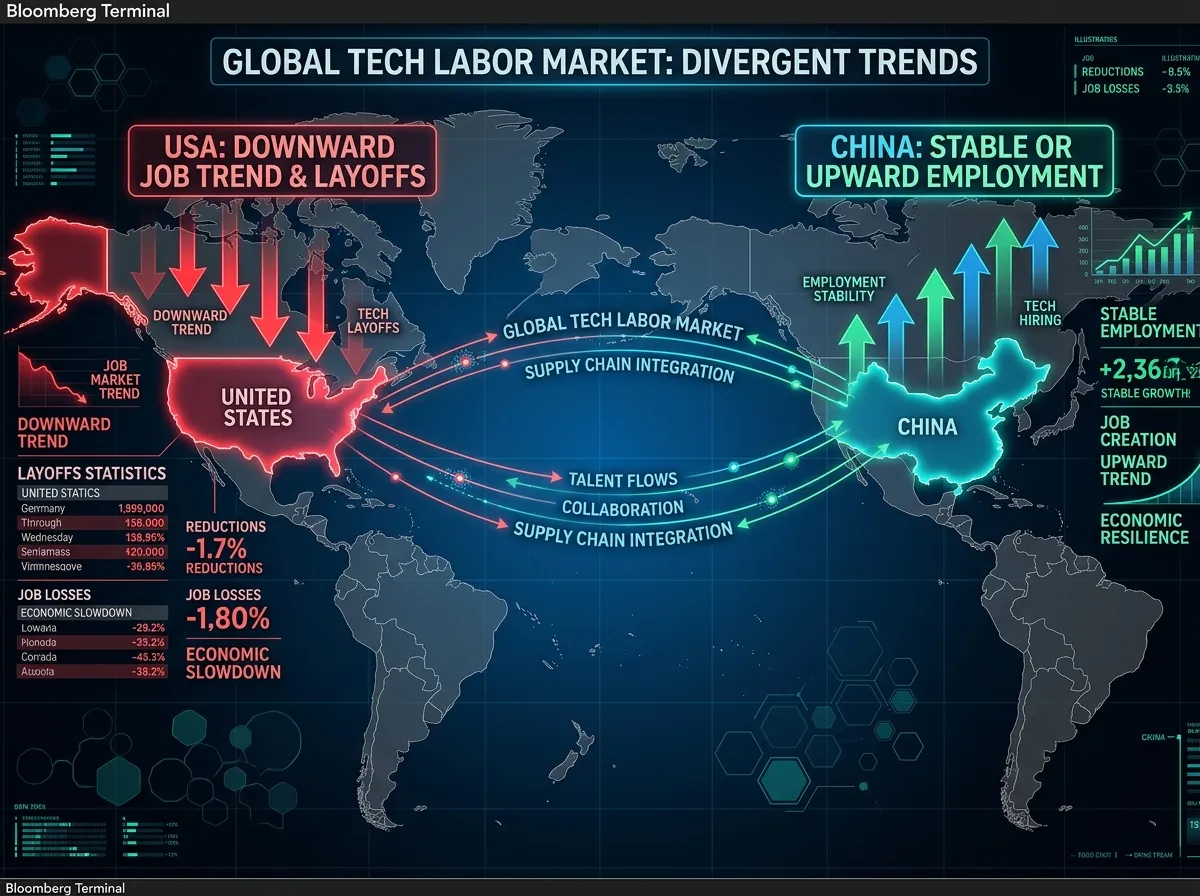
One of the most underreported aspects of the AI layoff story is geographic. According to CNBC's analysis published today, AI-driven job losses are hitting American workers far harder than their Chinese counterparts.
The structural reasons are revealing. Chinese companies are less digitalized than their American equivalents, meaning there's less software-based work for AI to absorb. Many Chinese tech firms also employ proportionally more workers in marketing and customer operations rather than engineering, roles that current AI tools are less equipped to replace. Huawei reported 114,000 employees in research and development as of December, up from 113,000 a year earlier. Tencent disclosed a modest increase in total headcount.
The salary gap adds another layer. A high-demand algorithm engineer in China earns an average monthly salary of about 20,035 yuan, roughly $2,900. A comparable "level 2" software engineer in the United States earns approximately $300,000 annually in base salary. When a company is deciding where to cut costs, the math is not subtle. American tech workers are expensive, and that expense makes them targets in ways that lower-cost Chinese engineers are not, regardless of what AI can or cannot actually do.
What the Pattern Actually Tells Us
Strip away the AI narrative, and the Q1 layoff data tells a story about something more familiar: a cost correction dressed in futuristic language. Companies hired aggressively during the pandemic boom, made enormous capital commitments to AI infrastructure (Amazon, Meta, Google, and Microsoft are projected to invest a combined $650 billion in AI this year alone), and now need to pay for those bets. Cutting payroll is the fastest way to fund a data center.
The consequences extend beyond individual workers. San Francisco office vacancy rates hit 36.7% in Q1 2026, up from 33.9% a year ago. The traditional entry-level developer role is contracting as companies decide, again based on potential rather than evidence, that AI tools can replace junior engineers. That creates a genuine long-term problem: if the industry stops training the next generation of engineers because it believes AI will handle entry-level work, it will face a devastating talent pipeline gap in five to ten years when it turns out the technology was never as capable as the quarterly earnings call suggested.
The honest version of what most companies are doing is not "AI replaced these workers." It's "we over-hired, margins are under pressure, AI gives us a story Wall Street likes, and cutting headcount is cheaper than admitting we didn't have a plan." That framing isn't as clean. It doesn't make for a compelling press release. But it's a lot closer to the 2% reality that the data actually supports.
The Verdict
The 71,000 jobs lost in Q1 2026 are real. The pain for the people who lost them is real. But the story companies are telling about why it happened deserves far more scrutiny than it's getting. When 60% of executives admit they're cutting based on anticipation and only 2% can point to actual AI results, the industry isn't executing a technological revolution. It's executing a narrative one, and workers are paying the price for a bet that hasn't been proven.
Sources
- Companies Are Laying Off Workers Because of AI's Potential, Not Its Performance - Harvard Business Review
- Tech Layoffs 2026: Over 71,000 Jobs Gone as Companies Double Down on AI - BusinessToday
- AI Isn't the Real Reason for Tech Layoffs? Salesforce CEO Marc Benioff Calls It a 'Lazy Way Out' - BusinessToday
- AI Layoffs Hit U.S. but Not China Jobs, Yet - CNBC