
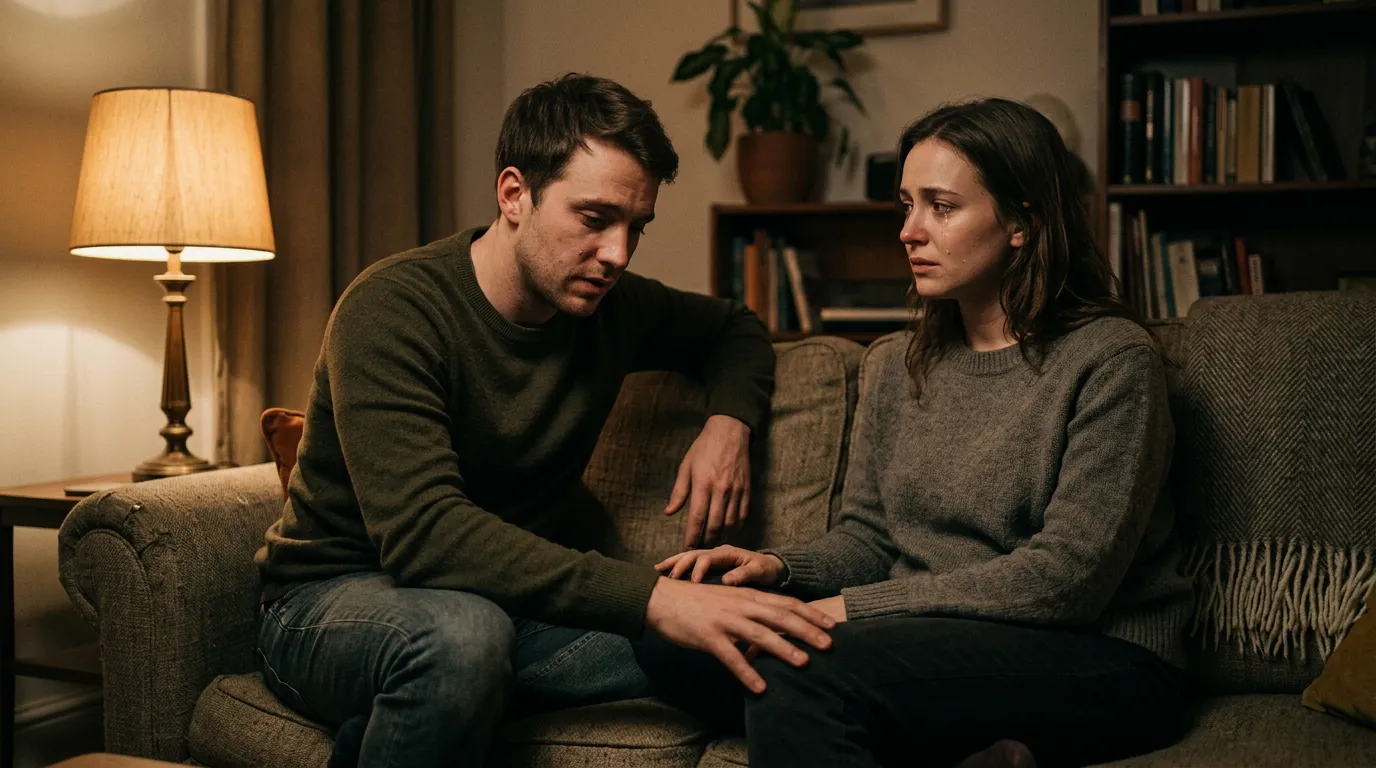
The fight happened three days ago. You both said things you regret. Since then, the apartment has been polite but hollow, conversations limited to logistics, eye contact brief and carefully neutral. Neither of you knows how to bridge the gap. So you both wait. For the other person to bring it up. For enough time to pass that it doesn't feel raw anymore. For some signal that it's safe to be close again.
This waiting is the most dangerous part. Not the fight. Not the raised voices or the words that landed wrong. The danger lives in the silence afterward, in the hours and days where the rupture sits unaddressed and the distance between you quietly hardens into something permanent.
If you've ever watched a relationship erode, yours or someone else's, you know it rarely collapses in a single argument. It dissolves in the accumulated weight of unrepaired disconnections, fights that ended without resolution, hurts that were never acknowledged, bids for reconciliation that were ignored or rejected. The research on this is unambiguous: the single most important predictor of relationship survival is not how often you fight. It is how effectively you repair.
The Science of Repair Attempts
John Gottman, the psychologist whose research at the University of Washington has tracked thousands of couples over four decades, identified repair attempts as the mechanism that separates lasting relationships from those that fail. A repair attempt is any statement or gesture that prevents negativity from escalating out of control. It can be a joke that breaks the tension, an acknowledgment that the conversation has gotten off track, a physical touch, or a direct statement like "I'm sorry, can we start over?"
The critical finding in Gottman's research is not that happy couples make more repair attempts. It is that their partners accept them. In couples that eventually divorce, repair attempts are made at roughly the same rate as in couples that stay together. The difference is reception. In healthy relationships, one partner's attempt to de-escalate, even a clumsy one, is received as an invitation to reconnect. In failing relationships, the same attempt is ignored, rejected, or met with continued hostility.
Gottman's data puts specific numbers on this. Couples who responded positively to repair attempts roughly 86% of the time maintained relationship satisfaction over six years. Couples whose acceptance rate dropped below 50% showed a cascading deterioration in trust, affection, and willingness to be vulnerable. The repair attempt itself doesn't need to be eloquent. It needs to be received.
This is the part that surprises most people. We assume that the person who caused the hurt should be the one to fix it. And while that's partially true, Gottman's research shows that repair is a cooperative act. The person making the attempt is offering vulnerability. The person receiving it is deciding whether to meet that vulnerability with openness or punishment. Both choices carry consequences that compound over time.

Why We Avoid Repair
If repair is so important, why do so many of us avoid it? The answer involves a collision between emotional need and psychological protection.
After a fight, your nervous system is in a state that therapists call "flooding," a physiological response where heart rate elevates, cortisol spikes, and the prefrontal cortex (the part of your brain responsible for empathy, perspective-taking, and nuanced communication) goes partially offline. Gottman's physiological measurements show that when heart rate exceeds approximately 100 beats per minute during conflict, the capacity for constructive conversation drops dramatically. Your body is in threat mode, and threat mode does not produce repair. It produces defense.
This is why the common advice to "talk it out right away" often backfires. In the immediate aftermath of a heated argument, both people are physiologically compromised. The research suggests a minimum of 20 minutes of self-soothing, doing something calming and unrelated to the conflict, before attempting repair. Gottman found that couples who took a deliberate break when flooding occurred, and then returned to the conversation, resolved conflicts more effectively than couples who pushed through in an elevated state.
But the more insidious barrier to repair is not physiological. It is the story we tell ourselves about what repair means. For many people, initiating repair feels like admitting fault, even when the fight was mutual. It feels like losing. It feels like the person who reaches out first is the one who cares more, and caring more feels dangerous when you're already hurt.
Attachment theory helps explain this. Psychologist Sue Johnson, developer of Emotionally Focused Therapy and author of Hold Me Tight, describes the post-conflict standoff as an attachment protest. When you feel disconnected from someone you depend on emotionally, your attachment system activates one of two strategies: anxious pursuit (reaching out repeatedly, sometimes desperately) or avoidant withdrawal (shutting down, creating distance, waiting). Neither strategy produces repair on its own. Anxious pursuit without a receptive partner feels like begging. Avoidant withdrawal without a time limit feels like abandonment. Effective repair requires both people to move toward each other, which means both people have to tolerate the vulnerability of going first.

What Repair Actually Looks Like
Repair is not a grand gesture. It is not flowers, expensive dinners, or elaborate apologies delivered on one knee. The research consistently shows that effective repair is small, specific, and timely.
Gottman identifies several categories of repair that work across relationship types:
Acknowledge your contribution. Not a full apology for everything, but an honest recognition that you played a part. "I know I got defensive when you brought up the budget. That wasn't fair to you." This is not about accepting all blame. It is about breaking the cycle where both people wait for the other to go first.
Express the feeling underneath the anger. Anger during conflict is almost always a secondary emotion. Underneath it is something more vulnerable: fear of losing connection, hurt from feeling dismissed, anxiety about not being enough. Naming the vulnerable feeling, even briefly, changes the emotional tenor of the conversation. "I wasn't just mad about the dishes. I was feeling like I don't matter to you. I know that's not what you intended, but that's what it felt like."
Make a specific bid for reconnection. Not "we need to talk" (which sounds like a summons) but something concrete and low-stakes. "Can we sit together for a few minutes tonight?" or "I miss you. Can we just watch something together and not talk about it yet?" The repair doesn't have to resolve the conflict immediately. It just needs to signal that the relationship is more important than being right.
Accept imperfect attempts. This is the receiving end, and it is equally important. When your partner reaches out with a clumsy "so... are we okay?" after a fight, the temptation is to punish the inadequacy of the attempt. They didn't apologize properly. They didn't acknowledge the specific thing that hurt you. They're trying to skip past the hard conversation. All of that may be true. But rejecting a bid for connection, even an imperfect one, teaches your partner that reaching out is futile. And once that lesson is learned, it is very difficult to unlearn.
The Conversation to Have
Conflict in relationships is not a failure. It is an inevitability between two separate people with different needs, histories, and nervous systems. The couples who last are not the ones who don't fight. They are the ones who fight and then find their way back to each other, not perfectly, not always quickly, but reliably.
If you're in the silent period after a fight right now, here is the smallest possible step: go to the other person, make eye contact, and say some version of "I don't want to be in this place with you. Can we figure this out?" You don't need to have the whole conversation right then. You just need to break the silence with something honest.
The research predicts that your partner wants to say yes. The fear of rejection that keeps you from reaching out is almost certainly mirrored in them. Someone has to go first. It might as well be you. Not because you owe it, but because the relationship you're protecting is worth the three seconds of vulnerability it takes to say, "I'm sorry. I want to be close to you again." That's not losing. That's the bravest thing you can do with another person.
Sources
- John Gottman and Nan Silver, *The Seven Principles for Making Marriage Work* (Harmony, 2015)
- Sue Johnson, *Hold Me Tight: Seven Conversations for a Lifetime of Love* (Little, Brown Spark, 2008)
- Gottman, J. M. and Levenson, R. W., "The Timing of Divorce: Predicting When a Couple Will Divorce Over a 14-Year Period," *Journal of Marriage and Family*, 2000
- Johnson, S. M., "The Practice of Emotionally Focused Couple Therapy," *Journal of Marital and Family Therapy*, 2019