

You need help with something, and you know exactly who could help. Maybe it's a colleague who has the expertise. Maybe it's your partner, who doesn't realize you're drowning. Maybe it's a friend who you haven't called in months because you feel like you should have your life more together before reaching out.
So instead of asking directly, you hint. You sigh loudly. You mention how overwhelmed you are and hope they'll offer. You drop the subject into conversation sideways, like tossing a ball near someone's feet instead of into their hands. And when they don't pick it up, you feel disappointed, or worse, resentful. Not because they refused. Because they never heard the ask in the first place.
This pattern, the inability to make clear, direct requests, is so common that most people don't recognize it as a skill gap. We treat asking for help as a personality trait (some people are comfortable with it, others aren't) rather than what it actually is: a learnable communication skill that most of us were never explicitly taught.
Why Asking Feels So Hard
The reluctance to ask runs deeper than politeness. It is tied to some of the most fundamental ways we process social risk.
Psychologist Vanessa Bohns at Cornell University has spent over a decade studying what happens when people make direct requests. Her research, published across multiple studies in the Journal of Personality and Social Psychology and compiled in her book You Have More Influence Than You Think, reveals a consistent and striking pattern: people systematically underestimate how likely others are to say yes.
In one of her most replicated experiments, participants were asked to approach strangers with simple requests, like borrowing a phone or filling out a survey. Before making the requests, participants predicted roughly a 50% compliance rate. The actual rate was closer to 80%. The gap between expected and actual compliance was remarkably stable across different request types, settings, and cultures. We are, as a species, badly calibrated about how willing other people are to help us.
The reason for this miscalibration is what Bohns calls "the spotlight effect meets the empathy gap." When we imagine asking for something, we focus on our own vulnerability, the awkwardness, the potential rejection, the exposure of needing help. We underweight the other person's perspective, which in most cases involves a genuine desire to be helpful combined with social pressure to comply with direct requests. The person being asked faces their own calculus: saying no to a face-to-face request feels uncomfortable, and most people choose the discomfort of helping over the discomfort of refusing.

The Hidden Cost of Hinting
When you hint instead of asking directly, you create a situation where the other person is set up to fail. They can't respond to a request they never received. This generates a cycle that family therapist Terry Real describes as the "passive-indirect" communication pattern: one person feels unmet, the other person feels confused, and both feel disconnected without understanding why.
The research on this is consistent across relationship types. John Gottman's studies at the University of Washington found that couples who made explicit bids for connection, stating what they needed rather than implying it, had significantly higher relationship satisfaction than couples who relied on their partners to intuit their needs. The specific finding was that successful couples responded to direct bids positively roughly 86% of the time. But couples who communicated needs indirectly had much lower response rates, not because their partners cared less, but because the bid was never clearly received.
In professional settings, the cost of indirect communication is measured in productivity and advancement. A study in the Academy of Management Journal found that employees who made direct requests for resources, mentorship, and feedback received them at rates 40-60% higher than employees who relied on hints or waited for offers. The researchers noted that managers consistently reported wanting to help their direct reports but being unaware of specific needs because they were never stated.
The pattern extends to friendships, family relationships, and even interactions with strangers. Indirect communication feels safer because it preserves plausible deniability. If you hint and the other person doesn't respond, you can tell yourself you didn't really ask, so you weren't really rejected. But that protection comes at the cost of the thing you actually needed, which remains unmet.
What a Direct Request Actually Sounds Like
A direct request has three components, and most people skip at least one of them.
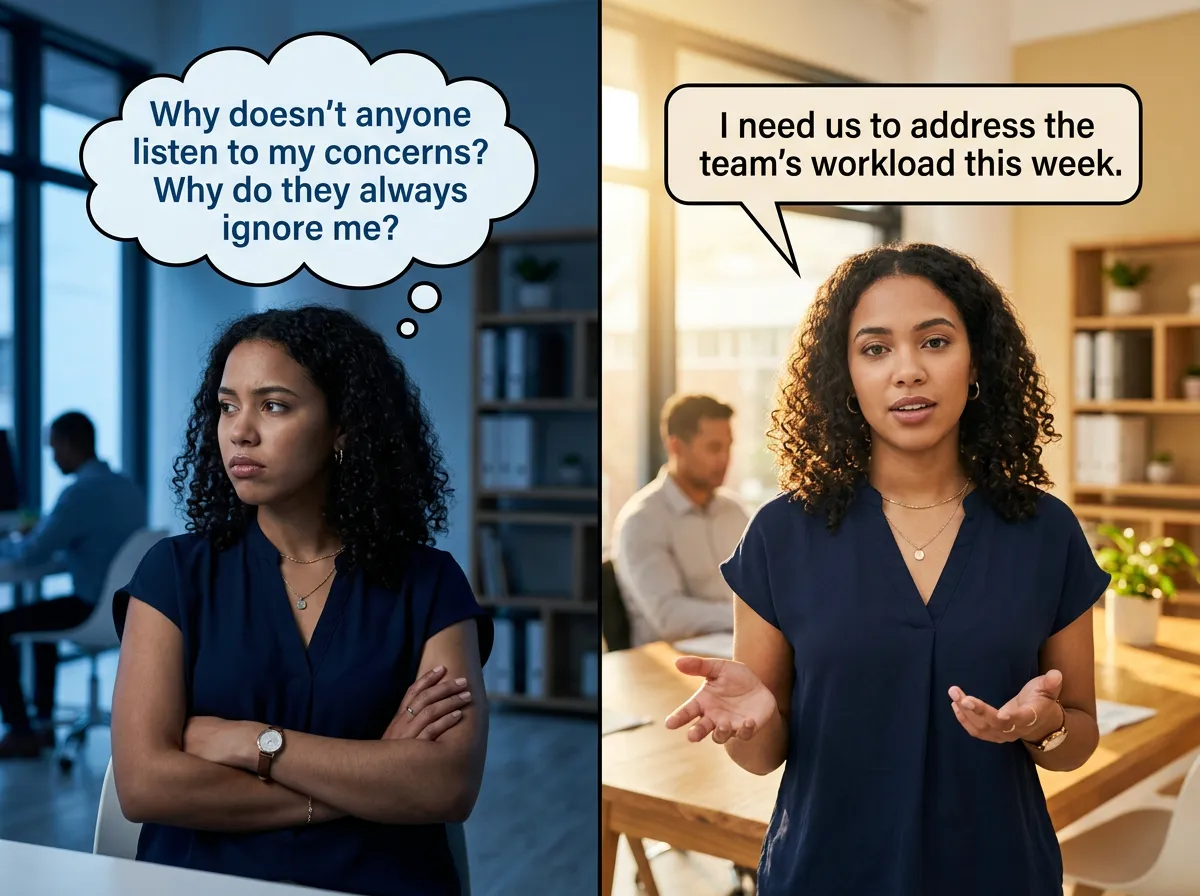
Name the need. Not the frustration, not the backstory, not the criticism of what's currently happening. The need. "I need help with dinner tonight" is a request. "I can't believe I always have to do everything around here" is a complaint that contains an invisible request. The other person hears the complaint. They don't hear the request.
Be specific about the action. "Can you pick up the kids on Thursday?" is actionable. "I need more support" is vague. Vague requests put the burden of interpretation on the other person, who may genuinely want to help but doesn't know what help looks like to you. Specificity is not demanding. It is kind. It gives the other person a clear path to success.
Accept the answer. This is the part that makes asking feel risky, and it is also the part that makes it honest. A genuine request includes the possibility of no. If you ask in a way that punishes refusal, you are not making a request. You are issuing a command dressed up as a question. The research consistently shows that people are more responsive to requests when they feel genuinely free to decline, precisely because the freedom to say no makes saying yes feel like a choice rather than an obligation.
Here is what these sound like in practice:
Instead of: "You never help around the house." Try: "Can you take over bedtime routine on Tuesdays and Thursdays? I need those evenings to decompress."
Instead of: "I feel like nobody at work appreciates what I do." Try: "I'd love feedback on the proposal I submitted. Could you take 15 minutes this week to look at it?"
Instead of: Saying nothing and hoping your friend notices you're struggling. Try: "I'm having a rough time. Can we get coffee this week? I could really use someone to talk to."
The Fear That Keeps You Quiet
Underneath the difficulty of asking is usually a belief, often formed in childhood, about what asking means. For some people, asking equals weakness. For others, it means being a burden. For others still, it risks rejection that confirms a deeper fear: that their needs don't matter, or that the relationship can't hold the weight of an honest request.
Psychologist Harriet Lerner, author of The Dance of Connection, points out that many people learned in their families of origin that direct requests were met with anger, dismissal, or withdrawal. If asking for what you needed as a child resulted in punishment or emotional distance, your nervous system learned to code directness as danger. That coding does not disappear in adulthood. It just shows up as the vague unease you feel when you think about saying what you actually need, the tightness in your chest, the voice that says "never mind, it's fine."
Recognizing this pattern does not require therapy, though therapy can accelerate the process. It requires one honest observation: the next time you feel reluctant to ask for something, notice what you're afraid will happen. Not the surface fear (they'll say no) but the deeper one (they'll think less of me, they'll pull away, I'll be too much). Name that fear, even if just to yourself, and it loses some of its grip. You're not a child asking a parent for permission. You're an adult making a reasonable request of another adult who has the freedom to respond however they choose.
Your Next Step
You do not need to become a different person to start asking directly. You need to make one request this week that you would normally hint at or swallow.
Pick something small. Not "I need you to fundamentally change how you show up in this relationship." Start with "Can you grab milk on your way home?" or "I need 30 minutes to myself when I get home from work" or "Could you proofread this email before I send it?"
Notice what happens. Most likely, the person will say yes. Bohns' research predicts they will say yes roughly twice as often as you expect. Notice also how you feel after asking: probably relieved, possibly vulnerable, and almost certainly less resentful than you would have felt if you'd stayed quiet and waited for them to guess.
The skill of asking directly is built one request at a time. Not through a transformation. Through a conversation you stopped avoiding. The first one is always the hardest. After that, it gets easier, not because the vulnerability disappears, but because the evidence starts to accumulate: people want to help. They just need you to let them know how.
Sources
- Vanessa Bohns, *You Have More Influence Than You Think* (W.W. Norton, 2021)
- John Gottman and Nan Silver, *The Seven Principles for Making Marriage Work* (Harmony, 2015)
- Harriet Lerner, *The Dance of Connection* (William Morrow Paperbacks, 2002)
- Bohns, V. K., "A Face-to-Face Request Is 34 Times More Successful Than an Email," *Harvard Business Review*, 2017