
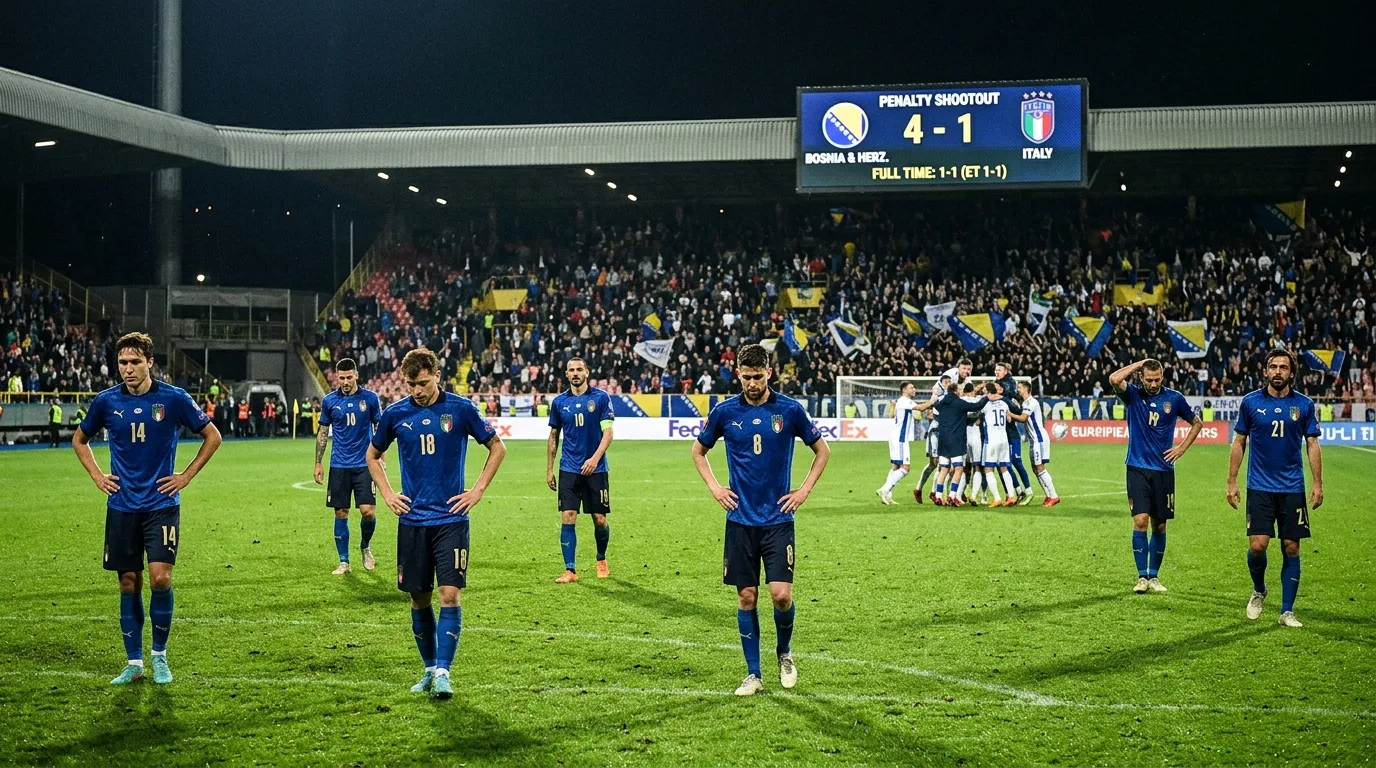
Italian newspapers called it "a third apocalypse." That's not hyperbole. On Monday night in Zenica, Bosnia and Herzegovina eliminated Italy from the 2026 FIFA World Cup in a penalty shootout, ending any remaining doubt about the state of Italian football. The Azzurri, four-time World Cup champions and once the standard for tactical brilliance in the sport, have now failed to qualify for three consecutive tournaments. No former champion in the competition's 96-year history has ever done that.
The match itself was a miniature of everything that's gone wrong. Italy took the lead, then lost a man to a red card, then spent more than an hour desperately defending with ten men, then conceded an equalizer, then crumbled in the shootout. It was less a single failure than a condensed version of a decade-long collapse, played out in 120 minutes and five penalty kicks in a half-empty stadium in central Bosnia.
The Red Card That Broke the Match
Italy started well. In the 15th minute, Moise Kean capitalized on a handling error from Bosnia goalkeeper Nikola Vasilj, poking the ball home for a 1-0 lead that, briefly, felt like a lifeline for a program in crisis. For 27 minutes, the Azzurri looked like they might just survive.
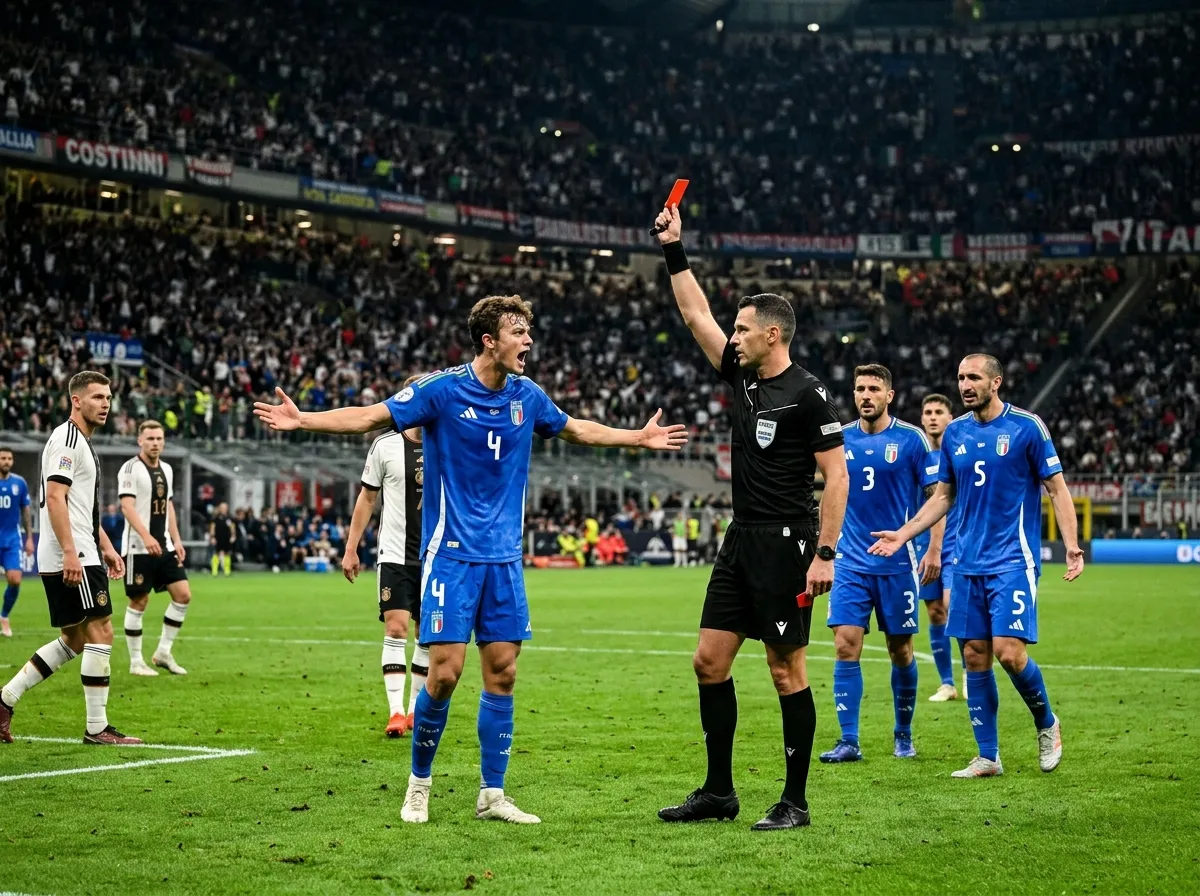
Then Alessandro Bastoni changed the trajectory of the entire evening. In the 42nd minute, the Inter Milan defender hauled down Amar Memic as the last man, leaving the referee no choice. Straight red card. Italy would play the remaining 48 minutes of regulation and all 30 minutes of extra time with ten men, on the road, in a match they could not afford to lose.
Bastoni had already been facing boos from traveling Italian supporters before the incident, a reflection of his inconsistent qualifying campaign. The red card transformed what had been a fragile lead into a survival exercise. Manager Gennaro Gattuso was forced to reorganize his back line on the fly, pulling an attacker and trying to build a wall that could hold for more than an hour.
Seventy-Eight Minutes Down a Man
What followed was both admirable and agonizing. Italy retreated into a deep defensive block, absorbing Bosnian pressure with the kind of desperate organization that the Azzurri once made look artful. For a long stretch it worked. Goalkeeper Gianluigi Donnarumma made several strong saves, including one that drew comparisons to his heroics at Euro 2020, the tournament Italy won just five years before missing two straight World Cups.
But ten men defending for more than an hour against a team playing for its first-ever World Cup berth was never sustainable. In the 79th minute, substitute Haris Tabakovic found the equalizer, and the stadium erupted. Bosnia, a country whose football federation was only recognized by FIFA in 1996, had clawed its way level against the four-time champions. The goal felt inevitable. Italy's defense had been absorbing punishment since the first half, and the math finally caught up.
Extra time solved nothing. Italy barely managed to get forward with ten men, and Bosnia probed without finding a winner. It went to penalties.
The Shootout
Italy's penalty record in major competitions has historically been poor, and nothing that happened in Zenica changed that reputation. Pio Esposito stepped up first for Italy and missed. Bosnia converted. Bryan Cristante, who should have been a steady hand, put his attempt wide. Bosnia scored again. The gap became unbridgeable.
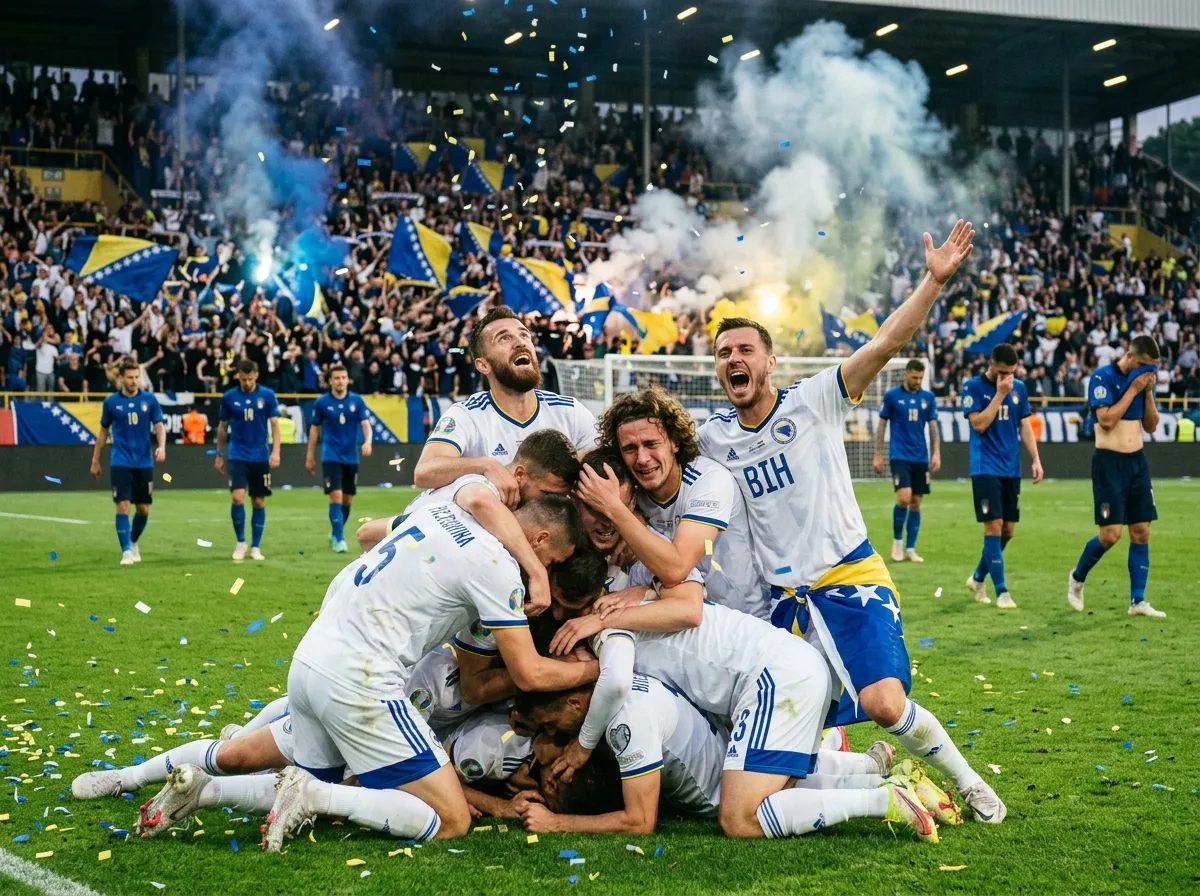
Esmir Bajraktarevic, a 21-year-old midfielder who plays his club football in the United States with New England Revolution, converted the winning penalty to send Bosnia to the World Cup for the first time in the nation's history. Final score in the shootout: 4-1 Bosnia.
The contrast was striking. On one side, Bosnian players collapsed in a pile of joy, tears, and disbelief, celebrating qualification for a tournament that their nation, scarred by war in the 1990s, has never reached. On the other, Italian players stood frozen on the pitch, some with their shirts pulled over their faces, processing the third straight installment of the same humiliation.
Three Apocalypses
The timeline of Italian football's decline reads like a slow-motion institutional collapse. In 2006, Italy won the World Cup in Berlin. In 2010 and 2014, they exited in the group stage. In 2018, they failed to qualify entirely after losing a playoff to Sweden, a result that was treated as a national crisis. Then came Euro 2020, held in 2021 due to the pandemic, where Italy won the entire tournament, briefly suggesting the crisis was over.
It was not over. In March 2022, Italy lost a one-off playoff to North Macedonia, a nation with a population smaller than Milan's, and missed the 2022 World Cup in Qatar. Manager Roberto Mancini, the architect of the Euro 2020 title, resigned in August 2023 under murky circumstances. Luciano Spalletti replaced him, oversaw a dismal Euro 2024 campaign, and was eventually replaced by Gattuso, whose fire and intensity were supposed to restore something the Azzurri had lost.
Instead, Italy find themselves exactly where they've been since 2018: watching the World Cup on television. The 2026 tournament, co-hosted by the United States, Mexico, and Canada, will be the largest in history with 48 teams. Italy couldn't qualify for a tournament that accepted 16 more participants than the one they won 20 years ago.
The structural problems run deeper than any single manager. Italy's youth development pipeline, once the envy of European football, has stagnated. Serie A clubs increasingly rely on foreign talent, leaving fewer pathways for young Italian players to develop at the highest level. The Italian Football Federation (FIGC) has cycled through coaches, presidents, and reform plans without addressing the fundamental disconnect between the domestic league's commercial interests and the national team's competitive needs.
Final Whistle
Gattuso's post-match comments were raw. "If you poke me with a dagger today, nothing will come out," he told reporters. "My blood is all gone." He praised his players for fighting with ten men and insisted they didn't deserve the result, but his face told a different story. FIGC president Gabriele Gravina issued a statement asking Gattuso to stay on, though how much patience remains in the federation after three consecutive failures is an open question.
The deeper issue isn't who manages Italy. It's what Italy has become. The sport that once defined the country's global identity, that gave the world catenaccio and Baggio and the 2006 triumph in Berlin, now produces a national team that can't beat Bosnia in a playoff. American sports are wrestling with their own identity crises, but none of those involve a four-time champion becoming a qualifier afterthought.
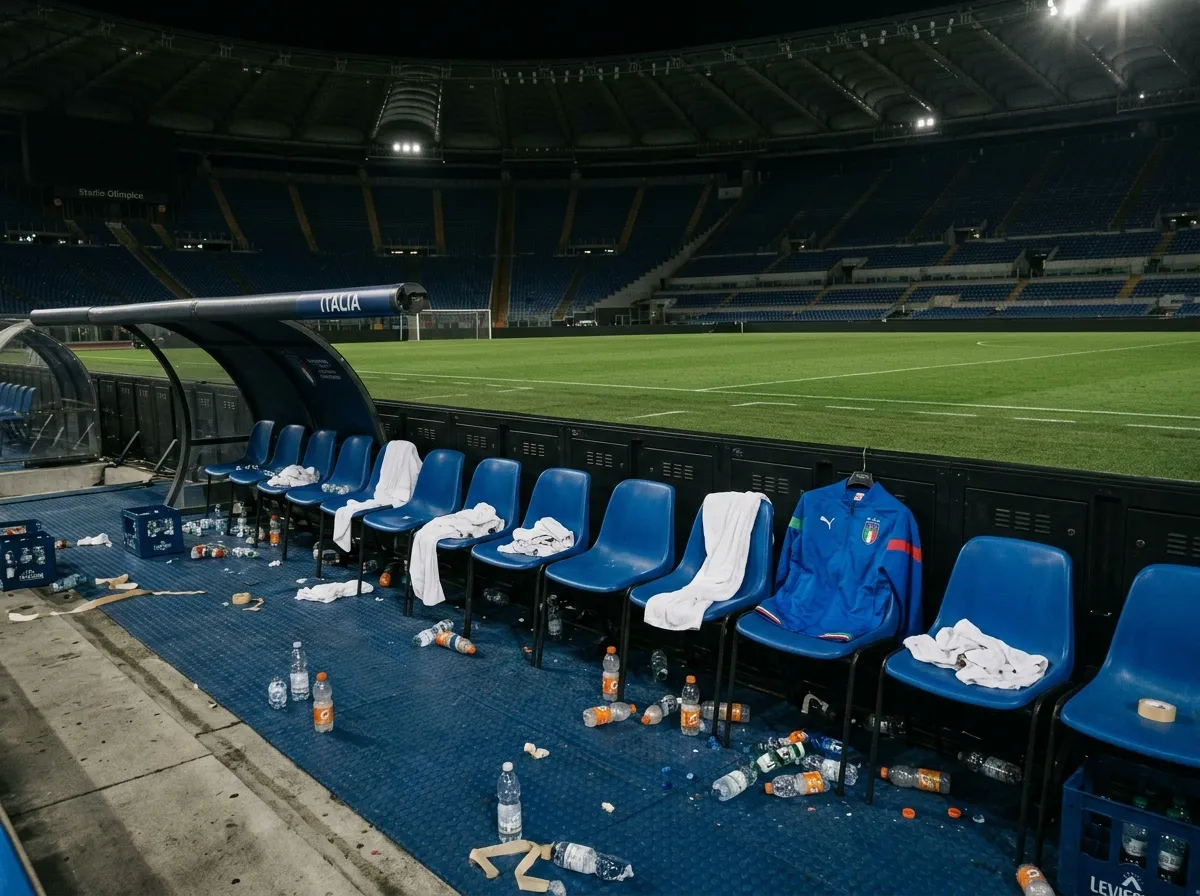
Italian football writers have already started calling this the worst period in the Azzurri's 116-year history. That's hard to argue with. In 2026, the biggest sporting event on the planet will take place across three countries, featuring 48 nations, and Italy will not be among them. For the third time in a row, the four-time champions will be spectators. At some point, the word "crisis" stops being strong enough. The Italian press reached for "apocalypse." After three of them, it might just be the new normal.
Sources
- Italy miss out on third straight WC in shootout loss to Bosnia - ESPN
- Italy World Cup woe branded 'a third apocalypse' by national papers - ESPN
- Italian soccer is in a nightmare that it can't wake up from - CNN
- 'Really hurt' Gennaro Gattuso vents after Italy miss out on third straight World Cup - Goal.com
- Italy's timeline of missed World Cups - Yahoo Sports