

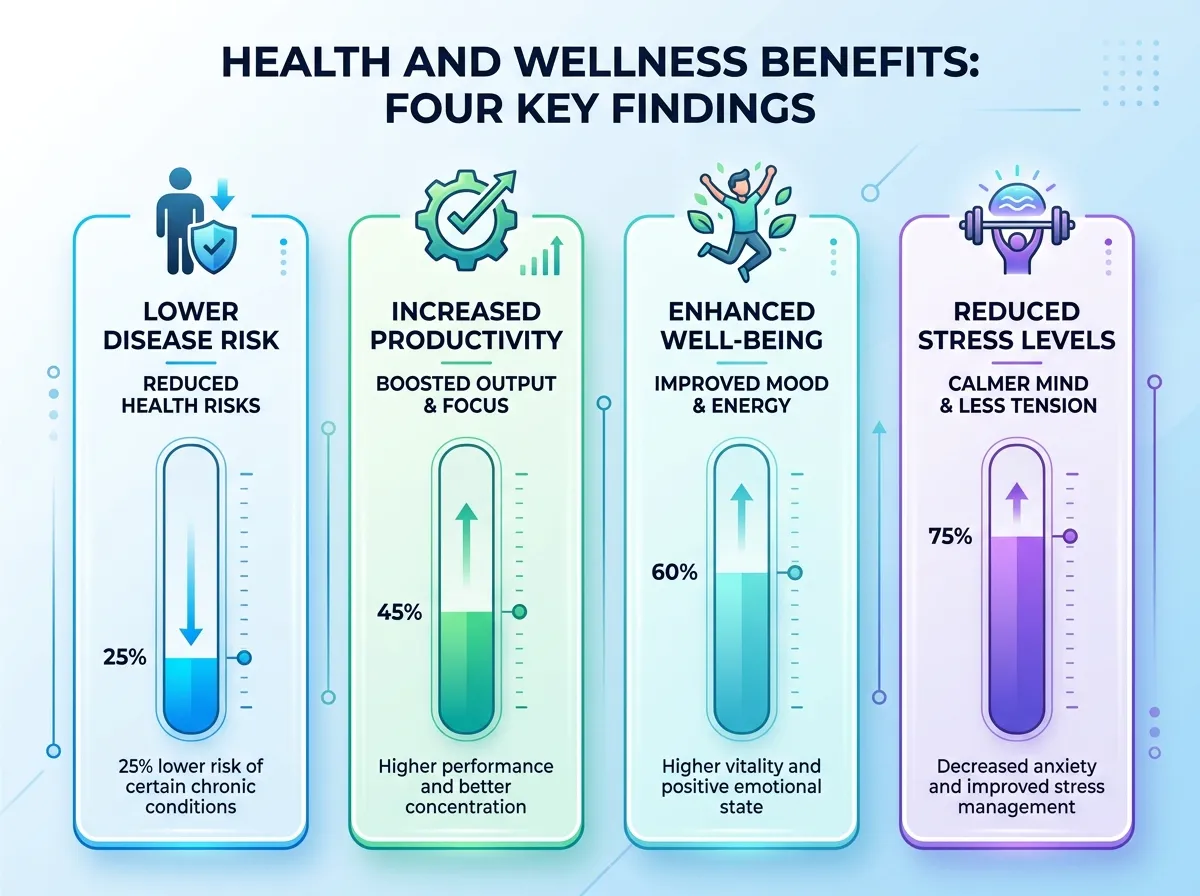
If you sit for more than eight hours a day, a new meta-analysis suggests your brain is paying a tax you probably have not been counting. Researchers at York University in Toronto just pooled 69 prospective studies covering close to three million adults and produced the clearest numbers yet on how three ordinary parts of daily life, movement, sitting, and sleep, track with the odds of developing dementia later in life. The headline figure is a 25% lower risk for adults who hit the right combination across all three.
The paper, published April 8 in PLOS One and led by Akinkunle Oye-Somefun of York's School of Kinesiology and Health Science, is not a clinical trial. It cannot prove causation. What it does do, at a scale no prior synthesis has matched, is pin down the shape and size of the associations that most previous studies could only sketch. Regular physical activity cut dementia risk by roughly 25%. Sitting eight or more hours a day raised it by about 27%. Sleeping less than seven hours raised it by 18%. Sleeping more than eight hours raised it by 28%. The sweet spot for sleep, seven to eight hours, was unambiguous.
Those four numbers, taken together, quietly reframe a conversation that has often been dominated by genetics, drugs, and aging. The modifiable risk factors are showing up with effect sizes in the same neighborhood as some of the pharmaceutical interventions currently in late-stage trials.
What the York Team Actually Did
Oye-Somefun and his colleagues set out to resolve a problem that has dogged lifestyle and dementia research for years: individual cohort studies tend to look at one behavior at a time, and their effect sizes wander. One study finds walking cuts risk 30%. Another finds 10%. A third finds no effect after adjusting for education. Journalists pick the punchy number. Clinicians do not know what to tell patients.
A prospective meta-analysis tries to fix that by combining many cohorts into one pooled estimate. The York group searched the literature through early 2025 and kept only studies that tracked healthy adults aged 35 and older, measured physical activity, sitting time, or sleep duration at baseline, and then followed participants long enough to record new cases of dementia. They ended up with 49 studies on physical activity (about 2.86 million participants), 17 on sleep duration (about 1.34 million), and three on sedentary behavior (about 296,000).
The sedentary arm is the smallest and the newest. Only three cohorts had measured sitting time in a way rigorous enough to include. Despite that, the signal was strong and consistent. In the press release accompanying the paper, Oye-Somefun noted that dementia "affects more than 55 million people worldwide with no cure yet," which is why isolating behaviors people can change "remains a critical research priority."
The Sitting Problem Is Not the Exercise Problem
One of the more useful things the York analysis clarifies is that sitting and exercise are not opposites. They are different exposures with different effects. A person can be physically active for 45 minutes in the morning and still spend ten hours seated afterward. That person is both "active" and "sedentary." Previous research, including a widely cited 2023 JAMA study from the University of Southern California, had already suggested that sitting time carries its own cardiometabolic risk independent of exercise. The York paper extends that logic to the brain.
The mechanism is still being worked out, but the leading explanations are vascular and inflammatory. Prolonged sitting reduces blood flow to the brain, raises fasting glucose, increases circulating inflammatory markers, and blunts insulin sensitivity. All four are implicated in the slow process that turns a healthy midlife brain into an aging brain with accumulated amyloid, tangled tau, and damaged small vessels. Amy Reichelt, a neuroscientist at Western University in Ontario who studies diet and cognition and was not involved in the paper, told NBC News that the findings align with what researchers have been seeing in vascular dementia cohorts for years: "What's good for the heart is good for the brain, and what's bad for circulation is bad for the brain."
The practical implication is that replacing an hour of sitting with an hour of movement is not just a caloric swap. It is two different exposures changing at once.
The U-Shaped Sleep Curve Nobody Likes to Talk About
The sleep results are the part of the paper that will probably generate the most reader confusion. Most dementia coverage has framed short sleep as the villain, pointing to 2013 work from Maiken Nedergaard's lab at the University of Rochester showing that the brain's glymphatic system, the recently mapped drainage network that clears waste proteins, works most effectively during sleep. Less sleep, more amyloid, higher dementia risk. That story is still intact in the York data.
What the pooled analysis also shows is that long sleep is just as strongly associated with elevated risk as short sleep. That does not necessarily mean sleeping ten hours causes dementia. In older cohorts, long sleep is often a symptom of something else: untreated depression, undiagnosed sleep apnea, thyroid disease, or the very earliest prodromal phase of dementia itself. Reverse causation is a real problem in sleep epidemiology, and Oye-Somefun's team is careful to flag the limitation.
The takeaway for a healthy adult in middle age is simpler than it looks. Seven to eight hours most nights, with consistent wake and sleep times, is the pattern that consistently shows the lowest risk. Anything substantially shorter or longer is worth a conversation with a clinician about why.
Where the Study Falls Short
Three cohorts is a thin evidence base for the sitting finding, and the authors say so. The sedentary-behavior literature has exploded in the past five years but most of it is cross-sectional or relies on self-reported hours, which people are famously bad at estimating. Accelerometer-based cohorts, the gold standard, are only now starting to report long enough follow-up to feed meta-analyses. The next five years should sharpen the sitting estimate considerably.
The population skews older and Western. Most of the 69 studies were conducted in North America, Europe, and East Asia, with participants already over 60. Whether the same effect sizes apply to midlife adults in their 40s and 50s, the group most able to change behavior in time to matter, is still an open question. The few younger cohorts included produced directionally consistent but statistically weaker results.
And the paper is a meta-analysis, not a randomized trial. No one has yet tested whether assigning a group of middle-aged adults to break up their sitting time and standardize their sleep will, over 20 years, produce fewer dementia diagnoses than a control group. Such a trial would be expensive and slow, and may never be funded. Observational synthesis at this scale is the best tool researchers currently have.
What It Means for Readers Under 60
The honest frame is that three million people's data cannot tell any individual what their own brain will do. What it can do is give midlife adults a set of adjustable dials that tilt the odds. The evidence base for these three is now about as robust as lifestyle science gets. Four practical moves follow from the findings without requiring any heroics:
- Break the eight-hour sitting wall. Standing every 30 minutes, walking during phone calls, or adding a 10-minute walk after lunch moves most desk workers under the threshold where risk rises most steeply.
- Treat the seven-to-eight-hour window as a target, not a suggestion. If you are regularly outside it in either direction, investigate why rather than adjusting quietly.
- Aim for 150 minutes of moderate activity a week. That is the WHO threshold, and it aligns with the studies that contributed to the 25% risk reduction.
- Ask about sleep quality, not just quantity. Apnea, fragmented sleep, and insomnia all show up as "seven hours" on a self-report but produce very different brain outcomes.
None of these are new ideas. What is new is the effect size. A 25% relative reduction in dementia risk is larger than the effect of most currently approved anti-amyloid drugs, which run in the 20 to 30% range for slowing decline in early Alzheimer's at considerable cost and side-effect burden. The chair, the bed, and the morning walk are free.

The Research Context Most Coverage Skipped
One detail the general press has mostly missed is how the York paper fits against the GLP-1 dementia story that has dominated headlines for the past year. Observational data have suggested that semaglutide and similar drugs may reduce dementia risk by 40 to 70% in diabetic populations, though Novo Nordisk's EVOKE and EVOKE+ trials, which tested oral semaglutide directly in patients with early Alzheimer's, failed to slow disease progression. Our earlier coverage of the GLP-1 cognitive data laid out why the observational signal and the trial failure are both likely true, depending on whether the drug is being used to prevent or treat established disease.
The lifestyle results sit in exactly the same prevention-versus-treatment frame. The 25% figure is for reducing the odds of developing dementia in the first place. There is no published evidence that changing sitting time in someone already diagnosed reverses the trajectory. The window that matters, for all three behaviors, is the 20 to 30 years before symptoms appear.
That window includes most people reading this. The Lancet Commission on dementia prevention estimated in 2024 that up to 45% of dementia cases worldwide could be prevented or delayed by addressing 14 modifiable risk factors, of which physical inactivity and sleep disturbance are two. The York analysis quantifies those two more precisely than the Lancet group could at the time. The emerging synthesis, rough but increasingly coherent, is that the brain's long-term resilience is built in middle age through the unglamorous routines of movement, rest, and circulation. Social habits matter too: research we covered in early April suggested that strong social ties rival exercise as a longevity factor, and the neural pathways overlap.
What the Research Tells Us
Midlife is where the case is made. The York meta-analysis does not promise anyone a dementia-free old age, and it does not replace the genetic risk factors, vascular disease management, and hearing protection that make up the rest of the prevention picture. It does, at a resolution finally worth quoting to a patient, tell clinicians that the three most ordinary levers in a person's week are moving the needle in measurable, replicable ways.
The behaviors are boring. The numbers are not.
Sources
- Oye-Somefun A, et al. "The Relationships between physical activity, sedentary behaviour, sleep, and dementia: A systematic review and meta-analysis of cohort studies." *PLOS One*, April 8, 2026.
- NBC News coverage of the York University meta-analysis
- Mirage News summary, "Exercise, Sleep Tied to Lower Dementia Risk"
- Scientific American, "7 Important Health Stories We'll Be Following in 2026"
This article is informational and does not substitute for medical advice. Readers concerned about dementia risk should discuss their individual circumstances with a qualified clinician.