
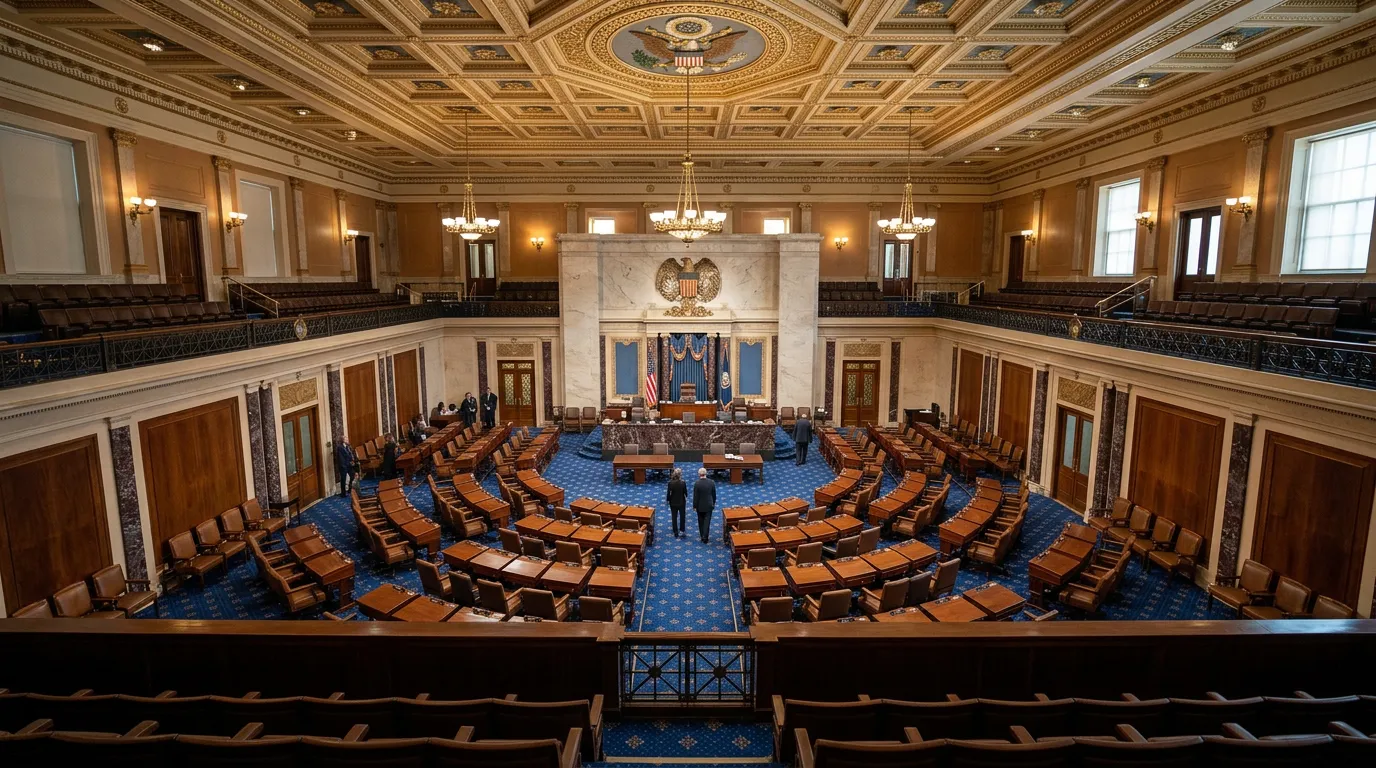
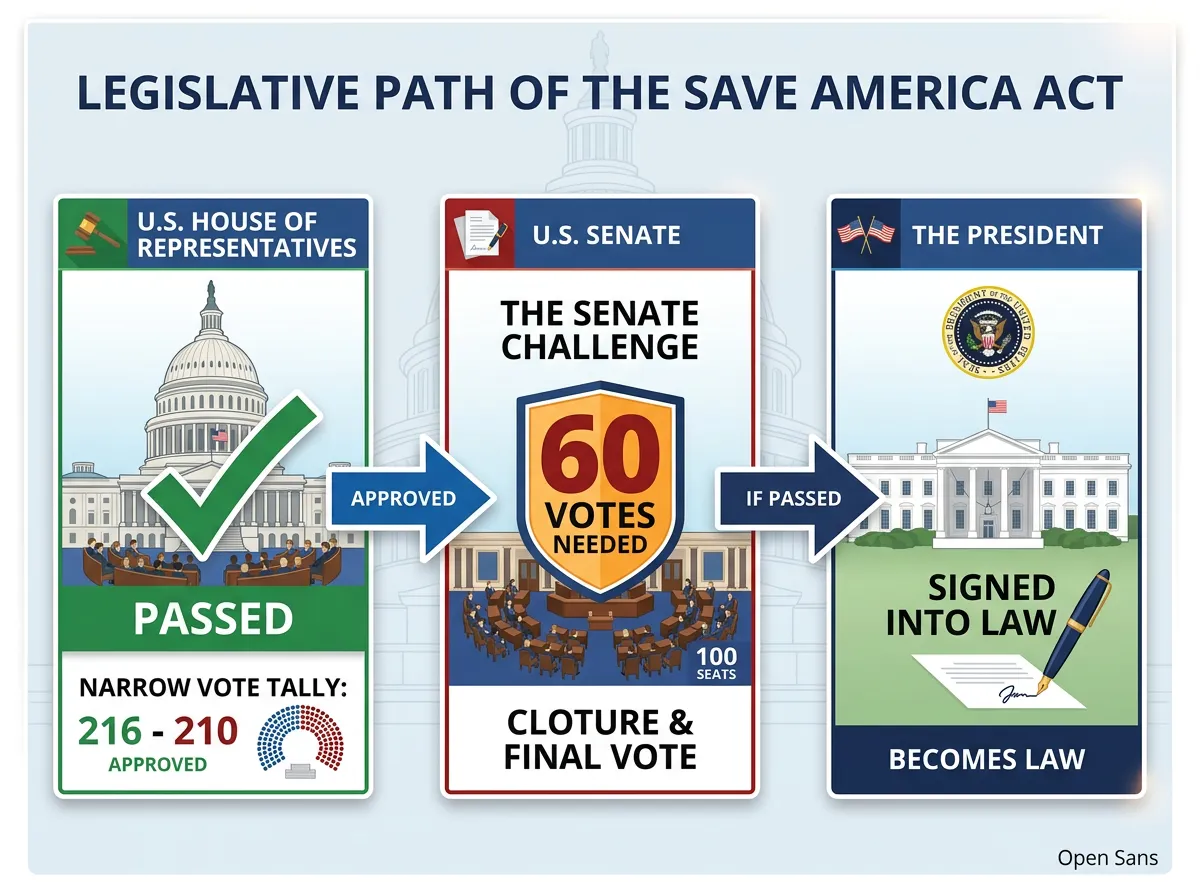
President Trump told House Republicans in Florida this week that he will not sign any legislation until Congress passes the SAVE America Act, the voter ID bill that the House narrowly approved in February with a single Democratic vote. "If you don't get it, big trouble," Trump warned lawmakers. The problem is that the bill needs 60 votes to clear a Senate filibuster, Democrats have called it "dead on arrival," and even Senate Majority Leader John Thune, Trump's own party leader in the upper chamber, has publicly rejected every path the President has proposed to get it through. What started as a policy push has become a standoff between a President who insists on legislative loyalty and a Senate leader who keeps saying the math doesn't work.
The SAVE America Act would require voters to provide proof of citizenship and photo identification to cast ballots in federal elections. Trump has also demanded the bill include restrictions on mail-in ballots (with exceptions for military service members, disability, illness, or travel), language banning transgender athletes from women's sports, and provisions prohibiting gender-affirming care for minors. The additions have complicated an already difficult path by layering culture-war provisions onto an election security bill, giving moderate Republican senators additional reasons to hesitate.
The Filibuster Options, Explained
The core obstacle is the Senate filibuster, the procedural rule that requires 60 votes to end debate and move to a final vote on most legislation. With Republicans holding a narrow majority, they cannot reach 60 without Democratic support. Democrats have no incentive to provide it. That leaves three theoretical paths forward, and Thune has rejected all of them.
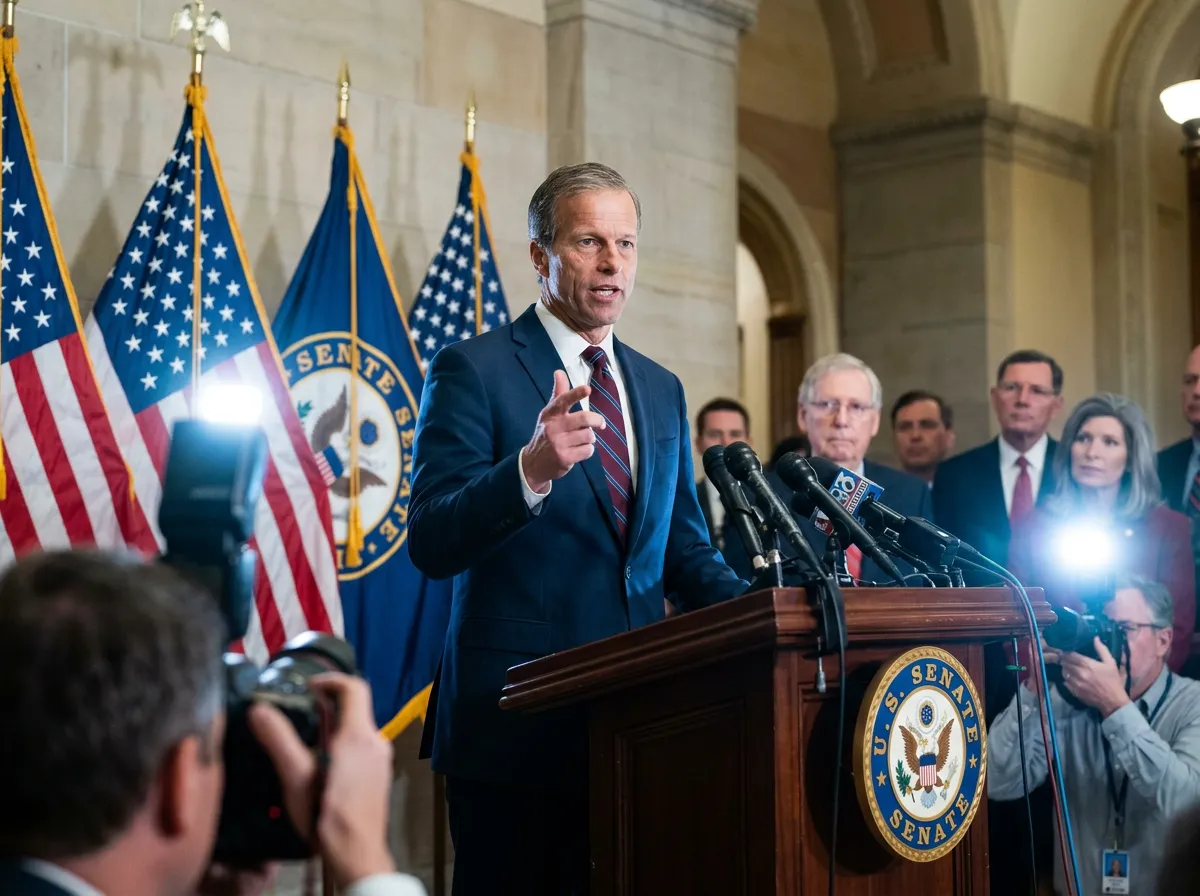
The first is the "nuclear option," a rules change that would eliminate the 60-vote threshold entirely and allow legislation to pass with a simple majority. Trump has pushed for this repeatedly. Thune's response has been unambiguous: "Having studied it and researched it pretty thoroughly, you have to show me how, in the end, it prevails and succeeds." He has told reporters that "there aren't anywhere close to the votes, not even close, to nuking the filibuster," describing the nuclear option as "so extreme that it's nicknamed 'the nuclear option'" for a reason.
The second path is the "talking filibuster," which would force opposing senators to physically hold the floor and speak continuously to maintain their block. In theory, this exhausts the minority and eventually allows a vote. In practice, as Thune noted, it is "much more complicated and risky than people are assuming." A talking filibuster would consume weeks of floor time, during which no other Senate business could proceed. It would require near-unanimous support from the Republican conference, which does not exist, and it would ultimately fail unless Democrats simply gave up, which they would not.
The third option is reconciliation, the budget process that bypasses the filibuster for fiscal matters. But the SAVE Act's provisions, voter ID, mail-in ballot restrictions, and culture-war add-ons, are not primarily budgetary in nature and would likely be struck down by the Senate parliamentarian under the Byrd Rule. Reconciliation is designed for spending and taxation, not election law.
Why Thune Is Saying No
Understanding Thune's resistance requires looking beyond the SAVE Act itself. The filibuster is the Senate's most powerful institutional protection for the minority party. Eliminating it for one bill creates the precedent for eliminating it for every bill. Republican senators who are happy to pass voter ID legislation with a simple majority today might be considerably less happy when a future Democratic majority uses the same precedent to pass gun control, immigration reform, or climate legislation with 51 votes.
This is not a hypothetical concern. In 2013, Senate Democrats used the nuclear option to eliminate the filibuster for most presidential nominations, frustrated by Republican obstruction of President Obama's judicial nominees. In 2017, Republicans extended that precedent to Supreme Court nominations, allowing Neil Gorsuch's confirmation with a simple majority. Each change was described at the time as narrow and specific. Each became a new baseline that the other party exploited when power shifted. Thune, a veteran institutionalist who has served in the Senate since 2005, appears to view the legislative filibuster as a line that, once crossed, cannot be uncrossed.
Senate Minority Leader Chuck Schumer has framed the confrontation in starker terms, warning that Trump's stance would create "total gridlock in the Senate" and that the President is "preparing to hold our government hostage." The hostage metaphor is not subtle, and it reflects the Democratic calculation that this fight benefits them politically. If Trump refuses to sign legislation until the SAVE Act passes, and the SAVE Act cannot pass the Senate, the result is legislative paralysis at a moment when the administration faces rising gas prices, an unpopular war in Iran, and midterm elections approaching.
The Pattern of Presidential Brinkmanship
Trump's "sign nothing until this passes" strategy is not unprecedented, but it is unusual. Presidents typically leverage their signature on legislation by threatening vetoes of bills they oppose, not by refusing to sign bills they support. The current approach creates a dynamic where Trump is, in effect, punishing his own legislative allies for failing to deliver something the Senate's rules make nearly impossible.
The strategy also carries domestic policy risks that compound the political pressure. Government funding, military authorization, and other must-pass legislation are on the congressional calendar. If Trump maintains his position through April and May, routine governance becomes hostage to a voter ID bill that does not have the votes. This is the kind of brinksmanship that characterized Trump's State of the Union address, where the President presented ambitious legislative demands as tests of party loyalty rather than subjects for negotiation.
The historical parallel that congressional observers are drawing is not to any recent president but to Andrew Jackson's battles with the Senate over the Bank of the United States in the 1830s. Jackson, like Trump, framed institutional resistance as a personal affront and used executive pressure to force compliance. The comparison is imperfect, but the dynamic is similar: a populist president who views Senate procedural rules as obstacles to the will of the people, and Senate leaders who view those same rules as essential protections against executive overreach.
What the Bill Actually Does (and What It Doesn't)
The SAVE America Act's core provision requires voters to present proof of U.S. citizenship and government-issued photo identification before casting a ballot in any federal election. Supporters argue this prevents noncitizen voting, which Trump has described as a widespread problem. Critics point out that noncitizen voting in federal elections is already illegal under existing law and that documented instances are exceedingly rare. A Brennan Center for Justice study of the 2016 election found that the rate of noncitizen voting was between 0.0003% and 0.001% of total votes cast, a figure that Trump's allies dispute but that state and federal courts have consistently upheld.
The bill's additional provisions, added at Trump's insistence, move beyond election security into territory that has nothing to do with voting. The ban on transgender athletes in women's sports and the restriction on gender-affirming care for minors are policy positions that many Republican voters support, but their inclusion in a voter ID bill makes the legislation harder to defend as a straightforward election integrity measure. It also gives moderate Republican senators, particularly those facing competitive 2028 races, a reason to distance themselves from the package without appearing to oppose voter ID itself.
The mail-in ballot restrictions would represent a significant change to how millions of Americans vote. During the 2020 and 2024 elections, mail-in voting expanded dramatically, with more than 40% of ballots cast by mail in some states. The SAVE Act would restrict mail-in ballots to voters who can demonstrate military service, disability, illness, or travel, effectively eliminating no-excuse absentee voting in states that currently allow it. Several Republican senators from states with high mail-in usage, including Utah and Arizona, have expressed reservations about this provision.
What to Watch
The SAVE Act standoff is heading toward one of two outcomes, neither of which is comfortable for Republicans. If Trump backs down and begins signing legislation without the SAVE Act's passage, he loses credibility on the issue he's called the GOP's "No. 1 priority" and invites questions about whether his threats carry weight. If he maintains his position, routine legislation stalls, government operations face uncertainty, and Senate Republicans face increasingly uncomfortable questions about whether they can govern with a President who is at war with their procedural rules.
Thune's strategy appears to be patience. By rejecting every proposed path forward publicly and repeatedly, he is establishing a record that the Senate did not obstruct the SAVE Act; rather, the votes simply don't exist under current rules. This positions him to absorb Trump's criticism while arguing that he explored every option in good faith. Whether that framing holds with Republican primary voters, who overwhelmingly support both Trump and voter ID requirements, is the political question that will define the legislative calendar through midterms.
The next concrete test comes when the Senate takes up government funding legislation in the coming weeks. If Trump refuses to sign it, the standoff goes from political theater to genuine crisis. Watch Thune's body language and Trump's social media. When one of them blinks, you'll know how this ends.
Sources
- Thune says no to filibuster changes even after Trump's threats about SAVE America Act - ABC News
- Trump Vows Not To Sign Any Bills Until SAVE America Act Is Passed - TIME
- Senate leaders resist Trump pressure on talking filibuster, SAVE America Act - Washington Times
- Thune stands firm on SAVE America Act as Trump threatens legislative blockade - CBS News