
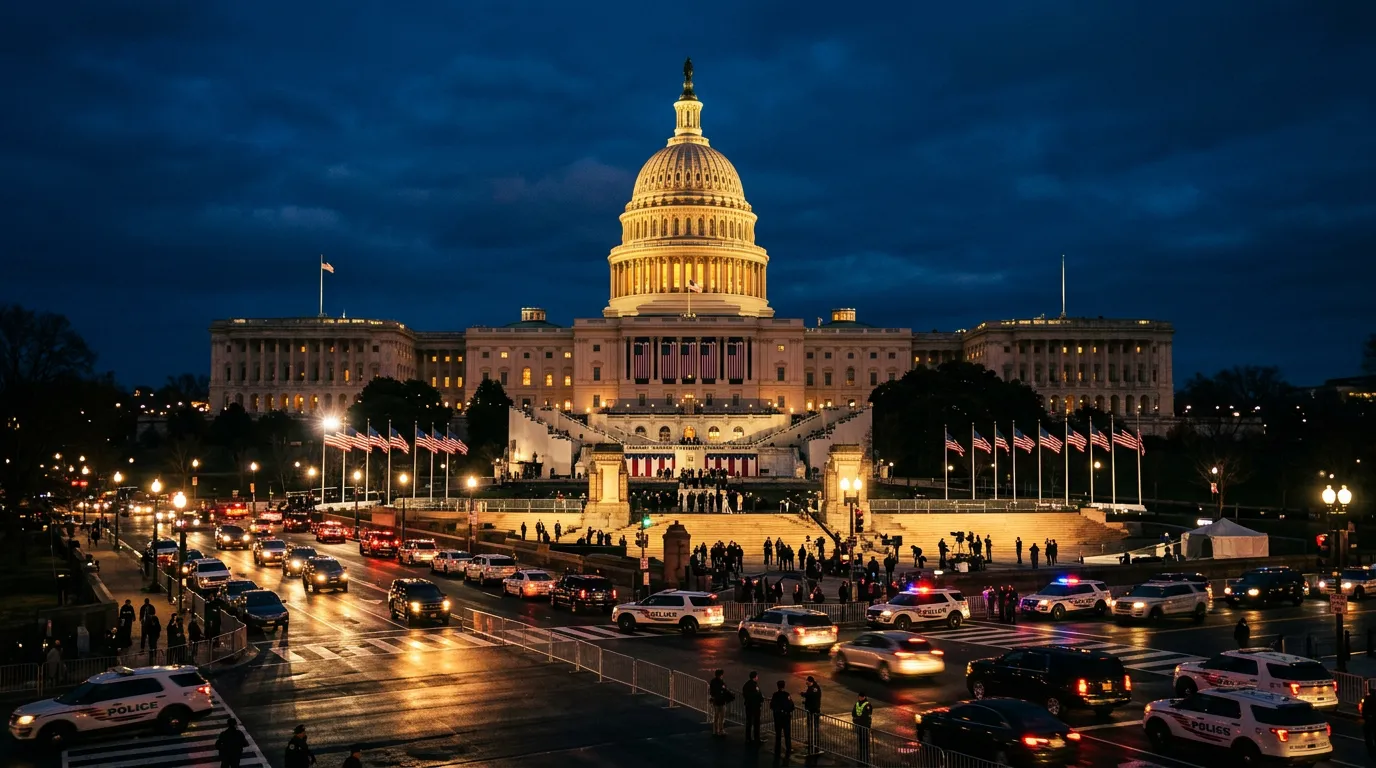
If you watched all of Trump's State of the Union on Tuesday night, you earned it. The speech clocked in at one hour and 48 minutes, making it the longest in American history by a comfortable 20-minute margin over Bill Clinton's marathon 2000 address. For context, that's longer than most feature films and roughly three times the length of a typical presidential address to Congress. Whether the extra time was worth it depends on where you sit politically, but the sheer runtime alone made this a speech for the record books.
The overarching theme was what Trump called "a golden age of America," built around a sweeping claim that the country's first 250 years were "just the beginning." He covered everything from the stock market to border security to a new plan for retirement savings, though some of the biggest global issues barely got a mention. Here's the full breakdown of what the president said, what he skipped, and why the gaps matter as much as the headlines.
The Economy: "A Turnaround for the Ages"
Trump opened with his strongest material: the economy. He pointed to stock market highs and declared, "We have achieved a transformation like no one has ever seen before. A turnaround for the ages." The line drew a standing ovation from the Republican side of the chamber and stone-faced silence from Democrats, which is about what you'd expect.
The economic pitch leaned heavily on market performance and broad declarations of success. Specific policy wins were thinner on the ground. Trump didn't spend much time on inflation, wages, or housing costs, topics that polling consistently shows voters care about more than the Dow Jones. Mark Zandi, chief economist at Moody's Analytics, noted before the speech that "stock market performance doesn't pay anyone's rent," and the address didn't do much to counter that criticism.
What Trump did offer on the economic front was a new retirement savings proposal. The plan would let private-sector workers who don't have employer-sponsored retirement plans save through a government-facilitated program. The details were sparse, but the concept addresses a real gap: roughly half of American workers in the private sector don't have access to a 401(k) or similar plan through their employer. If the administration follows through with legislation, this could be one of the more consequential domestic policy proposals of the speech.
Immigration and the Border
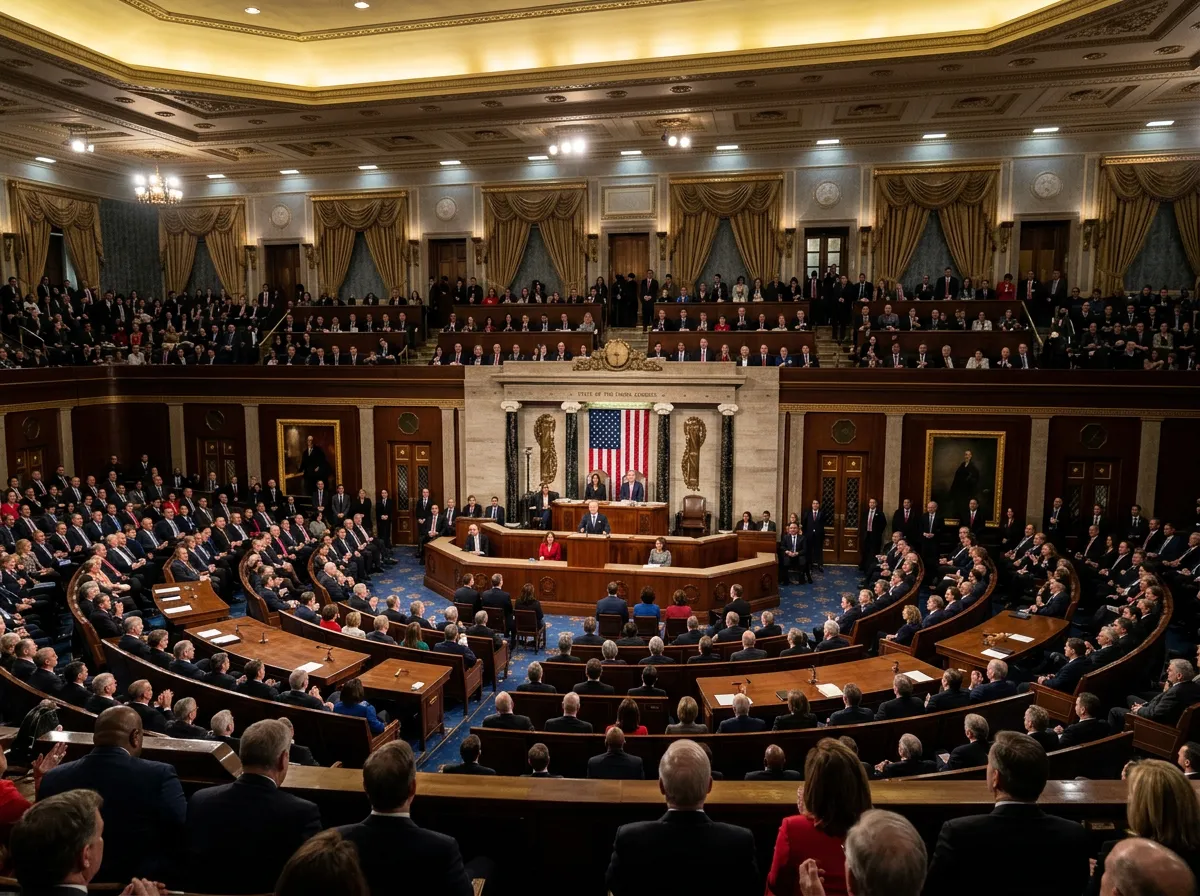
If the economy was the appetizer, immigration was the main course. Trump spent a significant portion of the speech on border security, calling it "the most secure border in American history by far." He highlighted the administration's fentanyl crackdown and pointed to a lower murder rate as evidence that tougher immigration enforcement is working.
The border section hit all the familiar notes from Trump's first year of executive orders:
- Claims of historic border security with fewer illegal crossings
- The fentanyl crackdown as both a law enforcement and public health win
- Lower violent crime rates tied directly to immigration enforcement
- Praise for ICE operations and expanded deportation efforts
What the speech didn't address was the humanitarian fallout or legal challenges. Federal courts have blocked several immigration-related orders, and advocacy groups have documented sharp increases in family separations at the southern border since enforcement ramped up. The administration has framed every court loss as judicial overreach, a pattern that has accelerated in recent months.
The murder rate claim is worth a closer look, too. While FBI data does show declining homicide rates, criminologists have pointed out that the trend started before the current administration took office and tracks more closely with post-pandemic normalization than any single immigration policy. Trump presented it as a direct cause-and-effect, which is a stretch by most academic standards.
AI, Energy, and the Rate Payer Protection Pledge
One of the more unexpected sections of the speech was a new policy on AI and energy. Trump announced what he called the "Rate Payer Protection Pledge," which would obligate technology companies to provide their own power for data centers running AI systems. The goal: prevent ordinary electricity customers from subsidizing the enormous energy demands of the AI industry.
This is a bigger deal than it might sound. AI data centers are already straining power grids in parts of Virginia, Texas, and the Pacific Northwest. Tech companies have been cutting deals with utilities and, in some cases, restarting decommissioned power plants to meet demand. The question of who pays for all that new capacity has been simmering in state-level policy debates for over a year. With the AI industry on track to spend over $2.5 trillion by 2030, the stakes aren't small.
Daniel Yergin, vice chairman of S&P Global and a Pulitzer Prize-winning energy author, has warned that "the collision between AI growth and energy infrastructure is the defining industrial challenge of the next decade." Trump's pledge positions the administration on the consumer-protection side of that collision, at least rhetorically. Whether tech companies accept the terms or lobby aggressively against them will be one of the key policy battles to track in the coming months.

The key details of the pledge as outlined in the speech:
- Tech companies running AI data centers must secure independent power sources
- Utility ratepayers won't absorb infrastructure costs from AI expansion
- New permitting pathways for dedicated power generation at data center sites
- Federal coordination to fast-track energy projects tied to AI facilities
The Protests and the Spectacle
No recap of this speech is complete without the disruptions. Rep. Al Green (D-Texas) was physically escorted from the chamber after holding up a sign reading "Black People Aren't Apes," a direct reference to a video Trump had reposted on social media depicting the Obamas as apes. The moment was jarring, capturing in a single frame the raw tension that has defined this political era.
Green wasn't alone. Reps. Ilhan Omar (D-Minnesota) and Rashida Tlaib (D-Michigan) also interrupted the speech at separate points, though neither was removed. The Democratic side of the aisle was visibly restless throughout, particularly during the immigration and economy sections where Trump's claims were at their most sweeping.
On the other side of the emotional spectrum, the speech had genuinely bipartisan moments. Trump invited the US men's hockey team, fresh off their Olympic gold medal, and the entire chamber stood for a sustained ovation. He also presented Medals of Honor, including one to a 100-year-old Korean War veteran whose introduction drew every member of Congress to their feet. These moments felt like brief cease-fires in an otherwise divided room.
What the Speech Didn't Say
Perhaps the most telling part of a nearly two-hour address was what got left out. Foreign policy received only a passing mention despite the fact that the world is not exactly quiet right now. The Ukraine-Russia conflict remains unresolved. Iran's nuclear program continues to generate headlines, and Tehran responded to the speech sharply, with the Foreign Ministry calling Trump's brief remarks "big lies" ahead of scheduled Geneva nuclear talks.
The administration's broader approach to Iran has been a mix of maximum pressure rhetoric and back-channel diplomacy, but you wouldn't have known any of that from the speech. For an address that broke every length record, the near-total absence of foreign policy was a deliberate choice, not an oversight.
There was also a notable development on the sidelines. Vice President JD Vance announced a halt to roughly $260 million in Minnesota Medicaid payments, a move that didn't come up in the speech itself but landed like a bombshell in policy circles. The timing, during the speech, felt strategic: drop a controversial funding cut while the cameras are pointed somewhere else.
Here's what was missing or barely mentioned in the address:
- Ukraine-Russia: No update on peace negotiations or US involvement
- Iran nuclear talks: Only a passing reference despite Geneva talks days away
- Climate and environment: Completely absent from the nearly two-hour speech
- Healthcare costs: No mention of prescription drug pricing or insurance premiums
- National debt: Unaddressed despite reaching record levels
The Bigger Story
Strip away the partisan reactions and the record-setting runtime, and you're left with a speech that was fundamentally about one thing: consolidation. Trump used the address to reinforce every narrative the administration has built over the past year. The economy is booming (don't look at the details). The border is secure (don't ask the courts). America is entering a golden age (just take his word for it).
The "golden age" framing is doing a lot of heavy lifting. It's a bet that voters will respond to optimistic branding over granular policy, and it's not a bad bet historically. Ronald Reagan's "Morning in America" campaign proved that broad optimism can win elections even when the data is mixed. Trump appears to be running a similar playbook, but at much higher volume and much greater length.
What makes this speech different from a typical State of the Union isn't the content. Most of these positions have been previewed in rallies, executive orders, and social media posts for months. It's the format: a nearly two-hour performance in the most formal setting American politics offers, delivered as if the sheer duration of the argument could make it more convincing. Whether that works depends on whether you were still watching at minute 108, when the speech was still going strong and Bill Clinton's record was already in the rearview mirror.
The real test won't come from pundits scoring the speech on style points. It'll come from whether the specific policy proposals (the retirement savings plan, the Rate Payer Protection Pledge, the continued immigration enforcement) translate into legislation or remain applause lines in the longest State of the Union address anyone has ever had to sit through.
Sources
- "Trump Delivers Longest State of the Union in American History" - Associated Press, February 24, 2026
- "State of the Union Fact Check: Trump's Claims on Economy, Border, and Crime" - Reuters, February 25, 2026
- "Iran Calls Trump's State of the Union Remarks 'Big Lies' Ahead of Geneva Nuclear Talks" - Al Jazeera, February 25, 2026
- "The AI Energy Collision: How Data Centers Are Reshaping the Power Grid" - S&P Global, Daniel Yergin, January 2026
- "Rep. Al Green Escorted From House Chamber During State of the Union" - The Washington Post, February 24, 2026