

You've tried meditation. Maybe more than once. You downloaded the app, found a quiet corner, set a timer for ten minutes, closed your eyes, and immediately started composing a grocery list. Your mind wandered to an email you forgot to send. Then to something awkward you said in 2019. Then to the fact that you were thinking about 2019 instead of meditating, which made you feel like you were failing at the one thing that's supposed to make you less stressed. By minute four, you'd quit. By minute five, you'd concluded that mindfulness is for people with calmer brains than yours.
Here's what the research actually says: you didn't fail. The format failed you. A growing body of evidence suggests that the traditional model of mindfulness, sitting still for 20 or 30 minutes, is neither the only way nor, for many people, the most effective way to train attention. Brief practices, some as short as two minutes, can produce measurable changes in stress, mood, and cognitive function. The catch is that nobody told you that was an option.
Your Attention Is Already Fragmented
Before we talk about solutions, it helps to understand the problem. Amishi Jha, a professor of psychology at the University of Miami and author of *Peak Mind*, has spent two decades studying how attention works and why it breaks down. Her lab's research, conducted across populations ranging from college students to active-duty military personnel, has produced a finding that reframes the entire mindfulness conversation: on average, people are paying attention only about 50% of the time. Half your waking life is spent mentally somewhere other than where you physically are.
That isn't a modern disease or a smartphone problem, though technology makes it worse. It's a feature of how human brains operate. Your attention system is designed to wander, scanning for threats, making plans, processing incomplete tasks. The problem isn't that your mind wanders. The problem is that you don't notice it's wandering until you've lost five, ten, or thirty minutes to a mental loop that serves no purpose. Jha's research shows that cognitive overload from constant context-switching accelerates this pattern, making sustained focus progressively harder as the day wears on.
The traditional prescription, sit down and meditate for 20 minutes, works for some people. But Jha's own findings point to a more accessible minimum effective dose: 12 minutes of daily practice is enough to protect attention and working memory, even in high-stress populations like military service members preparing for deployment. And recent research suggests even shorter sessions can produce meaningful results.

The Evidence for Going Short
A 2024 study in *Nature Human Behaviour* delivered one of the most significant findings in recent mindfulness research. Across 2,239 participants at 37 sites, researchers tested four self-administered mindfulness exercises: mindful walking, mindful breathing, loving-kindness meditation, and body scan. All four significantly reduced self-reported stress. But the headline result was this: four 5-minute sessions were as effective as, and in some measures superior to, four 20-minute sessions at improving trait mindfulness, state mindfulness, and stress reduction.
That finding alone should change how most people think about mindfulness practice. The barrier that stops millions of people from meditating, "I don't have 20 minutes," turns out to be a barrier to a format, not to the practice itself.
A systematic review of 85 studies on brief mindfulness interventions, published in Mindfulness, reinforced this conclusion. Seventy-nine of those 85 studies reported significant positive effects on at least one health-related outcome. Some interventions produced measurable results after a single session. Some were as brief as five minutes. A separate meta-analysis of 111 randomized controlled trials found no evidence that the number of sessions or total treatment duration moderated the effects of mindfulness on cognition. Brief interventions could "alleviate distress and enhance cognitive functioning" similarly to longer programs.
This doesn't mean a two-minute practice equals a weeklong retreat. Depth matters, and experienced meditators access states of awareness that beginners don't. But for the millions of people who've written off mindfulness because they can't sit still for 20 minutes, the science is clear: short practices count. They count more than the long practice you never do.
Three Micro-Practices That Actually Work
The following techniques are backed by research and designed to fit into the gaps that already exist in your day. None requires a meditation cushion, a quiet room, or a block of uninterrupted time. If you've been craving the benefits of stepping away from digital noise but can't carve out a full day, these practices offer a smaller but meaningful reset.
The Physiological Sigh (60 seconds). This technique, studied by Andrew Huberman and David Spiegel at Stanford, uses a breathing pattern your body already performs involuntarily when you're crying or falling asleep. Two quick inhales through the nose (the second one topping off the lungs completely), followed by one long, slow exhale through the mouth. In a 2023 randomized controlled trial published in *Cell Reports Medicine*, five minutes of daily cyclic sighing produced greater improvements in positive affect than mindfulness meditation, with measurable decreases in respiratory rate and heart rate. You don't need five minutes. Even one to three sighs between tasks can interrupt the stress cascade and bring your nervous system back toward baseline.
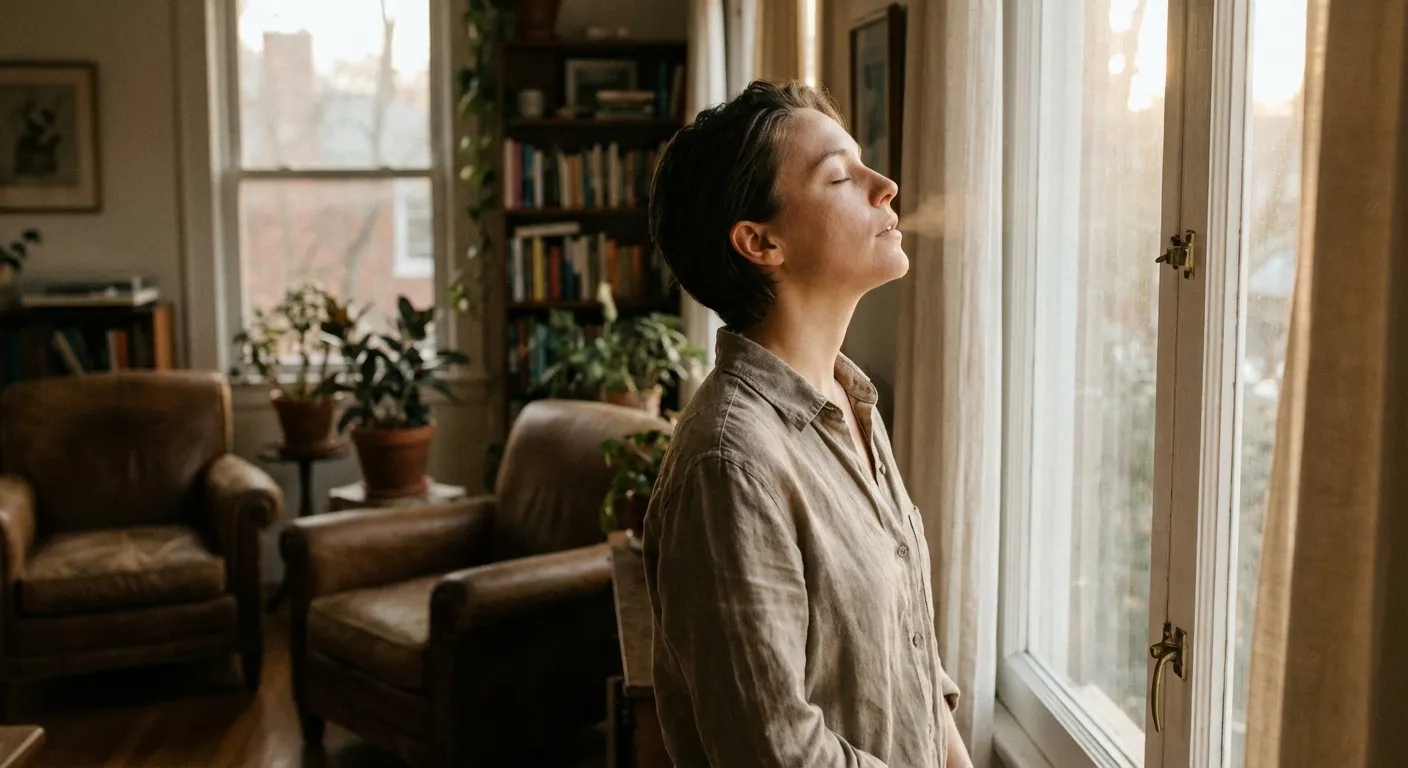
Benson's Mini Reset (2 minutes). Herbert Benson, a cardiologist at Harvard Medical School, pioneered the relaxation response in the 1970s and spent decades documenting its effects on blood pressure, heart rate, and stress hormones. The full technique involves 10 to 20 minutes of repetitive mental focus, but the core mechanism works in abbreviated form. Close your eyes. Breathe through your nose at a natural pace. On each exhale, silently repeat a single word, "one," "calm," "here," whatever feels neutral. When your mind wanders (it will), gently return to the word without judgment. Two minutes of this activates the parasympathetic nervous system and creates a measurable counterpoint to the rush of constant acceleration.
The Sensory Check-In (90 seconds). This isn't a formal technique from a single study, but it draws on the attentional training principles Jha's lab has documented. Wherever you are, pause and notice: three things you can see, two things you can hear, one thing you can feel (the chair beneath you, air on your skin, feet on the floor). This practice works because it forces your attention into the present moment through sensory channels rather than through cognitive effort. You're not trying to "clear your mind." You're redirecting it toward what's already happening right now. For people who find traditional meditation frustrating, this sensory approach often feels more natural because it gives the brain something concrete to do.
Building the Habit Without the Pressure
The biggest reason micro-mindfulness works where longer meditation fails isn't the neuroscience. It's the psychology of habit formation. B.J. Fogg's behavior design research at Stanford demonstrates that the most reliable predictor of whether a new behavior sticks isn't motivation or willpower. It's how easily the behavior fits into what you're already doing.
Micro-mindfulness practices succeed because they attach to existing routines rather than demanding new blocks of time. The physiological sigh before you start your car. Benson's mini reset while your coffee brews. The sensory check-in during the elevator ride after a meeting. You're not adding to your schedule. You're using the transitions that are already there.
This is also why consistency matters more than duration. The 2024 Nature Human Behaviour study didn't just show that short sessions work. It showed that the effects were cumulative: participants who practiced consistently across the study period, even in brief sessions, showed greater improvements than those who practiced sporadically for longer periods. The Stanford breathing study found the same compounding pattern: positive affect increased across consecutive days of practice, meaning the second day built on the first, and the third built on the second.

Your Invitation
If traditional meditation hasn't worked for you, that doesn't mean mindfulness hasn't worked for you. It means you haven't found the format that fits. The research is increasingly clear that the "right" mindfulness practice is the one you'll actually do, and for most people, that means something short enough to feel effortless and concrete enough to feel real.
Pick one of the three practices above. Try it once today. Not as a commitment. Not as the beginning of a "mindfulness journey." Just as an experiment. Two minutes to see what happens when you stop the momentum of your day long enough to notice that you're in it.
Your brain was not built for the volume of inputs it processes daily. But it does have a reset button. It's smaller than you thought, faster than you expected, and available to you right now.
Sources
- Jha, A. P. *Peak Mind: Find Your Focus, Own Your Attention, Invest 12 Minutes a Day.* HarperOne, 2021.
- Balban, M. Y., Neri, E., Kogon, M. M. et al. "Brief Structured Respiration Practices Enhance Mood and Reduce Physiological Arousal." Cell Reports Medicine, 2023.
- Hirshberg, M. J. et al. "Self-Administered Mindfulness Interventions Reduce Stress in a Large, Randomized Controlled Multi-Site Study." Nature Human Behaviour, 2024.
- Schumer, M. C. et al. "Brief Mindfulness-Based Interventions and Health: A Systematic Review." Mindfulness, 2019.
- Benson, H. "The Relaxation Response." Harvard Health, Massachusetts General Hospital.