
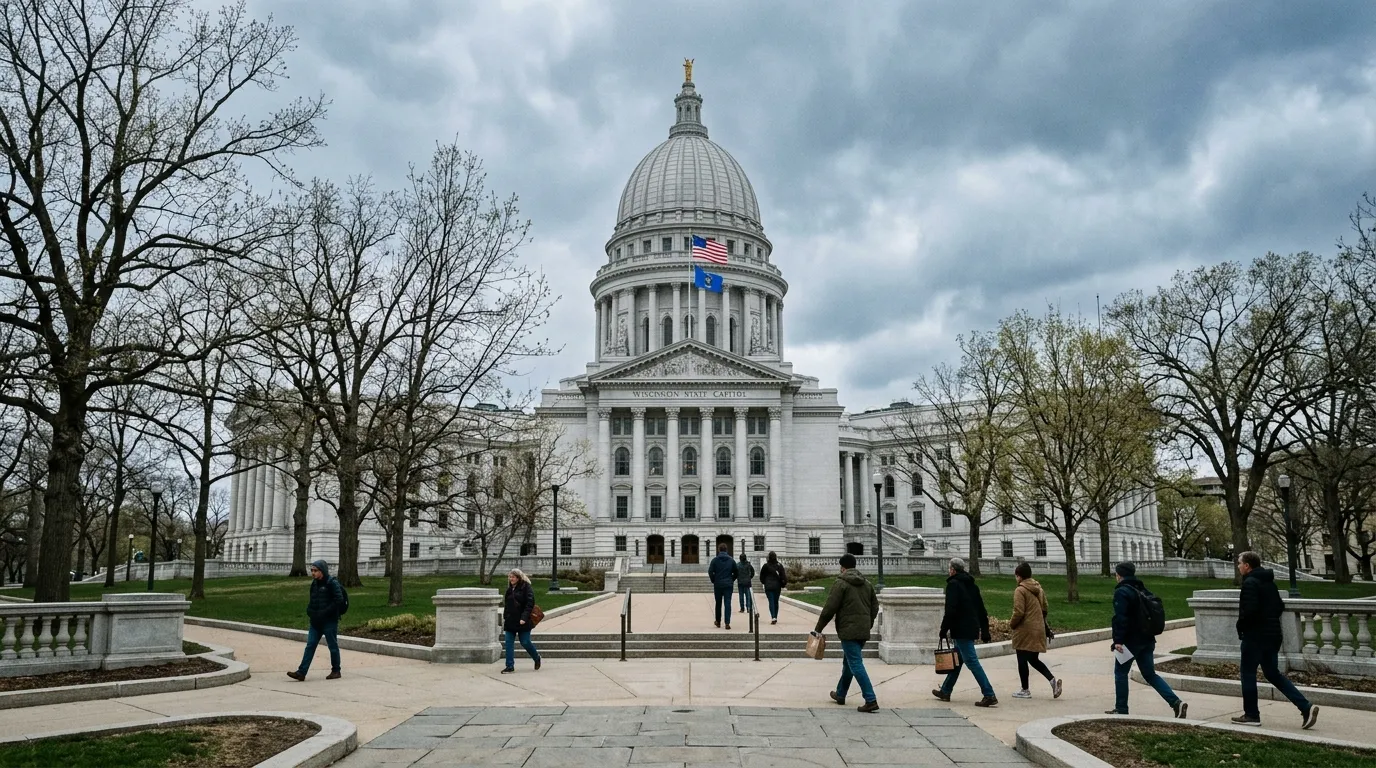
Wisconsin voters didn't just pick a new Supreme Court justice on Tuesday. They delivered a 20-point landslide that produced the most lopsided liberal majority the court has seen since the 1970s, locked it in through at least 2030, and sent a clear signal about where the state's most powerful legal body is headed for the rest of the decade.
Chris Taylor, a liberal Court of Appeals judge and former Democratic state lawmaker, defeated conservative judge Maria Lazar by a margin of 60% to 40%, collecting 905,157 votes to Lazar's 600,044. It was the widest margin in a Wisconsin Supreme Court race in 26 years and the fourth consecutive victory for liberal-backed candidates since 2020. The result pushes the court from a 4-3 liberal majority to 5-2, giving progressives a two-seat cushion that eliminates the single-vote anxiety that defined every contentious ruling since 2023.
For a state that decided the 2020 presidential election by roughly 20,000 votes, the court that handles redistricting, ballot access, and election disputes matters as much as any office on the November ballot. Now that court has a two-justice margin for the first time in modern memory.
What the Court Has Already Done
To appreciate why this race mattered, look at what the Wisconsin Supreme Court has accomplished since liberals first captured the majority in the landmark 2023 election.
That contest drew over $100 million in spending, making it the most expensive judicial race in American history, and flipped the court 4-3. The new majority moved quickly. Within months, the justices struck down Wisconsin's heavily gerrymandered state legislative maps, forcing the adoption of new districts that cost Republicans their supermajority in the legislature. They restored ballot dropbox access by rejecting GOP restrictions on mail voting that had been in effect since 2022. And in a 4-3 decision last year, the court struck down Wisconsin's 1849 criminal abortion ban, eliminating one of the oldest such statutes in the country.
Every one of those rulings came down to a single vote. A recusal, an absence, or one justice reconsidering could have reversed the outcome. That reality made the 2026 race feel consequential even without the stakes of a majority flip, because moving to 5-2 meant the court could absorb a dissent or a recusal and still rule the same way. The margin isn't just political symbolism. It is structural resilience.
A challenge to Wisconsin's congressional map, widely regarded as one of the most gerrymandered in the nation, is still working its way through the courts. With a two-justice buffer, the liberal majority can take up that case without the constant specter of a tie. In an era where federal legal leadership is being reshuffled at the executive level, state supreme courts have become the final authority on a growing number of voting and redistricting disputes, and Wisconsin's sits squarely at the center of that shift.
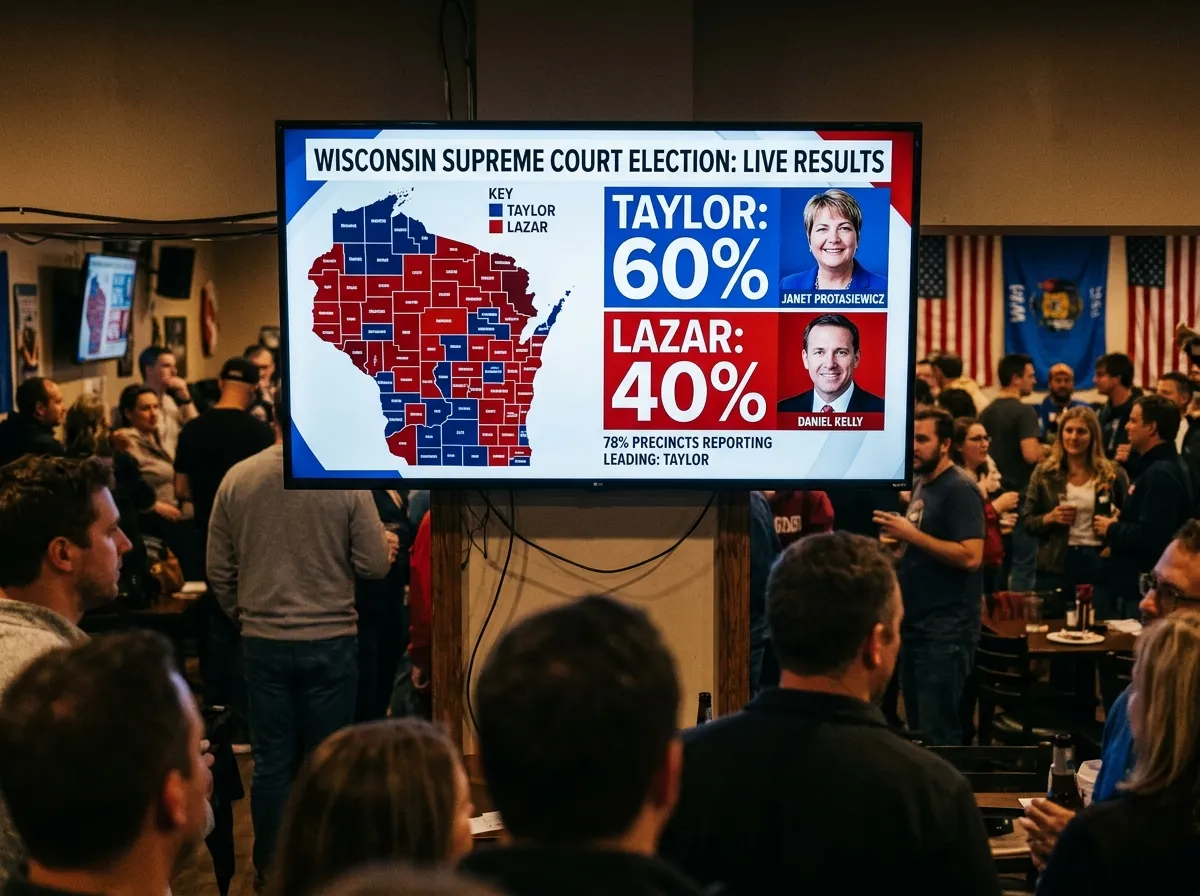
A Quiet Race That Still Made History
By every spending and turnout metric, this was a subdued affair compared to its predecessors. Total television ad spending reached roughly $4 million, a fraction of the $75 million spent in the 2025 race and barely a rounding error next to 2023's record haul. Taylor's campaign spent approximately $3.3 million on ads. Lazar's spent about $255,000, a nearly 13-to-1 disadvantage. Republican strategist Mark Graul acknowledged the disparity bluntly: "Judge Lazar was outspent somewhere in the neighborhood of 10 to 1."
Turnout followed a similar pattern. Roughly 1.5 million voters cast ballots, down sharply from 2.4 million in 2025. Early voting dropped by half, with 324,396 people casting early ballots compared to nearly 694,000 in the prior cycle. When the majority isn't on the line, the urgency drains out of the room, and both parties directed their financial and organizational resources elsewhere.
Douglas Keith, senior counsel at the Brennan Center for Justice, captured the paradox neatly: "This year's Wisconsin Supreme Court election looks like a supreme court election from another era, which is to say, a decade ago." The money and the mobilization stayed home. But the structural consequence of Taylor's victory may outlast the higher-profile races that preceded it, because it converts a fragile one-seat advantage into a durable two-seat cushion that can withstand defections, recusals, and unforeseen vacancies.
Two Judges, Two Visions
The candidates offered starkly different backgrounds and starkly different messages.
Chris Taylor came to the bench after serving in the Wisconsin state legislature as a Democrat and working for Planned Parenthood. On the Court of Appeals, she authored a ruling that expanded mail ballot access, giving her a judicial record that matched the priorities of the voters who elected her. Her campaign leaned heavily into abortion rights messaging, running ads that highlighted her long history of defending reproductive access. The 20-point margin suggests that the issue continues to move Wisconsin voters years after the Dobbs decision reshaped state-level political contests across the country.
Maria Lazar, also a Court of Appeals judge, had previously served as a deputy attorney general where she defended the state's abortion restrictions in court. She drew endorsements from figures connected to Trump's 2020 election challenges, including a participant in Wisconsin's fake elector scheme. Her campaign ran ads characterizing transgender people as threats to children's "safety and dreams," echoing a national Republican messaging strategy that has produced mixed results across recent election cycles.
The financial asymmetry made it nearly impossible for Lazar to compete for persuadable voters. Taylor dominated the airwaves by a factor of roughly ten, and in a judicial race where name recognition and visibility often determine outcomes, the spending gap likely widened a margin that ideology alone would have made significant but not overwhelming.
The Bigger Story
The structural implications of this result extend far beyond one election cycle, and they reveal something important about how power actually works in Wisconsin.
The 5-2 liberal majority is now guaranteed through at least 2030, meaning it will be in place for the 2026 midterms, the 2028 presidential election, and every legal dispute that arises from either. In a state where presidential elections are decided by margins measured in the tens of thousands, the court that rules on ballot access, recount procedures, and redistricting challenges functions as the infrastructure of democratic competition itself. Controlling that court by two seats rather than one fundamentally changes the risk calculus for both parties.
Taylor's 10-year term runs through 2036, meaning she will still be on the bench when the next redistricting cycle begins after the 2030 census. On the conservative side, Justice Annette Ziegler has already announced she will not seek reelection in 2027, creating yet another open seat. The subsequent seats to expire belong to Justice Rebecca Dallet (liberal, 2028), Justice Brian Hagedorn (conservative, 2029), and Chief Justice Janet Protasiewicz (liberal, 2030). For conservatives to claw back even a 4-3 minority, they would need to win multiple consecutive races, something they haven't managed since 2019.
The deeper question is whether Wisconsin's streak of liberal dominance in spring judicial elections has any predictive power for November general elections. Wanda Sieber, chair of the Brown County Democrats, urged restraint: "I don't think you can ever extrapolate a prognosis of November from what happens in April. It's two very different electorates." She's right about the electorate. Spring judicial contests attract a smaller, more politically engaged slice of voters than the general election universe does.
But the court itself doesn't change between April and November. The same 5-2 bench that was seated this week will be the one adjudicating voting rights challenges, interpreting ballot procedures, and deciding redistricting petitions during the next presidential cycle. Wisconsin's courtroom wars went quiet this spring, with less money and fewer voters than anyone expected. The fortifications they built, though, will hold for the rest of the decade.
Sources
- Takeaways from 2026 Wisconsin Supreme Court Election results - Fox 11 Online
- Liberals Gain Seat on Wisconsin Supreme Court, Adding to Firewall in Voting Cases - Bolts Magazine
- Taylor wins the 2026 Wisconsin Supreme Court election - PBS Wisconsin
- Chris Taylor wins Wisconsin Supreme Court race, expanding liberals' majority - NBC News