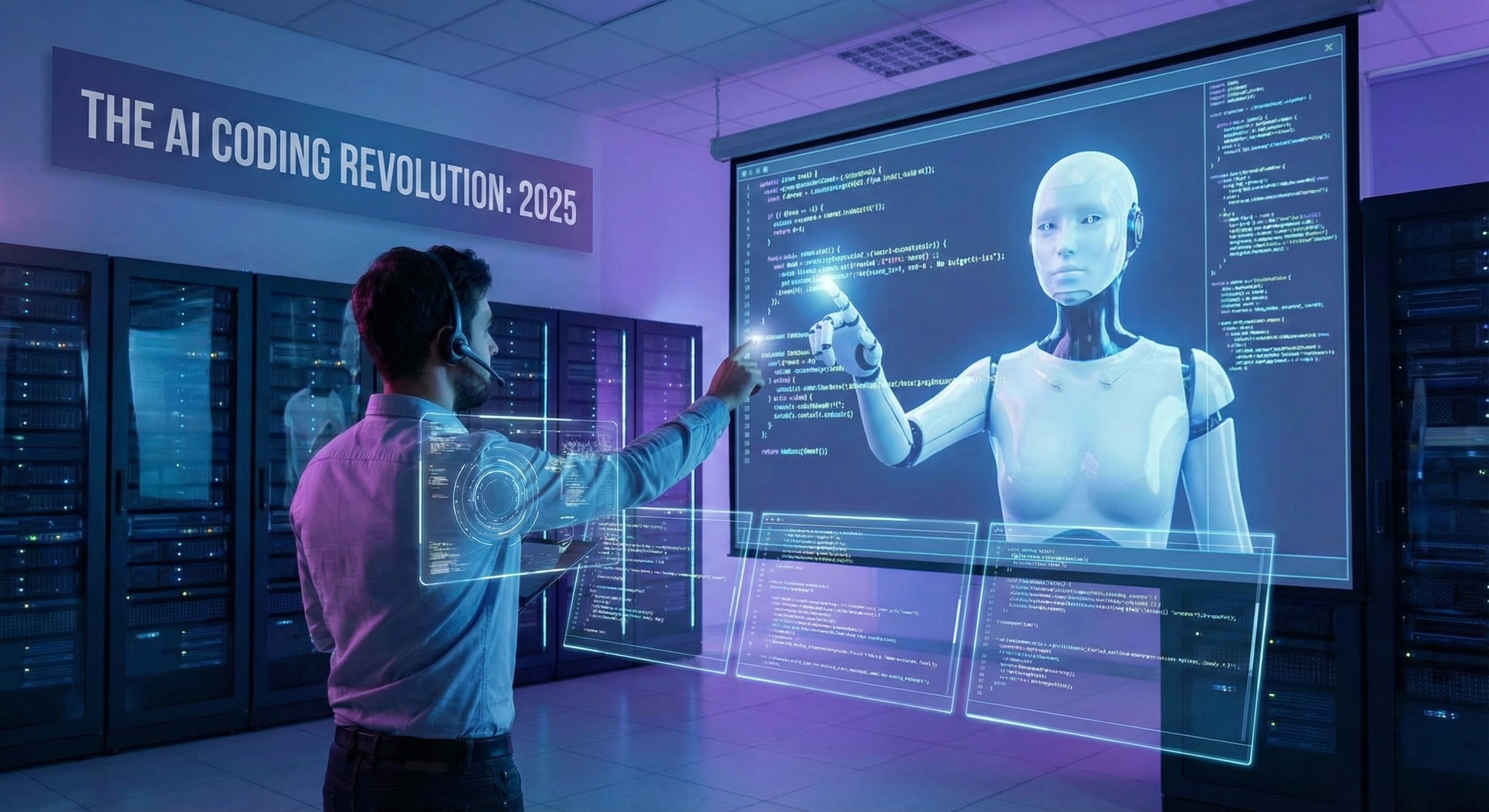
GitHub Copilot can write entire functions from a simple comment. Tell it “create a function to sort this array by date,” and it generates working code instantly. Describe what you want in plain English, and it produces the implementation. Developers who use it regularly report being 30-50% more productive. Tasks that took hours now take minutes. Boilerplate code writes itself. Bug fixes are suggested automatically.
This is remarkable technology. It’s genuinely useful. And it’s making software engineers ask uncomfortable questions about whether their jobs will exist in 10 years. If AI can write code this well now, and it’s improving exponentially, what happens when it gets even better? Will junior developer positions disappear? Will the industry need 30% fewer engineers?
The honest answer from people who understand both AI and software development: yes, probably. Not zero engineers, but fewer. And the ones who remain will need fundamentally different skills than today’s developers.
What AI Can Do Now (And It’s a Lot)
Current AI coding tools have moved far beyond glorified autocomplete. They’ve reached a level of capability that genuinely threatens to automate large chunks of what software developers do every day. GitHub Copilot, Amazon CodeWhisperer, and ChatGPT can generate entire functions from brief descriptions, translating plain English into working code. They handle language translation, converting Python to JavaScript or vice versa with surprising accuracy. Most impressively, they’ve started tackling debugging: feed the AI a block of broken code and an error message, and it often suggests the correct fix on the first try.
These tools are also automating what developers call “the chores.” Writing comprehensive test cases used to be tedious work that often got skipped. Now AI can generate test coverage automatically, including edge cases you might not have thought of. Legacy code that nobody understands anymore? AI can explain it in plain English, acting as on-demand documentation. These capabilities cover roughly 40-60% of what junior and mid-level developers do daily. That’s not a small efficiency gain. That’s substantial automation of current job functions.

The Junior Developer Problem
This creates an acute crisis for people trying to break into software development. Traditionally, junior developers learned the craft by doing routine tasks: implementing well-defined features from specifications, fixing minor bugs, writing tests, and generating documentation. These were low-stakes environments where you could make mistakes and learn. Today, AI can do all of these tasks at comparable or better quality levels, instantly, for $20 a month instead of an $80,000 salary.
The economic logic facing hiring managers is brutal. Why pay a junior developer when an AI subscription produces similar output without benefits, vacation time, or sick days? The data reflects this shift. Tech layoffs have disproportionately affected junior positions. Job postings for entry-level developers have dropped significantly year-over-year. Companies are explicitly stating they’re hiring fewer juniors because their senior staff, augmented by AI, can handle the workload.
This breaks the traditional talent pipeline. If the “apprentice” stage of becoming a software engineer is automated away, where do future senior engineers come from? The industry is creating a long-term problem while solving a short-term efficiency goal. As discussed in the broader context of AI agents in the workplace, this pattern is appearing across many knowledge work fields.
What Humans Still Do Better
Senior developers are less panicked because they understand what AI still struggles with. The value of a human engineer is shifting from “writing code” to “solving problems.” AI excels at pattern matching, but struggles with genuinely novel problems that require creative approaches outside established patterns. It can’t design complex system architectures or make high-level decisions about how different pieces of a large application should fit together. These tasks require deep contextual understanding and business logic that large language models don’t possess.

The skills that remain valuable are distinct from pure coding ability. System design and architecture matter more than syntax. Domain expertise, understanding the business context of what you’re building, is increasingly critical. The ability to translate between technical and non-technical stakeholders becomes more valuable when the technical implementation itself can be partially automated. Engineers who can make judgment calls about code maintainability, team dynamics, and long-term technical debt are safer than those who just implement specifications quickly.
The future engineer looks less like a bricklayer and more like an architect: overseeing the construction, making high-level decisions, and letting AI handle the repetitive assembly work.
The Hidden Costs
There’s a hidden cost to AI-generated productivity: code quality. AI-generated code works, in the sense that it compiles and passes basic tests. But it isn’t always good code. It can be verbose, inefficient, or fail to follow project-specific conventions. Worse, it can introduce subtle bugs that pass tests but fail in production edge cases. It can create security vulnerabilities that are difficult to spot without deep expertise.
Experienced developers catch these issues during code review. But junior developers who rely heavily on AI might accept suboptimal code as correct, leading to gradual degradation of the codebase. Over time, you end up with technically functional but poorly designed systems that become increasingly difficult to maintain.
There’s also a legal cloud hanging over the entire industry. Tools like Copilot were trained on billions of lines of public code, including open-source software with specific licenses. A massive class-action lawsuit is working its way through courts to determine if this constitutes fair use or copyright violation. If plaintiffs win, the entire economic model of training AI on public code could collapse, forcing a major restructuring of how these tools work.
The Bottom Line
The software engineering profession in 2035 will look noticeably different than today. Companies are already appointing Chief AI Officers to navigate this transformation. Realistic projections suggest 20-40% fewer total developer jobs than would have existed without AI automation. The “junior developer” position as we know it may be effectively eliminated or radically redefined, shifting toward roles focused on AI prompt engineering, code review, and testing rather than implementation.
For current and aspiring developers, the message is clear: adapt or struggle. Learn to use AI as a force multiplier rather than compete against it. Develop skills beyond rote implementation. Go deep into specific domains where contextual knowledge matters. The job isn’t gone yet, but the bar for entry has been raised permanently. The engineers who thrive will be the ones who embrace AI as a tool while developing the uniquely human skills that machines can’t replicate: creativity, judgment, and the ability to understand what should be built in the first place.
Sources: Software development industry surveys, AI coding tool documentation, tech employment data.