Your phone battery lasts one day, maybe two if you’re conservative with usage. You charge it every night. You carry portable battery packs. You’ve internalized battery anxiety as just part of owning a smartphone. This is simply how phones work.
Except it won’t be for much longer. Solid-state batteries, the technology that’s been “five years away” for the past fifteen years, are finally becoming commercially viable. Samsung announced they’ll ship phones with solid-state batteries by late 2026. Apple is reportedly testing them for 2027 iPhone models. This represents the kind of fundamental technology shift that companies are racing to lead. The improvements aren’t incremental. We’re talking about 2-3x energy density, meaning a phone could last a week on a single charge or become half as thick while maintaining current battery life.
Plus, they’re safer, charge faster, and degrade much slower than current lithium-ion technology. Battery anxiety is about to become a thing of the past.
Why Lithium-Ion Hit the Wall
Lithium-ion batteries have powered everything from phones to electric cars since Sony commercialized them in 1991. They’ve been remarkably successful, improving steadily for over three decades. But they’re approaching their theoretical limits. Recent improvements have slowed to 3-5% per year, and we’re fundamentally stuck with liquid electrolytes that limit energy density and create fire risks.
The liquid electrolyte is the bottleneck. It’s flammable, which is why lithium-ion batteries occasionally catch fire or explode. It limits how densely you can pack energy because you need safety margins. And it degrades over time through chemical reactions, which is why your phone battery gets worse after a few years.
To break through these limitations, we need fundamentally different chemistry. That’s where solid-state batteries come in.
The Solid-State Breakthrough
Solid-state batteries replace the liquid electrolyte with a solid ceramic or polymer electrolyte. This seemingly simple change enables massive improvements. Solid electrolytes allow the use of metallic lithium anodes, which store dramatically more energy than current graphite anodes. The solid electrolyte is non-flammable, essentially eliminating fire risk. The batteries can be cycled tens of thousands of times with minimal degradation, potentially lasting decades instead of years.
The result is a generational leap in capability. Energy density doubles or triples compared to current lithium-ion batteries. A phone with a solid-state battery could run for a week on a charge with current usage patterns, or manufacturers could make phones dramatically thinner and lighter while maintaining current battery life. Fast charging becomes even faster because solid electrolytes can handle higher current without degrading. And the safety improvement means devices could potentially be designed with batteries that are replaceable again, since the fire risk that drove sealed battery designs largely disappears.
The Rollout Timeline
For smartphones, the timeline is now clearly defined. Samsung is targeting late 2026 for the first premium models with solid-state batteries. Apple is reportedly testing them for 2027 iPhones, though Apple’s notorious secrecy means this could shift. By 2028-2030, solid-state should be standard in flagship devices across the industry. By 2035, it will likely trickle down to budget phones.
This means the battery anxiety that has defined smartphone ownership for 15 years will slowly vanish from daily life over the next decade. The constant checking of battery percentage, the nightly charging ritual, the carrying of backup batteries will become increasingly unnecessary for most users.
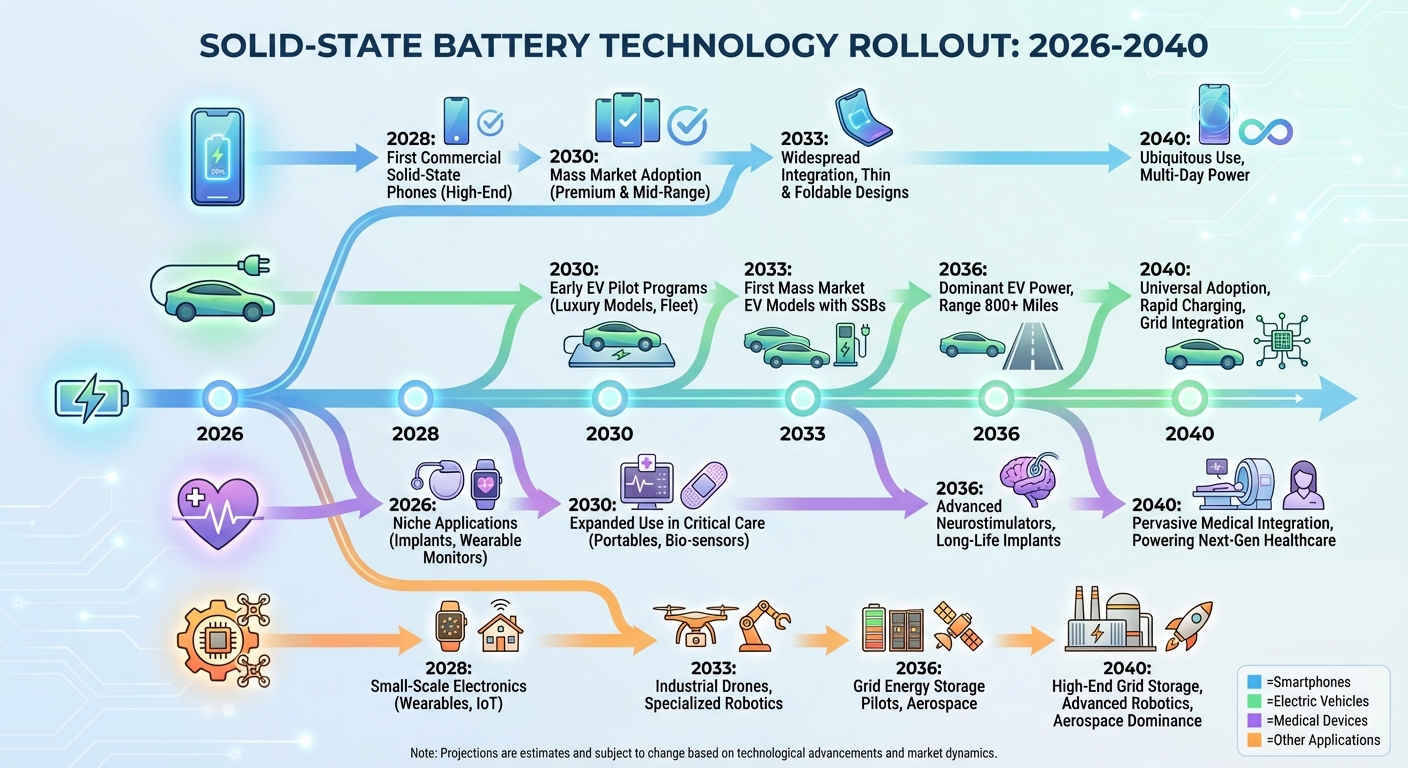
Beyond phones, the impact spreads across industries. Electric vehicles with solid-state batteries could offer 700-mile ranges and charge to 80% in under 10 minutes, eliminating range anxiety entirely. Medical devices like pacemakers could last decades without replacement surgery. Laptops could run for days on a single charge. Drones and electric aircraft become significantly more practical with the weight savings and energy density improvements. This is infrastructure-level technology that will touch almost every aspect of how we use portable electronics and electric transportation. Similar to how AI agents are transforming software, solid-state batteries will transform hardware.
The Remaining Challenges
The technology works. The physics is proven. The remaining barrier is purely economic: solid-state batteries currently cost 3-5x more to produce than lithium-ion batteries. Manufacturing them at scale is incredibly complex, requiring new factories, new processes, and new supply chains. The ceramic electrolytes are brittle and difficult to work with. Quality control is challenging because even minor defects can ruin a battery.
But billions in investment are pouring in from Toyota, Samsung, QuantumScape, and dozens of other companies and startups. Manufacturing costs are projected to fall rapidly once mass production begins, following the same cost curve that made lithium-ion batteries affordable. The first generation will be expensive, appearing only in premium flagship phones. By the third or fourth generation, costs should approach parity with current batteries.
The Bottom Line
Battery technology is finally making the leap everyone’s been waiting for since smartphones became ubiquitous. Solid-state batteries will transform personal electronics from devices you charge daily to devices you charge occasionally, like you might charge a laptop once every few days instead of every night.
We’re not quite there yet. The technology exists in labs and early production lines, but it’ll be another 2-3 years before you can buy a phone with a solid-state battery. But we’re close enough to see it coming clearly. Your next phone might be the last one you charge every single night. The phone after that almost certainly will be. Battery anxiety is about to join dropped calls and slow mobile internet as a problem we used to have but don’t anymore. And not a moment too soon.
Sources: Samsung Electronics product roadmaps, Nature Energy research journals, QuantumScape investor reports.