
American basketball used to be American basketball. The rest of the world played, but the NBA was our thing, a showcase for homegrown talent developed through American high schools, AAU circuits, and college programs. That era just officially ended. When NBA teams took the court for the 2024-25 season, 127 of the 450 players on opening-night rosters were from outside the United States. That’s 28%, the highest percentage in history.
Even more striking is who sits at the top. Five of the ten best players in the league right now are European, and it’s not even close. Nikola Jokic from Serbia, a three-time MVP, might be the best passing big man in history. Luka Doncic from Slovenia averages a near triple-double every season. Greece’s Giannis Antetokounmpo remains the most physically dominant force on the court. Then there’s Victor Wembanyama from France, the 7’4” “unicorn” redefining what’s possible. These aren’t outliers; they represent a systemic shift. Europe is currently producing better basketball players than the United States.
The Development System Difference
The difference lies in how players are built. European player development systems are simply superior in key ways. They emphasize fundamentals over flair. European youth players spend thousands of hours mastering footwork, passing, and shooting mechanics, while American AAU players often spend that time playing isolation ball and hunting for highlight-reel dunks.
European academies prioritize team play, teaching kids to pass, space the floor, and read defenses rather than play “hero ball.” They also start professional training much earlier. By age 16, top European prospects compete against grown men in professional leagues, learning to handle physicality and pressure that American teens playing against other high schoolers simply don’t face.
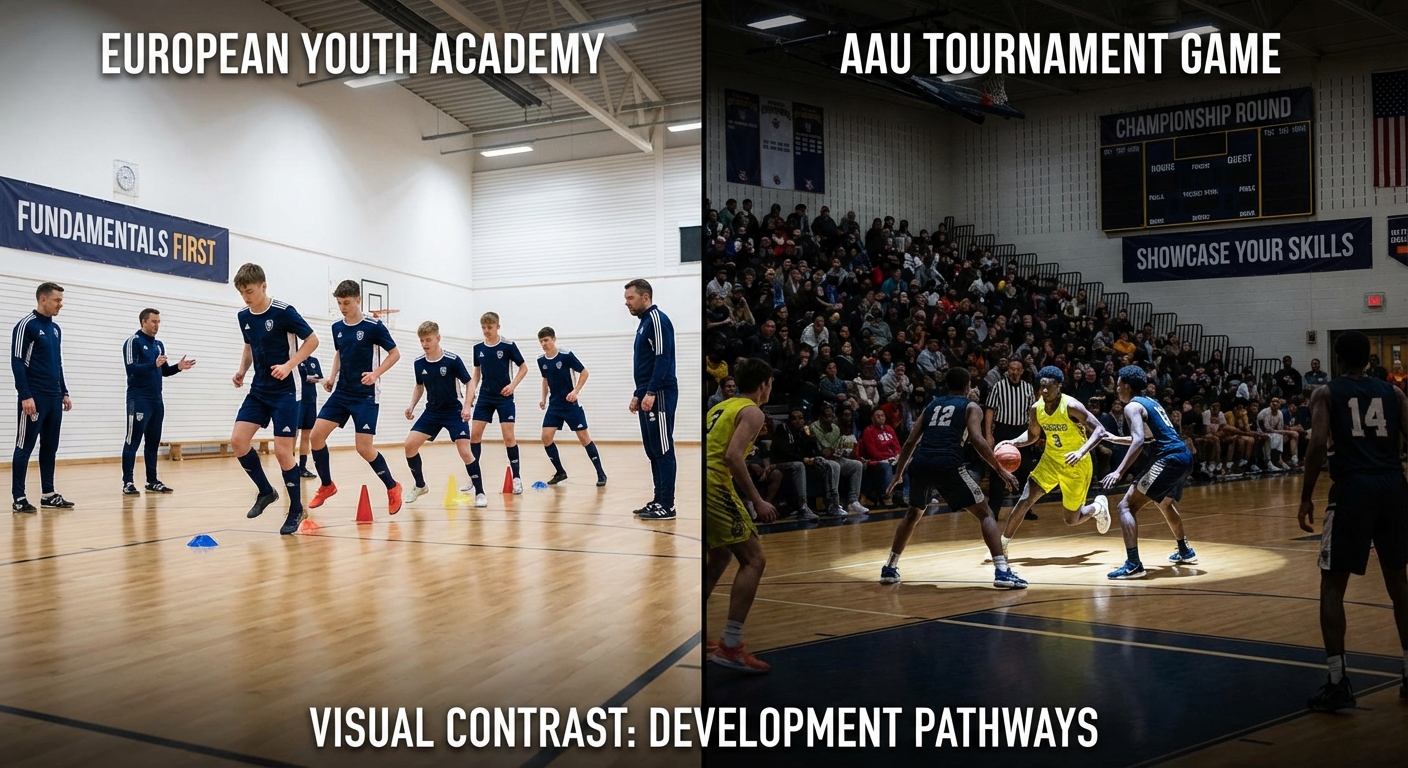
Perhaps most importantly, the European model believes less is more. Players participate in 50-60 games per year, leaving ample time for practice and skill acquisition. The American AAU circuit grinds kids through 100+ games annually, leading to burnout and overuse injuries without necessarily improving skills. European players arrive at the NBA more fundamentally sound and less physically worn down.
AAU and College Are Failing
To understand why Europe is winning, look at American system failures. AAU basketball, originally designed to give kids opportunities, has evolved into a showcase circuit optimized for recruiting rankings rather than player development. Coaches focus on winning games rather than teaching skills, encouraging one-on-one offense because it looks good in mixtapes. Defense, fundamentals, and team concepts fall by the wayside.
The college system is also faltering as a development pathway. Top American prospects increasingly view college as a one-year obligation before the NBA draft rather than a chance to improve. They play a short season against other students and leave, often without significant skill growth. Meanwhile, their European counterparts like Luka Doncic and Nikola Jokic were professionals by 17, learning their trade against seasoned veterans.
The League Is Better for It
Despite hand-wringing in U.S. basketball circles, this international influence has made the NBA a better product. European players brought “beautiful basketball” back to the league. Teams built around stars like Jokic feature constant motion, crisp passing, and team-oriented offense that’s aesthetically superior to the isolation-heavy style that dominated the 2010s.
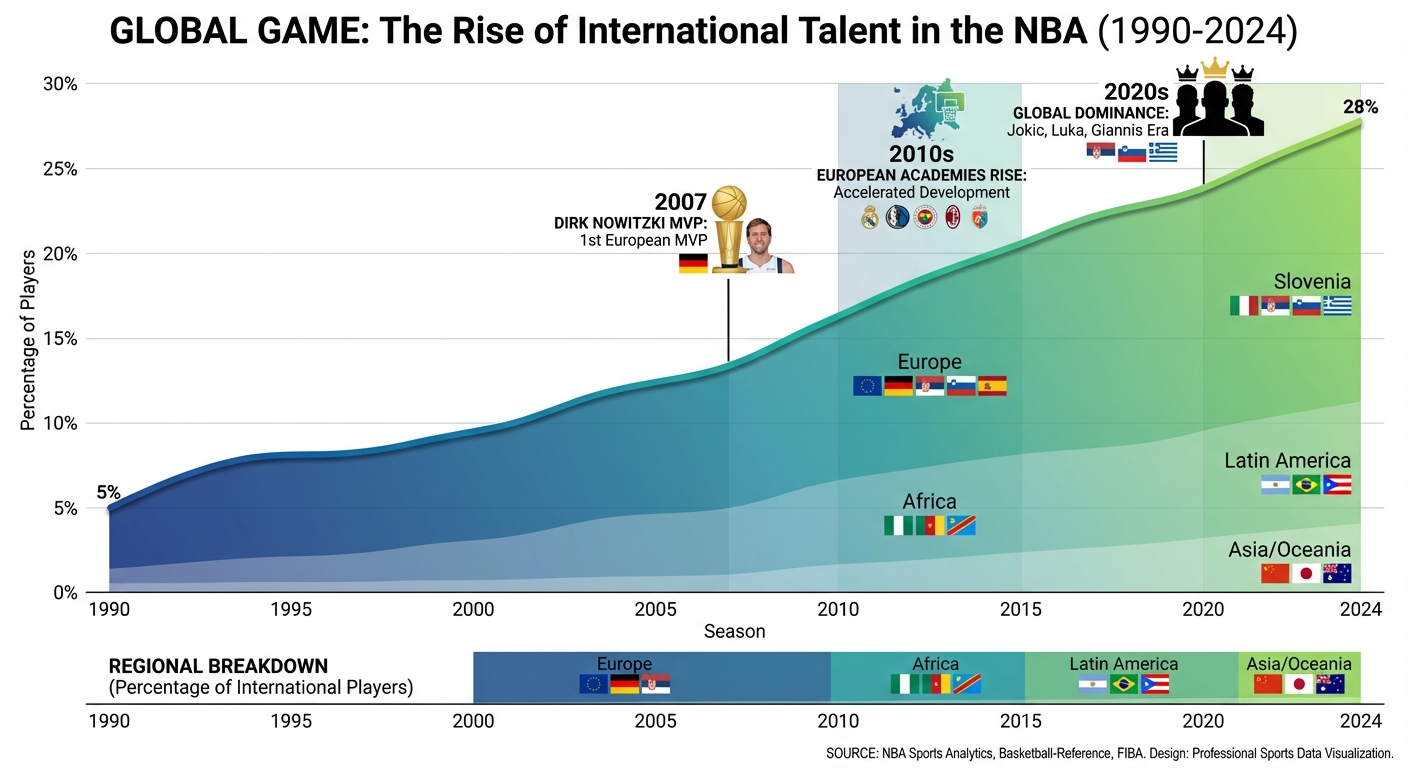
The league is now genuinely global, airing in over 200 countries. Kids in Serbia, Greece, France, and Germany grow up dreaming of the NBA just like American kids do. This influx of talent has raised the floor of the entire league, making it more competitive and exciting. The 2025 NBA draft is projected to have at least seven international players in the lottery.
American basketball will eventually adapt, it always does. But for the foreseeable future, the future of the NBA is being forged in European academies, not American gyms. The league’s top talent increasingly speaks with accents, plays with team-first mentality, and learned basketball the European way.
The Bottom Line
The NBA’s European takeover is complete. Five of the ten best players are European, and the development pipeline suggests this trend will continue. American basketball will need to rethink how it develops talent if it wants to reclaim dominance. For now, the best basketball in the world is being taught in Ljubljana, Belgrade, and Athens, not Los Angeles or New York. For more on international sports trends, check out cricket’s global expansion and the Saudi World Cup bid.
Sources: NBA roster data, European basketball academies, sports development research.