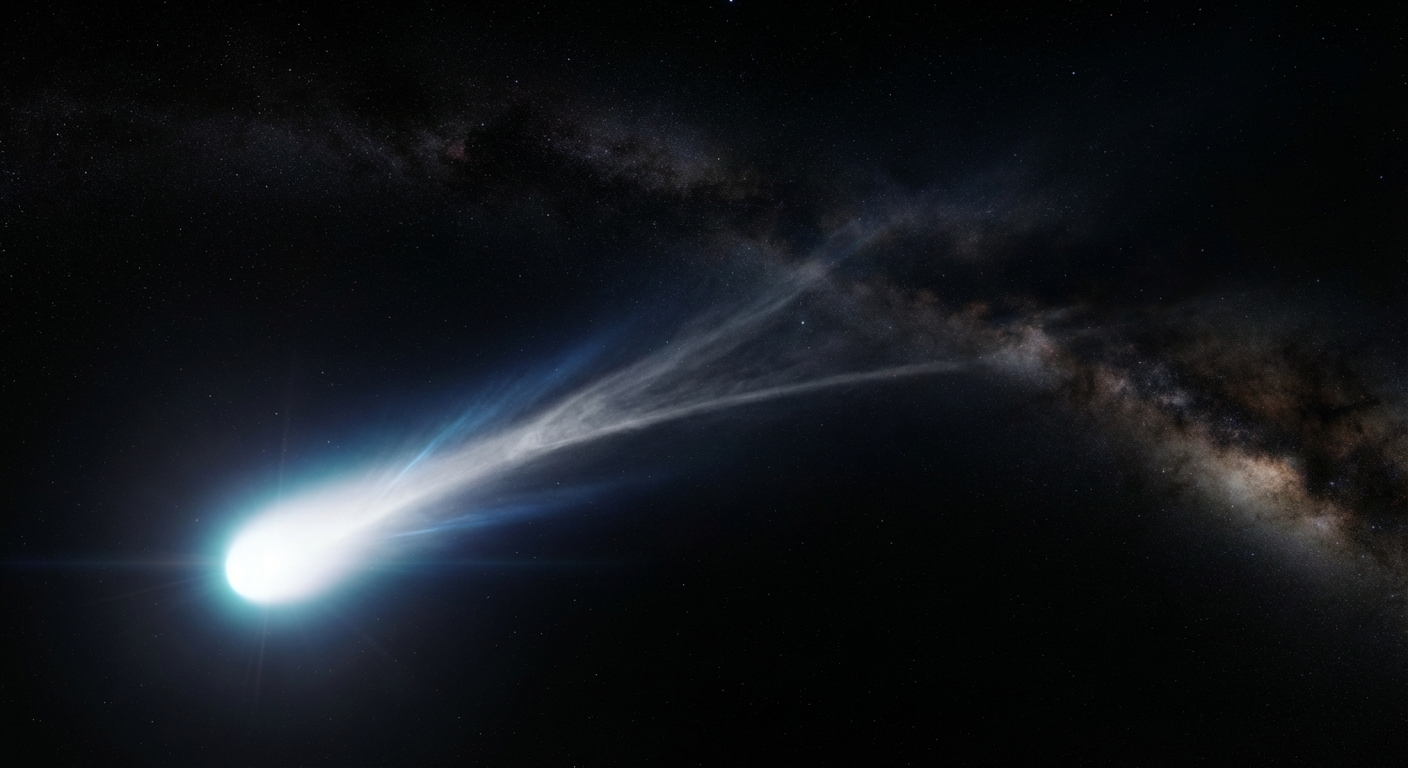
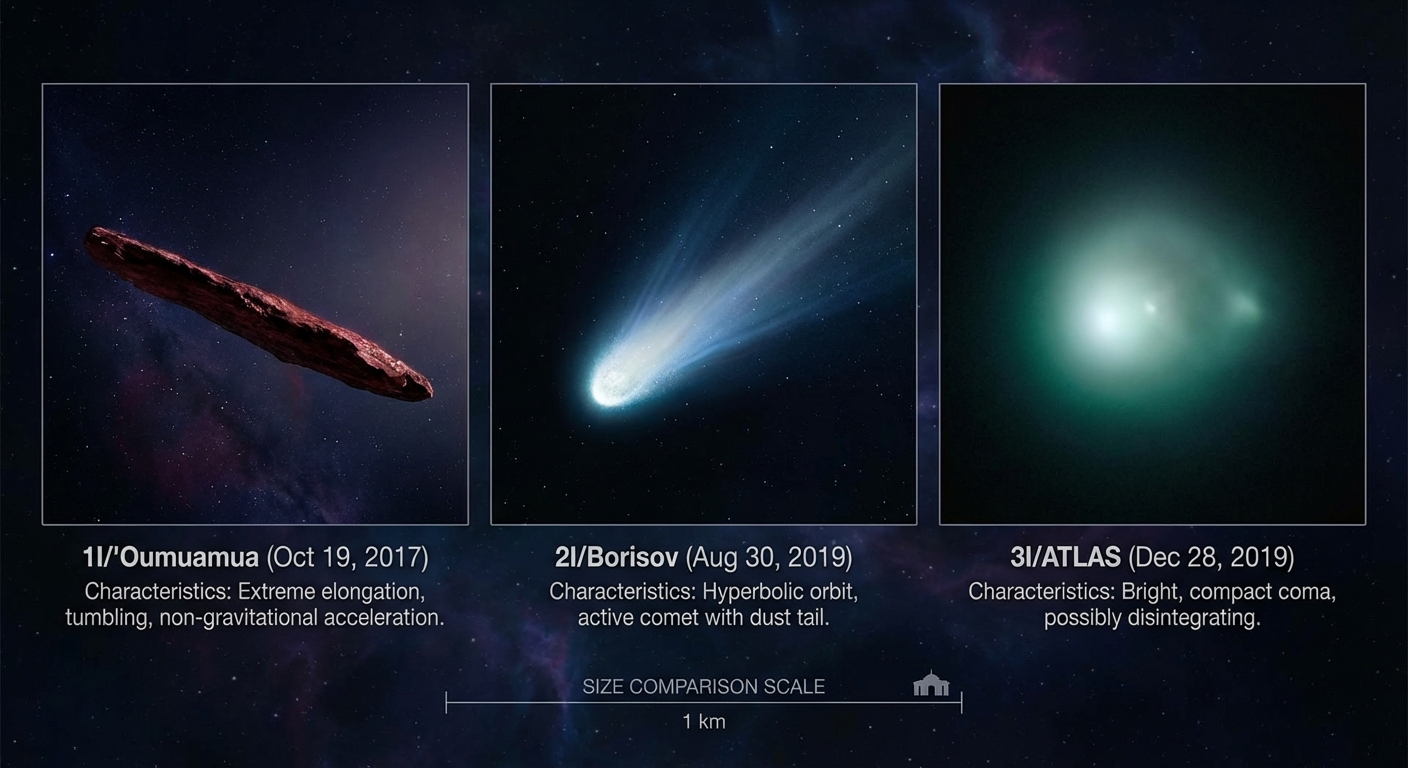
Something from another star system flew past Earth today, and it’s already teaching scientists things they didn’t expect. Interstellar comet 3I/ATLAS reached its closest approach to our planet at 1 a.m. EST this morning, passing within 168 million miles of Earth as it continues its one-way journey out of the solar system. This is only the third confirmed visitor from interstellar space, after 2017’s mysterious ‘Oumuamua and 2019’s 2I/Borisov, and scientists have deployed an unprecedented array of telescopes and spacecraft to study it before it’s gone forever.
The comet’s composition is already proving stranger than expected. Early measurements reveal unusually high levels of carbon dioxide, hydrogen cyanide, methanol, and peculiar concentrations of nickel and iron that don’t match any comet scientists have studied before. Whatever star system forged this object, it was nothing like our own.
What We’re Looking At
First spotted on July 1, 2025, by the ATLAS survey telescope in South Africa, 3I/ATLAS initially looked like an ordinary comet. But its trajectory told a different story. The object is moving too fast and at the wrong angle to have originated anywhere in our solar system. It came from interstellar space, made its closest approach to the sun in October, and is now looping outward toward the cosmic void from which it came.
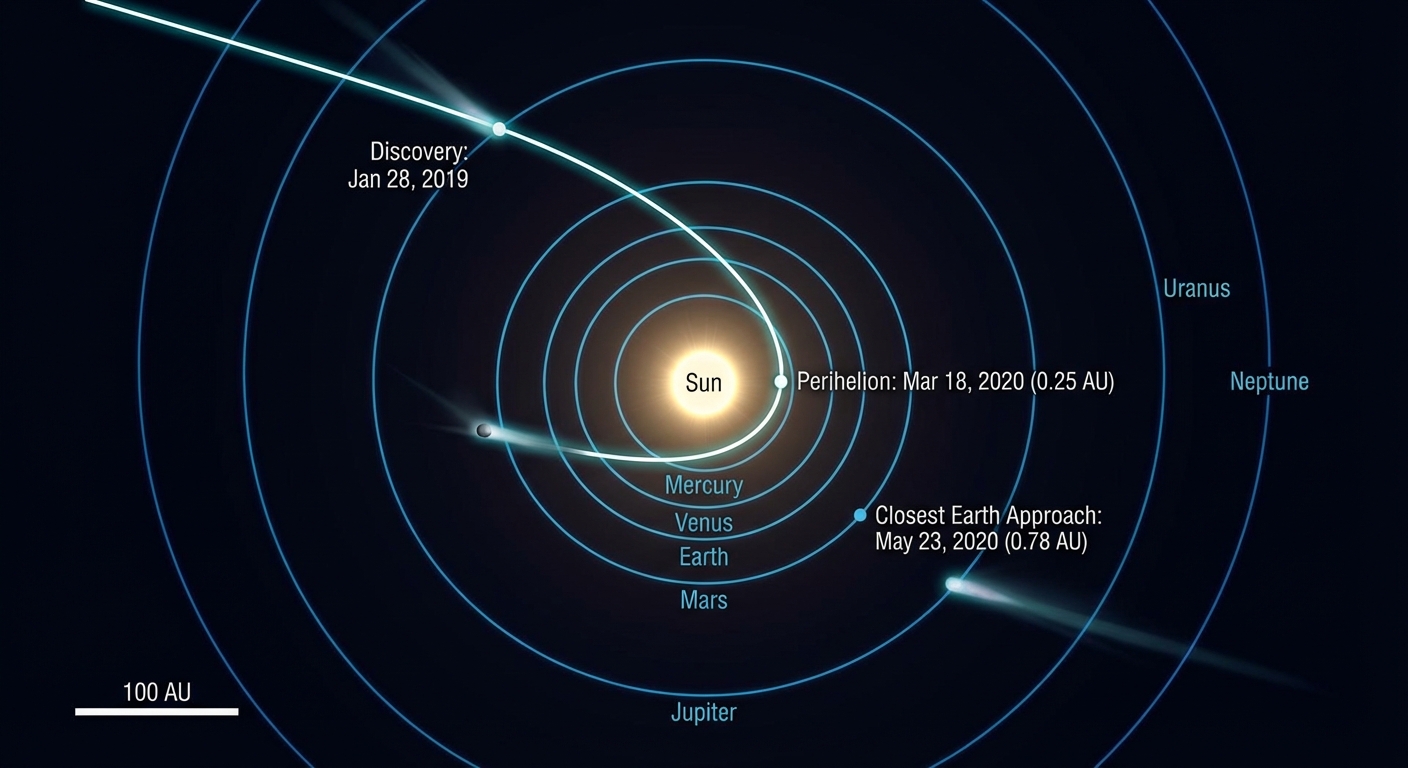
According to NASA’s Jet Propulsion Laboratory, the comet passed closest to Earth at 0600 GMT, maintaining a distance of about 270 million kilometers. For comparison, Mars is typically around 225 million kilometers away at its closest, so this wasn’t exactly a close shave. But for an object traveling between stars, it’s remarkably nearby, close enough for detailed study with modern instruments.
Unlike ‘Oumuamua, which baffled scientists with its elongated shape and lack of visible outgassing, 3I/ATLAS behaves more like a traditional comet. It has a visible coma, the fuzzy envelope of gas and dust surrounding its nucleus, and a discernible tail. That makes it far easier to study, and scientists have been taking full advantage.
The Arsenal Pointed at the Sky
NASA has mobilized an extraordinary collection of space assets for this cosmic visitor, a testament to the agency’s capabilities even as private space companies like SpaceX reach record valuations. The agency’s list of observatories studying 3I/ATLAS reads like a who’s who of space science: Hubble, James Webb, the Transiting Exoplanet Survey Satellite (TESS), the Swift gamma-ray observatory, and the newly launched SPHEREx infrared telescope. Even the Perseverance Mars rover has been drafted into service, along with orbital assets at Mars including MRO and MAVEN.
Perhaps the most surprising observer is Europa Clipper, NASA’s Jupiter-bound spacecraft that launched in October 2024. According to Space.com, the spacecraft used its Ultraviolet Spectrograph to study the comet on November 6, during a window when ground-based telescopes couldn’t get a good view due to the comet’s position relative to the sun.
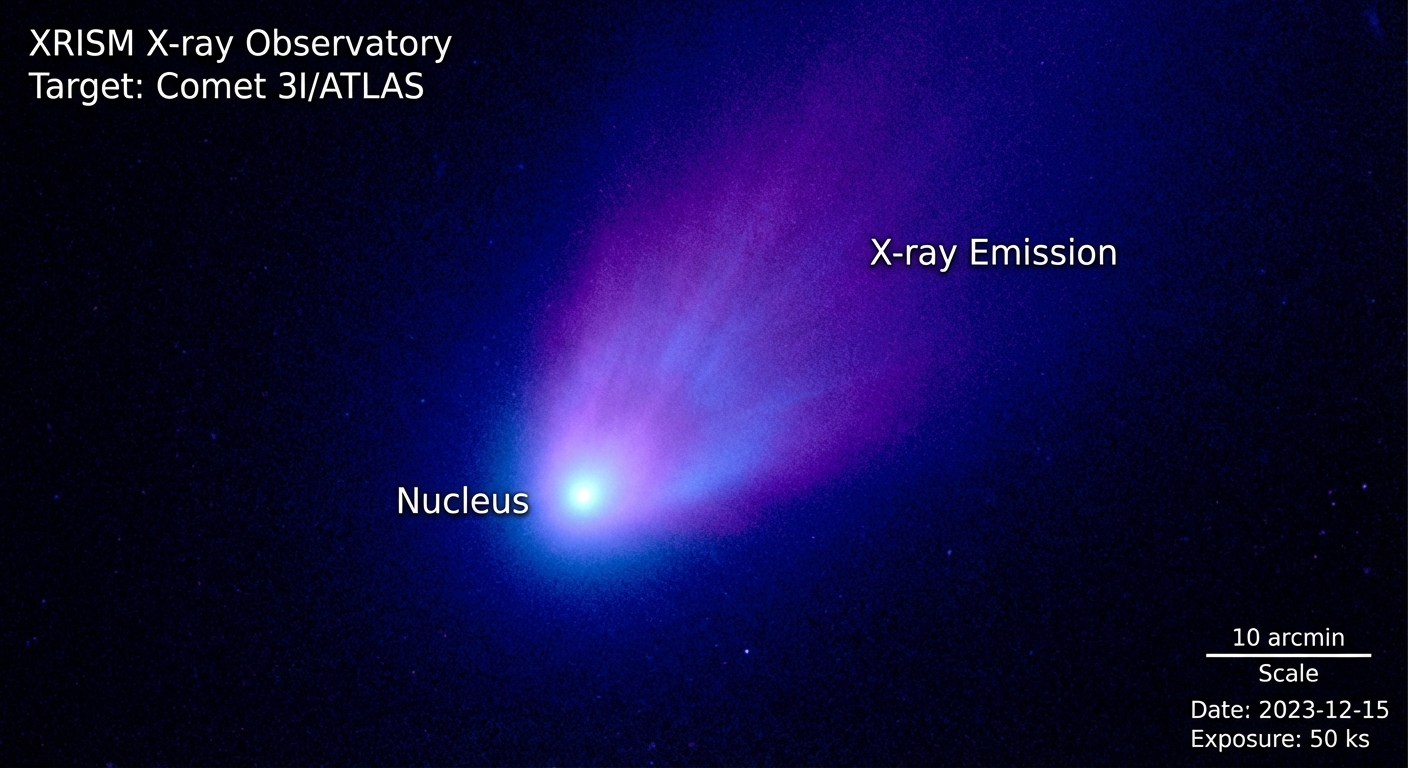
Japan’s X-Ray Imaging and Spectroscopy Mission (XRISM) observed the comet for 17 hours in late November, as reported by CNN, capturing X-rays emanating from a region extending 248,000 miles from the nucleus. The European Space Agency’s XMM-Newton X-ray observatory added another 20 hours of observations in early December. X-ray data is particularly valuable because it reveals information about how the comet interacts with the solar wind.
A Recipe From Another Kitchen
The chemical composition of 3I/ATLAS is where things get genuinely strange. According to researchers quoted by Science Alert, the comet began outgassing carbon dioxide much earlier in its approach to the sun than solar system comets typically do, suggesting its outer layers contain more volatile ices than we’re used to seeing.
Beyond the early CO2 activity, spectroscopic measurements have detected unusually large amounts of hydrogen cyanide and methanol in the coma. These molecules exist in our solar system’s comets, but not in the proportions observed here. Then there’s the nickel and iron content, which researchers described as indicating a “potentially extreme composition” unlike anything in our celestial neighborhood.
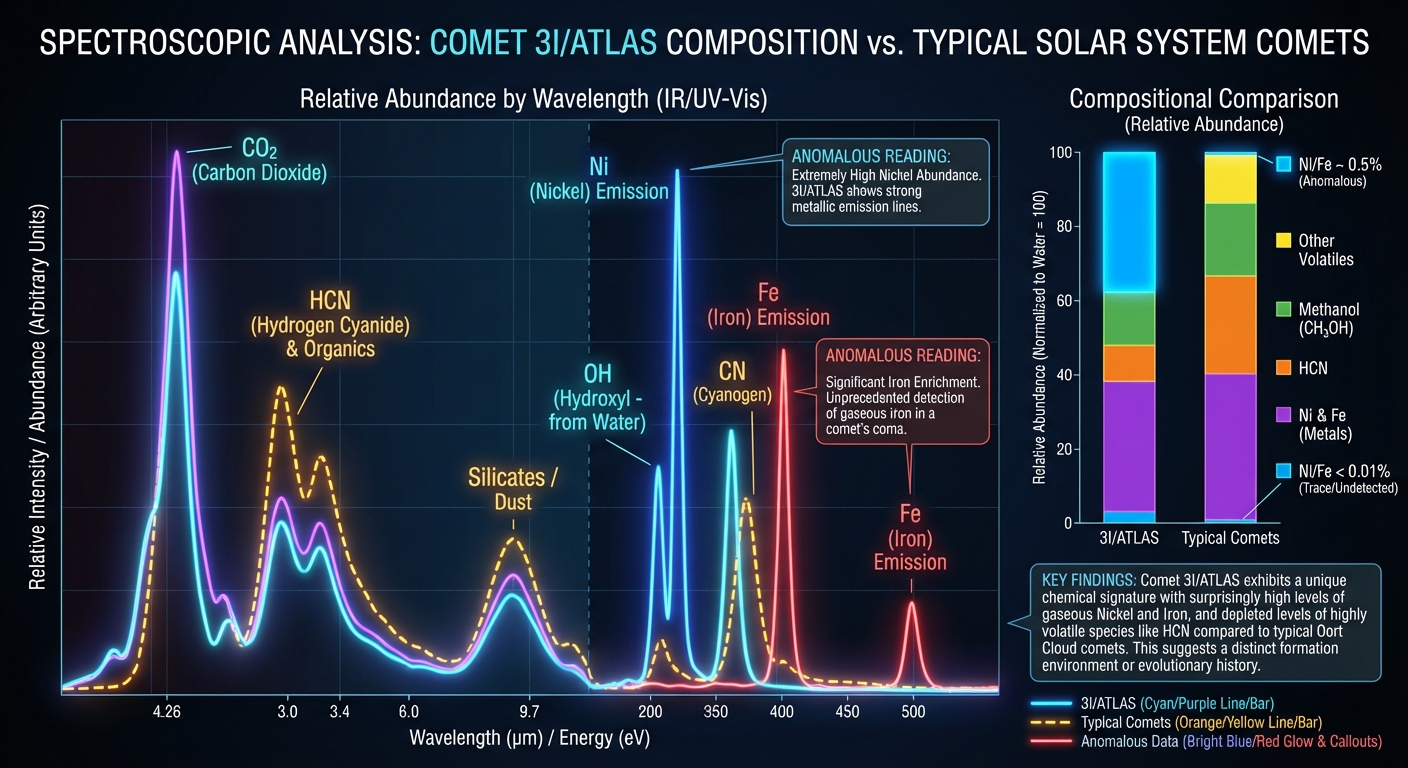
What does this tell us? Comets are essentially frozen time capsules, preserving the conditions of their formation billions of years ago. A comet from another star system offers a sample of how other planetary systems were built. The unusual chemistry of 3I/ATLAS suggests that wherever it came from, the protoplanetary disk that formed its parent star was significantly different from the cloud of gas and dust that became our solar system.
Scientists are particularly interested in comparing these findings to 2I/Borisov, the second interstellar comet discovered in 2019. That object showed a more familiar composition, leading some researchers to wonder if our solar system’s chemistry is typical or unusual among stars. Two data points aren’t enough to draw firm conclusions, but they’re two more than we had a decade ago.
A Brief Visit From Forever
Once 3I/ATLAS leaves, it’s never coming back. The comet is on a hyperbolic trajectory, meaning it has more than enough velocity to escape the sun’s gravitational pull entirely. It will cross Jupiter’s orbit in 2026 and pass Pluto’s distance from the sun in 2029, after which it will continue into the darkness between stars, likely for billions of years before encountering another stellar system.
This permanence is what makes the current observation campaign so urgent. Unlike periodic comets that return on predictable schedules, giving scientists multiple chances to improve their measurements, interstellar visitors offer exactly one opportunity. Everything we’ll ever learn about 3I/ATLAS from direct observation must be learned in the coming months as it recedes from view.
The good news is that the comet will remain visible to powerful telescopes for several more months, according to NASA, giving researchers time to conduct follow-up observations. Ground-based observatories will continue tracking it as it fades, and space telescopes may gather additional data through early 2026.
What It All Means
The discovery of three interstellar objects in less than a decade suggests these visitors may be far more common than astronomers previously believed. Before ‘Oumuamua in 2017, scientists had never confirmed an object from beyond our solar system, leading some to wonder if such visitors were extremely rare. Now the question is shifting to how many we’ve been missing. The advances in detection technology, including contributions from private space ventures reaching new heights, are helping answer that question.
Upcoming surveys like the Vera C. Rubin Observatory, expected to begin operations soon with its powerful Large Synoptic Survey Telescope, should dramatically increase detection rates. Some estimates suggest the observatory could find one new interstellar object per year or even more. If that proves accurate, the current sprint to study 3I/ATLAS could become a regular occurrence, with each new visitor offering another sample of the galaxy’s chemical diversity.
For now, scientists are making the most of this particular opportunity. Data from the coordinated observation campaign will take months or years to fully analyze, and the findings will likely spark new questions about how planetary systems form around other stars. The comet itself is already departing, but the science it enables is just beginning.
The Bottom Line
An object formed around another star is flying past Earth right now, and we’re watching it with nearly every capable telescope in the solar system. Interstellar comet 3I/ATLAS represents humanity’s third confirmed glimpse of material from beyond our cosmic neighborhood, and its unusual chemistry is already challenging assumptions about what we might find out there.
The comet will remain observable for several months as it recedes, but this is the closest it will ever get to our planet. Once it crosses Pluto’s orbit in 2029, it will become too faint to study from Earth, continuing on a journey that began before our solar system existed and will continue long after our sun burns out. For a few brief months, we get to watch it pass, and that’s more than any previous generation could say.
Sources: NASA Science, Space.com, CNN, Science Alert, Live Science, Virtual Telescope Project.