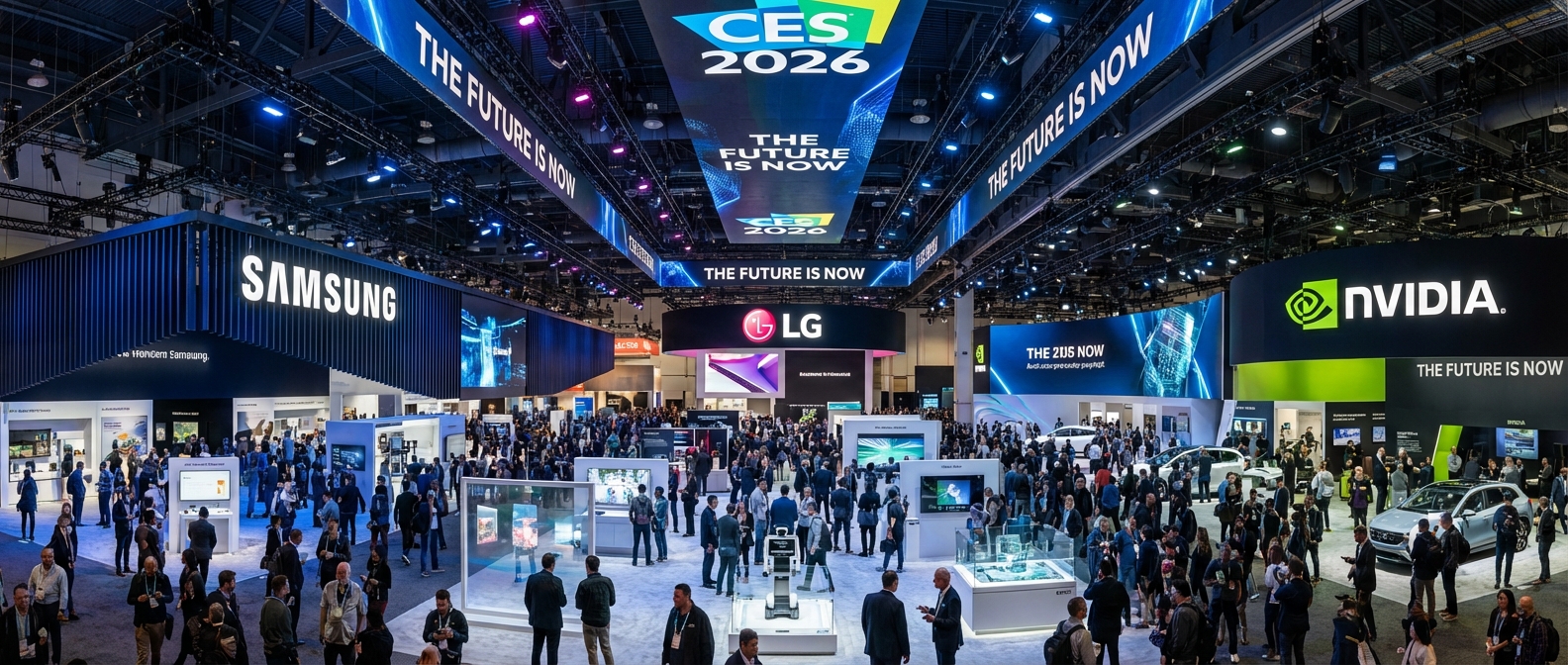
The annual tech pilgrimage to Las Vegas is in full swing, and CES 2026 is delivering exactly what the industry needed: actual products people might want to buy, not just concept cars that will never exist and NFT integrations that nobody asked for. From chips to televisions to robots that can finally fold your laundry, this year’s show marks a return to practical innovation.
The big three chip companies came out swinging on day one. Nvidia unveiled its next-generation Vera Rubin architecture ahead of schedule. AMD announced its latest Ryzen processors. Intel made its Core Ultra Series 3 products available immediately. But the real story isn’t any single announcement. It’s the collective signal that the AI hardware race has entered a new phase, one where companies are shipping products rather than promising futures.
Beyond semiconductors, the show floor reveals where consumer technology is actually heading. Televisions are getting both thinner and more expensive. Home robots are finally approaching usefulness. And Wi-Fi 8 routers are already on display despite the underlying standard not being finalized until 2028. Welcome to CES, where the future arrives two years early and costs twice what you expected.
Nvidia’s Vera Rubin: The AI Chip Everyone Wants
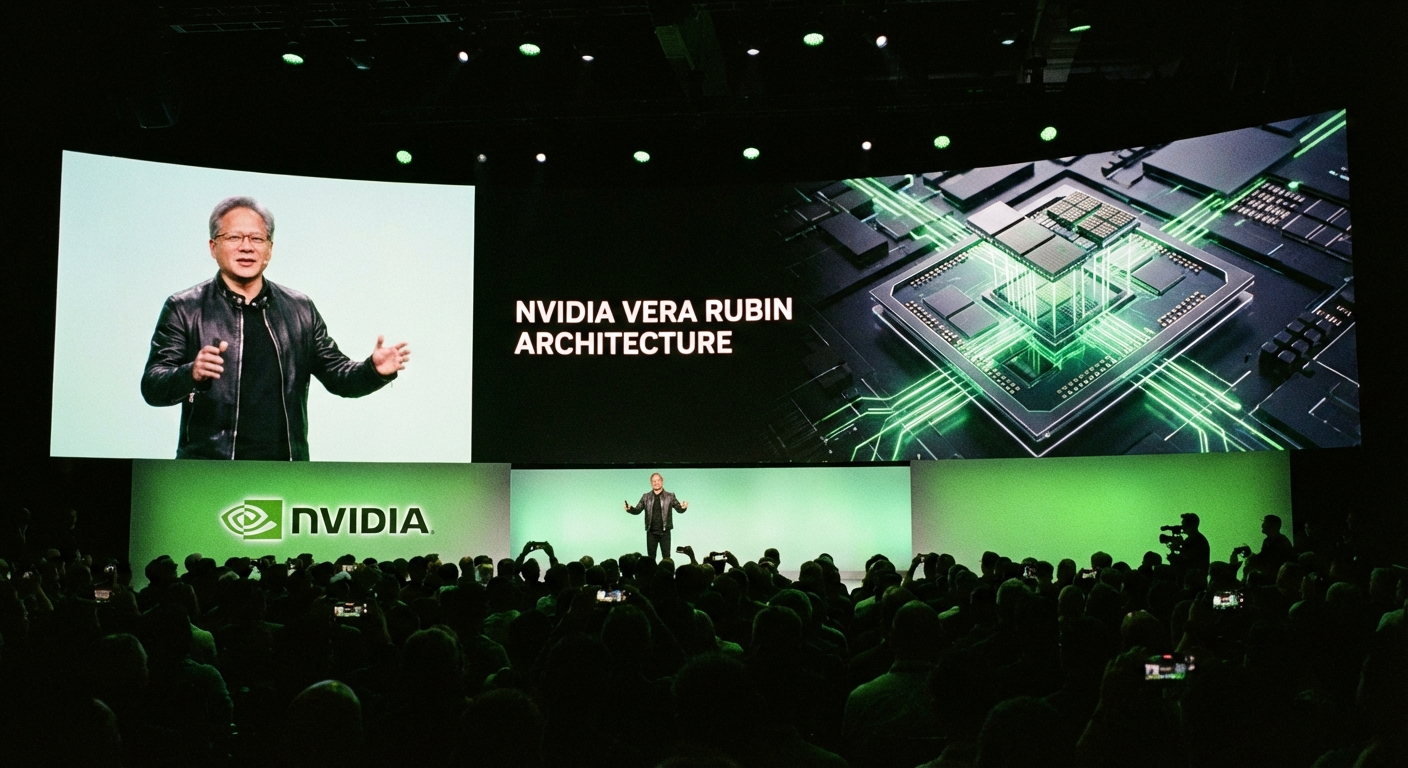
Jensen Huang took the stage in his trademark leather jacket to unveil something that matters far beyond gaming: the Vera Rubin architecture, Nvidia’s next-generation platform for AI computing. Named after the astronomer who discovered dark matter, the architecture promises to push AI capabilities into territory that was purely theoretical just two years ago.
The timing of the announcement caught industry watchers off guard. Vera Rubin wasn’t expected until late 2026 at the earliest, but Nvidia has accelerated its production timeline in response to overwhelming demand from cloud providers and AI labs. Amazon, Microsoft, and Google have reportedly placed orders worth billions of dollars for the new chips.
What makes Vera Rubin special is its approach to memory and processing integration. Previous Nvidia architectures separated computing and memory, creating bottlenecks that limited how quickly AI models could learn and respond. The new design embeds memory directly alongside processing units, reducing the distance data needs to travel and dramatically improving efficiency.
Nvidia also unveiled Alpamayo, a collection of open-source reasoning models specifically designed for autonomous vehicles. The models help self-driving systems handle edge cases, those rare but critical scenarios where standard algorithms struggle. A car approaching an intersection where a traffic light is malfunctioning, for instance, or navigating around a construction zone with confusing signage. These are the situations where human judgment currently outperforms AI, and Nvidia is betting that better models can close the gap.
The Television Wars Heat Up
If you thought your television was already big enough and thin enough, Samsung and LG would like to respectfully disagree. Both companies used CES 2026 to showcase displays that push the boundaries of what’s physically possible.
Samsung’s headline act is the Micro RGB 130-inch television, which won the CES Innovation Awards Best of Innovation distinction. The technology represents a fundamental shift from OLED, using microscopic LED elements that emit their own light without requiring an organic layer that can degrade over time. The result is brighter images, better color accuracy, and theoretically unlimited lifespan. The downside is a price tag that starts well into six figures.
LG took a different approach, rebooting its popular wallpaper-style television concept with AI capabilities. The new display is just 9 millimeters thick, designed to mount completely flush against a wall and blend with home decor. What makes this iteration interesting is its AI-powered art mode, which allows users to create and display custom artwork generated by the television itself. Tell the TV you want “a sunset over mountains in the style of Monet,” and it will generate the image and display it until you ask for something else.
Both companies are also pushing hard on MicroRGB technology for more mainstream screen sizes. Expect 65-inch and 75-inch versions to appear later this year at prices that, while still premium, won’t require a second mortgage. The technology’s advantages over OLED, particularly in brightness and longevity, make it a likely successor for high-end televisions once manufacturing costs come down.
Robots That Actually Do Things
For years, home robots at CES have been more concept than product. Cute companions that can tell you the weather and play music, perhaps, but nothing that would actually reduce the time you spend on household chores. That era appears to be ending.
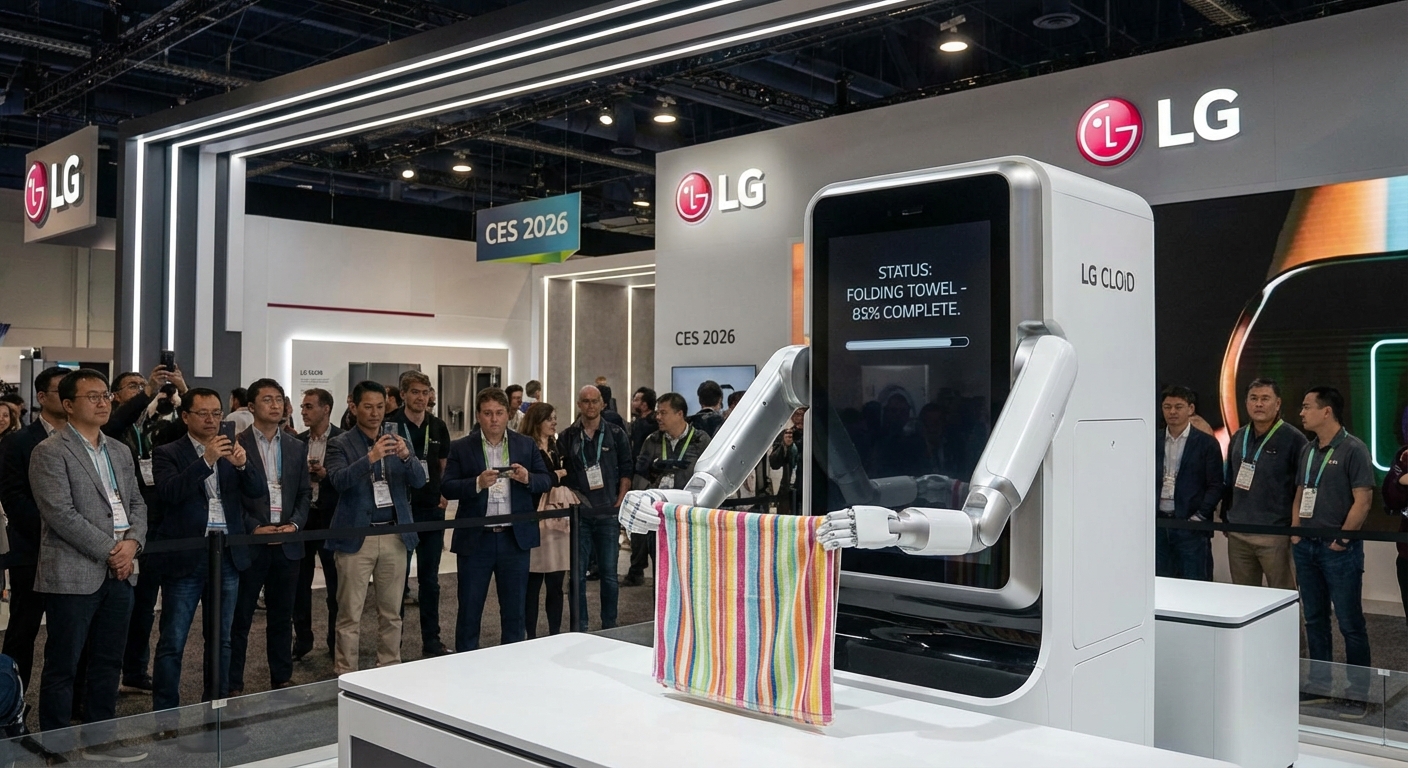
LG unveiled CLOiD, its first AI-powered home robot designed for actual utility. The robot uses advanced computer vision and manipulation capabilities to tackle tasks that have historically defeated automated systems: folding laundry, loading dishwashers, and performing basic food preparation. A demonstration showed CLOiD successfully folding a basket of towels with minimal human intervention.
The laundry-folding capability matters because it’s been a benchmark problem in robotics for years. Clothes are deformable objects with unpredictable shapes, making them far harder for robots to handle than rigid items. A robot that can reliably fold laundry has the foundational capabilities to perform many other household tasks.
Hyundai brought out a production version of Boston Dynamics’ Atlas robot, the humanoid that has captivated YouTube viewers with its backflips and parkour moves. The production model is less flashy but more practical, designed for warehouse and logistics applications. It can lift heavy items, navigate uneven terrain, and work alongside human employees. The company suggests pricing in the low six figures, positioning it as industrial equipment rather than a consumer product.
The Autonomous Vehicle Update
Ford’s announcement may be the most significant for everyday consumers, even if it won’t arrive until 2028. The company revealed plans to offer Level 3 autonomous driving capability on a mass-market electric vehicle priced at $30,000.
Level 3 autonomy represents a meaningful milestone. Unlike current driver-assistance systems that require constant driver attention, Level 3 allows you to take your eyes off the road entirely under certain conditions. The car handles all driving tasks, and you can read a book, check email, or simply zone out until the system requests you take over.
The catch is that Level 3 systems typically work only in specific scenarios, usually highway driving at moderate speeds in good weather. City driving, with its pedestrians, cyclists, and unpredictable traffic, remains beyond the current state of the art for most systems. But even highway-only autonomy would transform long-distance travel, eliminating the fatigue of hours behind the wheel.
Ford’s aggressive pricing is notable. Tesla has long promised affordable full self-driving but has yet to deliver either the technology or the price point. Mercedes-Benz offers Level 3 on some vehicles, but only in expensive models. A $30,000 EV with genuine hands-free highway driving could be the first truly mainstream autonomous vehicle.
The technology will be built on Ford’s new Universal EV platform, which the company designed specifically to accommodate the sensors and computing power that autonomy requires. By integrating these capabilities from the start rather than adding them to existing vehicle designs, Ford hopes to achieve both better performance and lower costs.
Connectivity Gets Faster (Again)
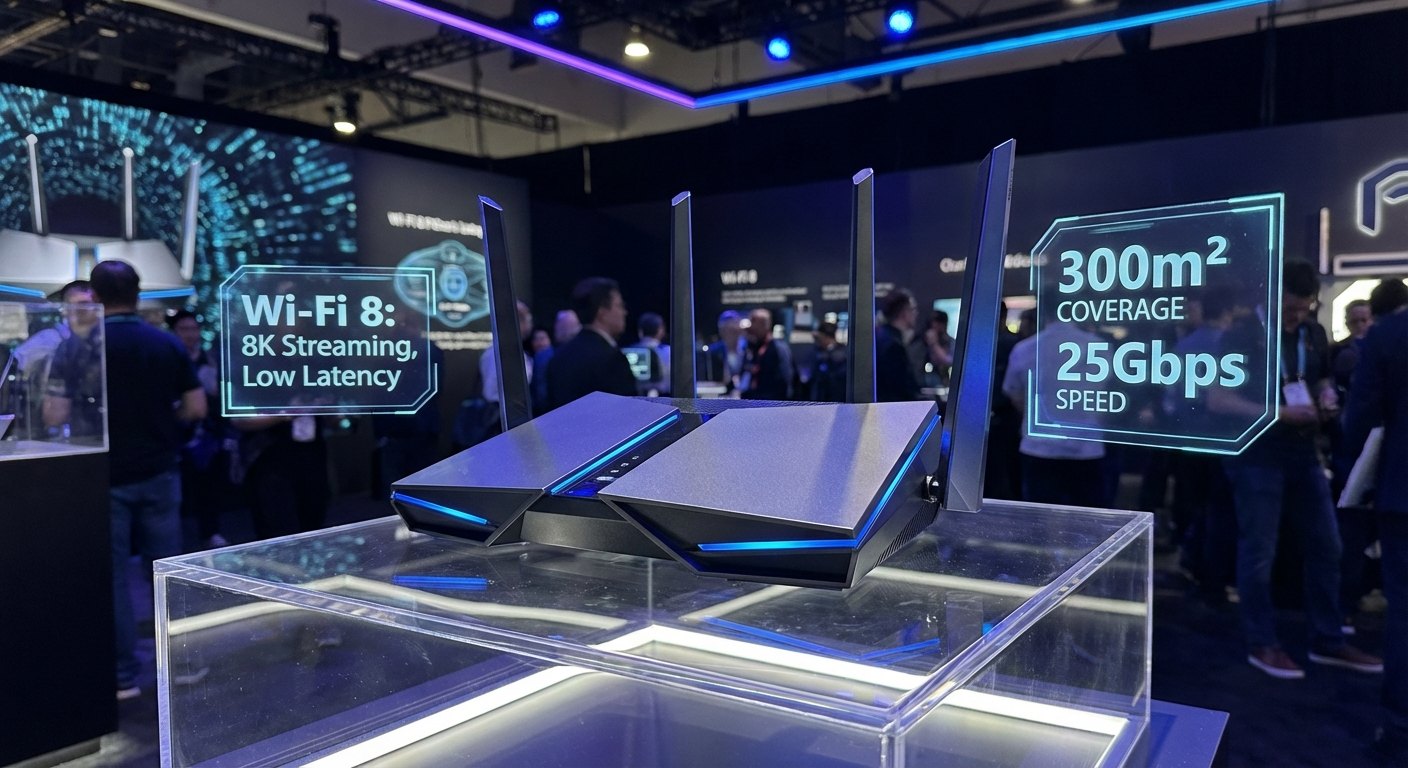
Just when you thought Wi-Fi was fast enough, CES 2026 arrives with Wi-Fi 8 routers from Asus, Broadcom, and MediaTek. The technology promises speeds exceeding 30 gigabits per second and significantly improved performance in homes with many connected devices.
There’s an asterisk here, of course. The IEEE 802.11bn standard that defines Wi-Fi 8 won’t be fully ratified until late 2028. The routers being shown at CES implement draft versions of the standard, which could change before finalization. Buying a Wi-Fi 8 router today is essentially a bet that the final standard will remain compatible with current implementations.
For most consumers, there’s no rush to upgrade. Current Wi-Fi 6E and Wi-Fi 7 equipment provides more bandwidth than typical home internet connections can deliver. The benefits of Wi-Fi 8 will be most apparent in environments with dozens or hundreds of connected devices, where the improved efficiency and spectrum management can make a meaningful difference.
Qualcomm also announced the Snapdragon X2 Plus chipset, designed for next-generation Windows laptops. The chip features a 10-core Oryon CPU, updated Adreno GPU, and built-in Wi-Fi 7 support. It represents Qualcomm’s continued push to compete with Apple’s M-series chips in performance and power efficiency. Laptops using the new chip should appear later this year.
The Quirky Stuff
No CES would be complete without products that make you wonder whether engineers ever spoke to an actual human being before starting development. This year’s crop doesn’t disappoint.
The Sweekar AI pet is perhaps the strangest concept: a robotic companion that physically grows over time as you interact with it. The more you play with it, talk to it, and keep it company, the larger it becomes. The metaphor for nurturing relationships is touching. The practical implications of a robot that takes up increasing space in your home are less so.
Lego announced its biggest change in 50 years with Smart Brick technology. The new bricks include embedded sensors and connectivity that allow them to interact with companion apps and other smart home devices. Build a castle, and the app can tell you stories about its inhabitants. Build a car, and you can control it from your phone. Whether this enhances the classic Lego experience or distracts from it depends on your perspective.
Dell, meanwhile, is bringing back the XPS brand after its confusing pivot to “Premium” branding that pleased approximately nobody. The new XPS laptops feature the latest Intel and AMD processors and return to the design language that made the line popular. Sometimes the best innovation is admitting a mistake and returning to what worked.
The Bottom Line
CES 2026 represents a maturation of technologies that have been developing for years. AI isn’t just a buzzword anymore; it’s appearing in actual products that solve actual problems. Autonomous vehicles are moving from demos to production timelines. Home robots are finally starting to justify their existence.
The show also reflects the growing importance of AI infrastructure. Nvidia’s Vera Rubin announcement dominated the conversation not because consumers will buy these chips directly, but because they’ll power the services and products that consumers will use. The AI race has moved from research labs to data centers, and the companies that can deliver the most capable hardware will shape the technology landscape for the rest of the decade.
For consumers, the practical implications are straightforward. If you’re in the market for a new television, the technology has never been better, though prices remain high for cutting-edge displays. If you’re hoping for a robot to do your chores, realistic options are finally approaching. If you’re considering an electric vehicle, waiting for the 2028 model year might be worth it.
And if you’re an investor watching the chip wars unfold, CES 2026 made clear that the competition is only intensifying. Nvidia, AMD, and Intel are all shipping products, not promises. The winners will be determined not by keynotes but by execution.
Sources
- Business Insider: Here Are the Biggest Announcements Coming Out of CES 2026 in Las Vegas
- The Verge: What surprised us the most at CES 2026
- Tom’s Guide: Best of CES 2026 Awards
- Engadget: Everything announced at CES 2026
- Samsung Newsroom: Inside Samsung’s The First Look 2026
- AP News: The coolest technology from Day 1 of CES 2026