

You're standing in the shower, thinking about absolutely nothing in particular, when it hits you. The solution to the problem you've been grinding on for three days. The perfect opening line for the email you've been drafting in your head. The realization that the project you've been forcing isn't working because you've been solving the wrong problem entirely.
You grab a towel, scramble for your phone, and try to capture it before it vanishes. And you wonder: why does this keep happening? Why do the best ideas arrive when you're not even trying?
The answer isn't some quirk of plumbing. It's neuroscience. And understanding it might change how you think about thinking itself.
Your Brain's Hidden Workshop
In 2001, neurologist Dr. Marcus Raichle at Washington University made a discovery that shifted our understanding of the brain. While studying brain scans, he noticed something unexpected: when people weren't doing anything, when they were resting between tasks with no instructions, specific brain regions became more active, not less.
He called this the default mode network, or DMN. It's a constellation of brain areas that light up when you're daydreaming, reminiscing, imagining the future, or just staring out the window. For years, neuroscientists had treated this "resting state" activity as noise, something to filter out of the data. Raichle realized it was the signal.
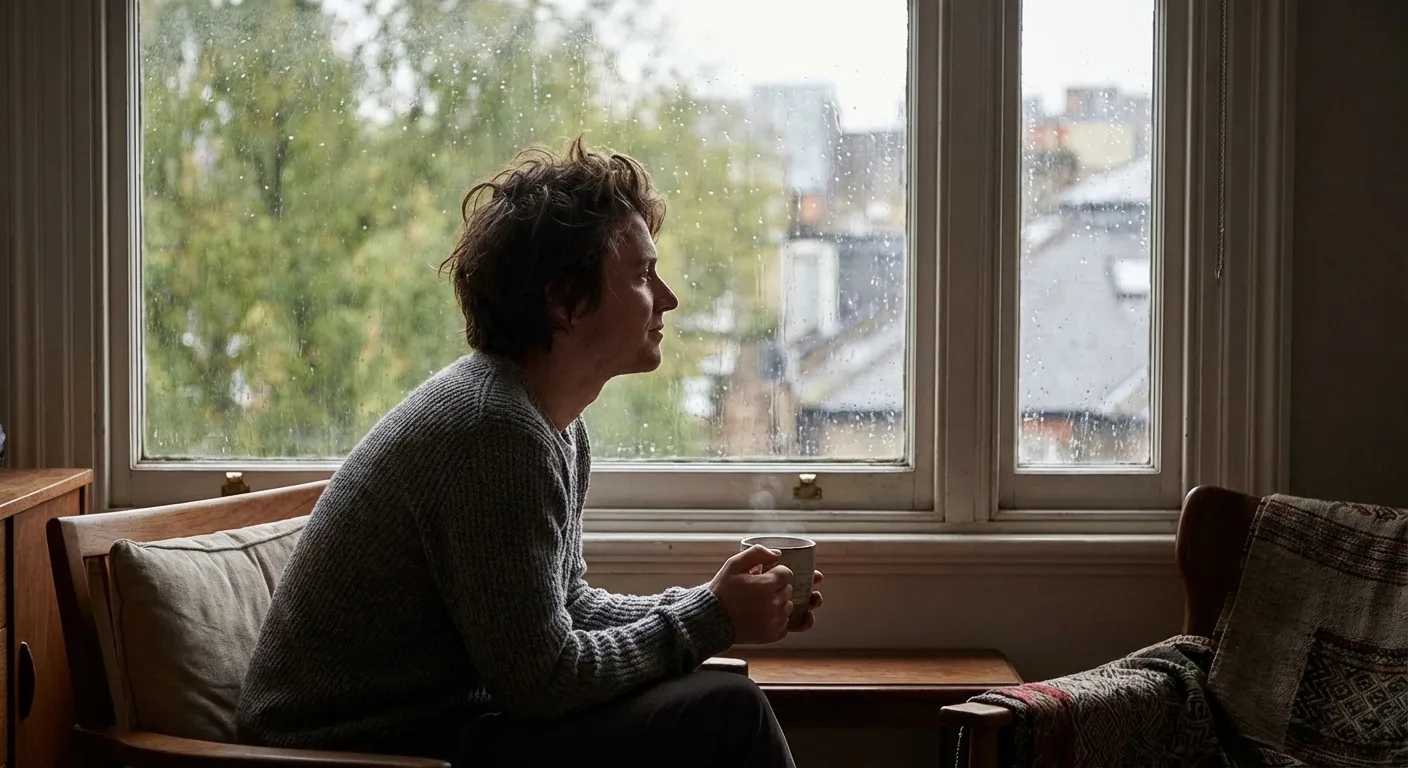
The default mode network turns out to be your brain's backstage crew. While your conscious mind clocks out, the DMN starts connecting dots that your focused attention would never link. It pulls from memory, emotion, and imagination simultaneously, running loose associations across vast neural territory. This is why solutions appear in the shower, on walks, or in that drowsy space before sleep. You haven't stopped thinking. You've switched to a different kind of thinking, one that's slower, wider, and far more creative than the linear problem-solving your prefrontal cortex does during focused work.
Dr. Kalina Christoff, a neuroscientist at the University of British Columbia who has studied mind-wandering for over fifteen years, describes it this way: "Mind-wandering is not the absence of thought. It's thought in its most unconstrained, exploratory form." Her research shows that the DMN doesn't just replay the past or fantasize about the future. It actively recombines information in novel ways, which is the cognitive foundation of creativity.
Why Focus Isn't Always the Answer
Here's the paradox that most productivity advice misses entirely: trying harder often makes creative problems worse.
Psychologist Ap Dijksterhuis at Radboud University demonstrated this through a series of experiments on what he calls Unconscious Thought Theory. In one study, participants faced a complex decision, choosing the best apartment from several options with many attributes. Those who were given time to consciously deliberate performed worse than those who were distracted with an unrelated task before deciding. The distracted group, whose unconscious minds had been processing the information without deliberate effort, made objectively better choices.
The reason comes down to capacity. Your conscious, focused attention can hold roughly four to seven pieces of information at a time. For simple problems, that's plenty. But for complex, multi-variable challenges, the kind that involve trade-offs, creative leaps, and connecting disparate ideas, your working memory hits a wall. The default mode network doesn't have the same bottleneck. It processes in parallel, weaving together far more strands of information than conscious thought can manage.
This doesn't mean focus is useless. Far from it. The research consistently shows that creative insight follows a specific sequence: immersion first, then incubation. You need the focused phase where you deeply engage with the problem, absorb the constraints, and wrestle with possibilities. But then you need to let go. The shower insight doesn't come from nowhere. It comes from your unconscious mind continuing the work your conscious mind started.
Mathematician Henri Poincare described this rhythm over a century ago, long before brain scanners confirmed it. He noticed that his breakthroughs came after periods of intense work followed by rest, during walks, on omnibus rides, or while falling asleep. Modern neuroscience has validated his intuition: the creative process alternates between focused engagement and unfocused incubation, and both phases are essential.

The Incubation Effect in Practice
If unfocused thinking is so valuable, why do we spend so much energy fighting it?
Partly because our culture equates busyness with worth. Partly because staring out the window looks unproductive, even when it's the most productive thing you could be doing. And partly because we've confused mindfulness with constant focus.
Here's what's interesting: mindfulness research actually supports strategic mind-wandering. Dr. Jonathan Schooler at UC Santa Barbara, who has studied both attention and mind-wandering extensively, draws a crucial distinction between two types of mental drift. "Mindless" mind-wandering, where you don't even realize you've drifted, tends to correlate with lower mood and reduced performance. But "mindful" mind-wandering, where you deliberately allow your thoughts to roam while maintaining a gentle awareness that you're doing so, correlates with creativity, future planning, and emotional processing.
This is where the micro-mindfulness practices you might already use become relevant in a new way. The ability to notice where your mind goes, without immediately dragging it back to the task, is itself a creative skill. It's the difference between a dog that's been let off the leash in an open field and a dog that's escaped and doesn't know it's free. Both are wandering, but only one is doing so productively.
A 2012 study published in Psychological Science made this tangible. Researchers gave participants a creative problem-solving task, then split them into four groups during a break: one did a demanding task, one did a simple, undemanding task, one rested quietly, and one had no break. The group that performed the simple, undemanding task, the kind of light activity that promotes mind-wandering, outperformed every other group on the creative task when they returned. Not the rest group. Not the hard-work group. The gentle, mind-wandering-friendly group.
Create Space for Unfocused Thinking
You don't need to overhaul your schedule to harness this. You need to stop filling every gap. Here's how to create conditions for the incubation effect in a world that demands constant attention.
Protect your transition moments. The walk to the car. The minutes before a meeting. The commute. These liminal spaces are prime incubation territory, but only if you don't reflexively fill them with podcasts, scrolling, or email. Try leaving your headphones off for one commute this week. Let the silence feel uncomfortable. Your default mode network will thank you.
Schedule "think about nothing" time. It sounds absurd, but if you don't protect unfocused time, it won't happen. Block 20 minutes after deep work sessions for a walk, a shower, or simply sitting with your coffee. This isn't laziness. It's the second half of the creative process, the part where the real synthesis happens.
Use the immersion-incubation cycle deliberately. When you're stuck on a problem, don't push harder. Instead, spend 45 minutes in focused engagement, then switch to something completely different: a physical task, a walk, a conversation about anything else. Neuroscientist Dr. Andrew Huberman describes this as "defocusing to refocus," a deliberate toggle between the brain's task-positive and default mode networks.
Keep a capture system close. Insights from mind-wandering are real but fragile. They emerge from loosely connected neural activation patterns that dissolve quickly without reinforcement. Keep a notes app, a pocket notebook, or a voice memo habit for those shower moments. The idea doesn't have to be fully formed. A few words are enough to reconstruct it later.
Distinguish productive wandering from avoidance. This isn't a license to scroll social media and call it creativity. Productive mind-wandering happens during low-stimulation activities: walking, showering, doing dishes, gardening. High-stimulation distractions, social media, news, video, actually suppress the default mode network by demanding attentional resources your unconscious mind needs.
The Shift
We live in a culture that treats every unfocused moment as wasted time, something to optimize away with another app, another podcast, another task crammed into the margins. But your brain wasn't built for constant focus. It was built to alternate between two modes of thinking, and we've been systematically starving the one that generates our most original ideas.
The next time you catch yourself staring out the window, resist the urge to snap back to "productivity." That unfocused moment isn't a failure of discipline. It's your brain doing exactly what it was designed to do: wandering toward something you haven't thought of yet.
Give it the space, and it usually finds what it's looking for.
Sources
- Raichle, M. E. (2015). The Brain's Default Mode Network. Annual Review of Neuroscience, 38, 433-447.
- Christoff, K., et al. (2009). Experience Sampling During fMRI Reveals Default Network and Executive System Contributions to Mind Wandering. Proceedings of the National Academy of Sciences, 106(21), 8719-8724.
- Dijksterhuis, A. (2004). Think Different: The Merits of Unconscious Thought in Preference Development and Decision Making. Journal of Personality and Social Psychology, 87(5), 586-598.
- Baird, B., et al. (2012). Inspired by Distraction: Mind Wandering Facilitates Creative Incubation. Psychological Science, 23(10), 1117-1122.
- Schooler, J. W., et al. (2011). Meta-awareness, Perceptual Decoupling and the Wandering Mind. Trends in Cognitive Sciences, 15(7), 319-326.