

The Federal Trade Commission isn't just looking at Microsoft anymore. It's actively building a case.
Over the past several weeks, the FTC has issued civil investigative demands to at least half a dozen companies that compete with Microsoft in business software and cloud computing, according to Bloomberg. These aren't casual check-ins. Civil investigative demands are formal legal instruments, the agency's equivalent of subpoenas, and they signal that the FTC has moved past the "is there something here?" phase into "we need evidence to act."
The questions center on how Microsoft bundles its products, how it prices cloud services for customers who try to leave, and whether its aggressive integration of AI tools like Copilot into Office 365 and Azure constitutes an unfair competitive advantage. If the probe reaches its logical conclusion, it could reshape how the most valuable company in the world does business.
What the FTC Is Actually Investigating
The investigation focuses on three interconnected areas where Microsoft's dominance compounds on itself.
First, there's cloud licensing. Microsoft controls roughly 25% of the global cloud infrastructure market through Azure, trailing only Amazon Web Services. But the FTC's concern isn't market share alone. Investigators are examining whether Microsoft makes it artificially expensive for enterprise customers to run Office 365 and other Microsoft products on competing cloud platforms. The practice, if proven, would mean companies are effectively penalized for choosing AWS or Google Cloud, not because those platforms are inferior, but because Microsoft's licensing terms make them more costly.

Second, there's product bundling. Microsoft has a long history of packaging products together, a strategy that dates back to the Internet Explorer battles of the late 1990s. Today, the bundling is more sophisticated. Office 365 subscriptions increasingly include Azure credits, AI-powered Copilot features, and security tools like Microsoft Defender. The FTC wants to know whether this bundling effectively forces enterprise customers deeper into the Microsoft ecosystem, making it harder for standalone competitors in security, identity management, and AI to compete on merit.
Third, and perhaps most consequential, there's the AI question. The FTC's 2024 civil investigative demand to Microsoft devoted roughly one-third of its questions to artificial intelligence, requesting data on model training costs, data center capacity challenges, and product licensing decisions dating back to 2016. The agency is particularly interested in Microsoft's $13 billion investment in OpenAI and whether that partnership gives Microsoft an unfair advantage in the rapidly growing enterprise AI market.
A Probe That Survived a Change in Administration
What makes this investigation noteworthy isn't just its scope. It's the fact that it has survived a presidential transition.
The probe was launched during the final phase of the Biden administration under former FTC Chair Lina Khan, who made Big Tech accountability a centerpiece of her tenure. When Khan departed and Andrew N. Ferguson took over as chair under the Trump administration, there was widespread speculation that Biden-era tech investigations would quietly wind down.

That hasn't happened. In March 2025, the FTC confirmed it would continue the Microsoft probe. The recent escalation, sending demands to Microsoft's competitors rather than just Microsoft itself, suggests the investigation is gaining momentum, not losing it.
This bipartisan continuity reflects a broader political reality: skepticism of Big Tech's market power is one of the few issues that crosses party lines in Washington. Republicans and Democrats may disagree on content moderation and social media regulation, but both parties have shown willingness to scrutinize how dominant platforms use bundling and licensing to maintain their positions. The Trump administration's own approach to big tech regulation, including targeted tariff exemptions for chip manufacturers, shows that the relationship between government and the tech industry remains complex and contentious.
How Microsoft Has Responded
Microsoft hasn't ignored the scrutiny. The company has quietly loosened some of its cloud licensing policies in recent months, making it somewhat less expensive for customers to run Microsoft products on competing platforms. It's a preemptive move, the kind of voluntary concession that companies sometimes make when they see regulators closing in, hoping to demonstrate good faith and reduce the perceived urgency of enforcement action.
When asked about specific product incompatibilities between Office 365 and rival cloud platforms, Microsoft has attributed them to "differences in technologies" rather than deliberate anti-competitive design. In other words: it's not that we're locking you in, it's that our products work best in our environment.
Antitrust lawyers will recognize that framing. It's the same argument Microsoft made during the Internet Explorer case in the late 1990s, when the company argued that integrating the browser into Windows was a natural product improvement, not an attempt to crush Netscape. The government disagreed then, and the FTC's current questions suggest it may disagree again.
The company also took an unusual step in December 2024, requesting that the FTC's inspector general investigate an alleged leak of probe details to the media. That move was widely interpreted as a signal that Microsoft is taking the investigation seriously enough to play hardball on process, even as it makes concessions on substance.
Why This Matters Beyond Microsoft
If the FTC ultimately brings an enforcement action, the implications extend well beyond Redmond.
The enterprise AI market is projected to reach $2.52 trillion in spending this year, and the companies that control the infrastructure layer, cloud platforms, developer tools, and AI model access, will shape how that spending flows. Microsoft sits at a uniquely powerful intersection: it sells the operating system most enterprises run, the productivity software most knowledge workers use, the cloud platform those applications increasingly depend on, and now the AI tools that are being layered on top of everything.
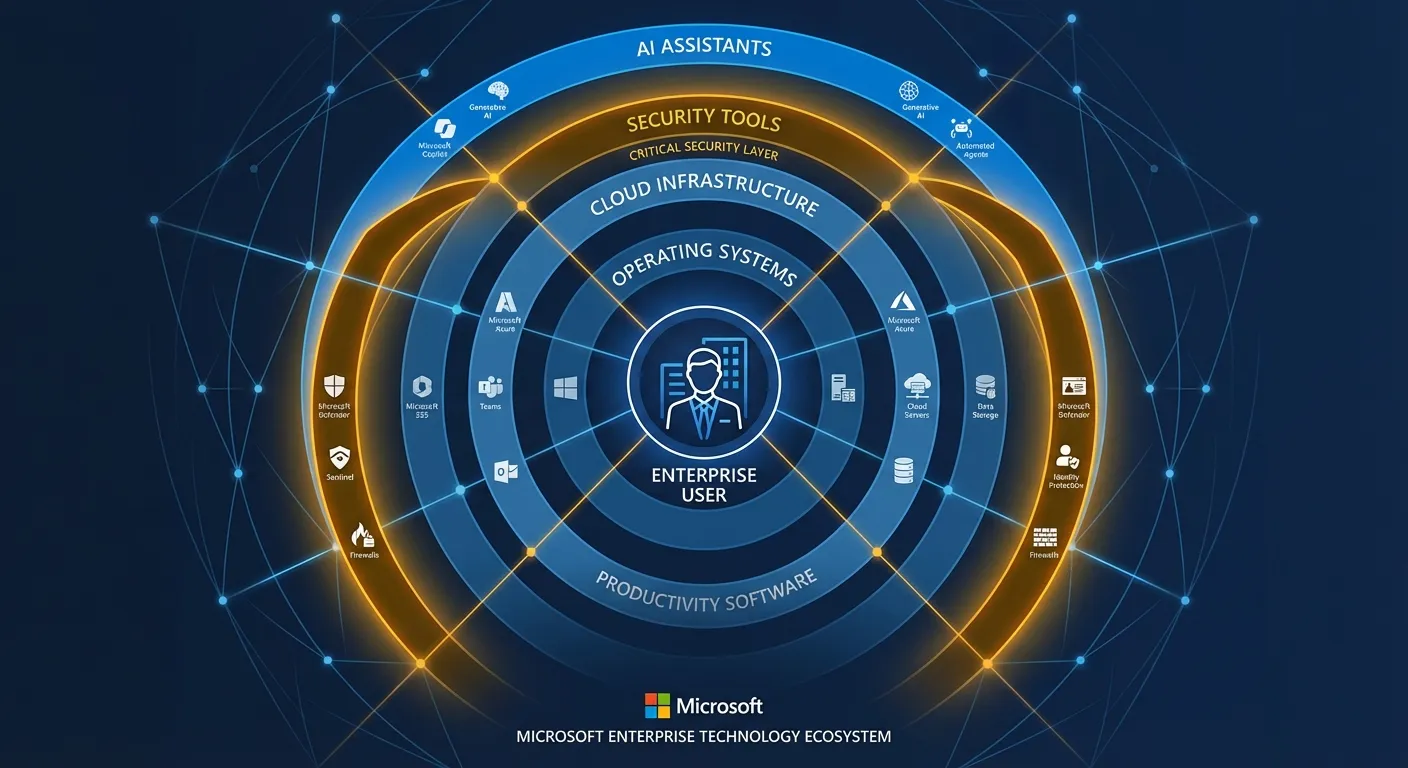
The question the FTC is really asking isn't just whether Microsoft plays fair in cloud computing. It's whether the AI era's dominant infrastructure providers should be allowed to leverage existing market positions to control the next wave of enterprise technology. That question applies equally to Amazon's integration of AI into AWS, Google's bundling of Gemini into Workspace, and Apple's approach to on-device intelligence.
A ruling against Microsoft, or even a consent decree that forces meaningful unbundling, would set a precedent that reverberates across the entire tech industry. It would establish that being big in one market doesn't entitle you to carry that dominance into adjacent markets, even when the integration seems technically seamless.
The Bigger Story
The Microsoft investigation is part of a pattern that has been accelerating for two years. The FTC and Department of Justice have pursued antitrust cases against Google, Apple, Amazon, and Meta. Congress has held hearings on AI competition. The European Union has moved ahead with its own enforcement actions under the Digital Markets Act.
What's different about the Microsoft case is its timing. Unlike the Google search case, which challenged a market position that had solidified over a decade, the FTC is examining Microsoft's AI strategy in real time, before the market has fully formed. If the agency acts, it would be one of the first major antitrust interventions aimed at preventing AI market concentration rather than breaking it up after the fact.
For enterprise customers, the immediate practical impact is limited. Microsoft isn't going to suddenly unbundle Office 365 or sever its OpenAI partnership because the FTC is asking questions. But the investigation creates leverage. Companies negotiating cloud contracts with Microsoft can point to regulatory scrutiny as a reason to demand better terms on interoperability and data portability. And competing cloud providers can make the case that the regulatory environment is shifting in their favor.
The FTC hasn't announced any formal charges, and investigations of this scale often take years to reach resolution. But the direction is clear: the agency is assembling evidence, questioning witnesses, and building a record. Microsoft's bundling strategy, the same approach that defined its competitive playbook for three decades, is under the most serious regulatory scrutiny it has faced since the browser wars.