
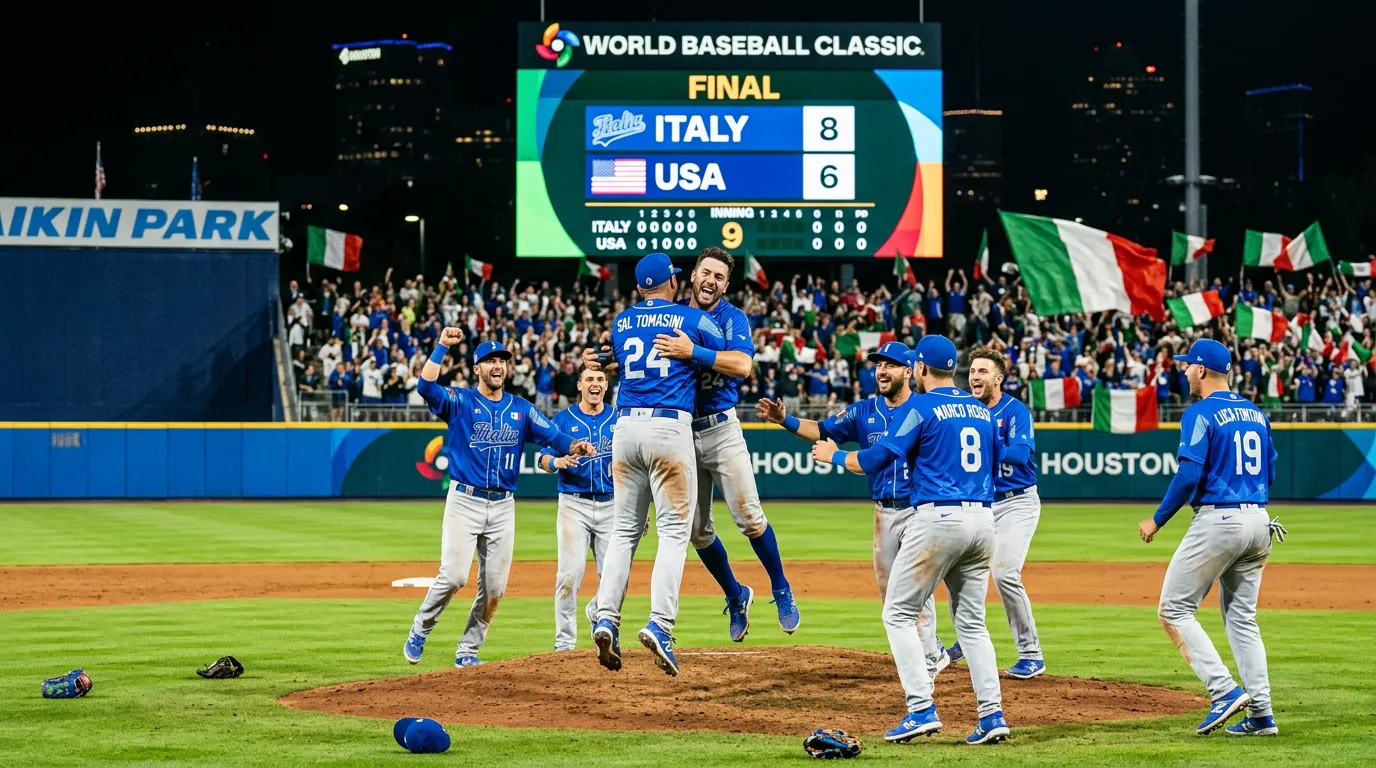
For ten consecutive innings spanning two games, the most talented roster the United States had ever assembled for the World Baseball Classic could not score a run. Ten innings of Mike Trout, Mookie Betts, Gunnar Henderson, and Pete Crow-Armstrong producing nothing. Ten innings of the lineup that was supposed to steamroll through pool play looking pedestrian against pitching that, on paper, had no business keeping them quiet. When Italy's 8-6 victory became final at Daikin Park in Houston on Tuesday night, manager Francisco Cervelli called it "one of the best days of my life." For Team USA, it was something closer to a reckoning.
Italy's win was not a matter of luck, small sample size, or tournament randomness. The Azzurri built an 8-0 lead through six innings, put up crooked numbers off a pitching staff that Team USA sent to the mound with total confidence, and held on as America's bats finally woke up for a furious rally that fell two runs short. This was a team that wanted it more, prepared better, and executed when it mattered. That the United States possesses more raw talent is obvious. That raw talent guarantees nothing in a short tournament is the lesson Italy delivered Tuesday.
Michael Lorenzen and the Seven-Pitch Masterclass
Italy's veteran starter Michael Lorenzen turned in the kind of outing that will be replayed for years in WBC highlight packages. Over 4.2 innings, Lorenzen deployed at least seven different pitch types, generating swings and misses on six of them. He kept the USA lineup off-balance from the first pitch, mixing speeds, arm angles, and locations with the precision of a pitcher who understood that his job was not to overpower American hitters but to confuse them.
The numbers tell part of the story: zero earned runs over his outing, with a ground ball rate that kept Team USA from elevating anything into the gaps. But the numbers miss the artistry. Lorenzen threw cutters that started on the inside corner and darted away from right-handed hitters. He buried a changeup on Mookie Betts that generated an awkward check swing. He attacked Gunnar Henderson with fastballs up in the zone before dropping a curve that Henderson could only watch land on the outside corner. This was not a pitcher getting lucky against lesser competition. This was a veteran executing a game plan with the kind of conviction that American pitchers were supposed to bring.

The Bottom of Italy's Order Did the Damage
The most embarrassing detail for Team USA's pitching staff is where the damage came from. Italy's bottom three hitters, occupying the sixth through eighth spots in the batting order, went a combined 6-for-8 with three home runs and five RBIs. Kyle Teel, the White Sox catcher, launched a solo shot in the second inning to break the game open. Sam Antonacci, a White Sox prospect most casual fans had never heard of, crushed a 403-foot home run that left no doubt. And Jac Caglianone, one of the more intriguing two-way prospects in the minor leagues, put together a three-home-run performance that put his name on the international stage in a way no amount of prospect hype could have.
Meanwhile, Italy's top five hitters went hitless. Let that register for a moment. The Azzurri won 8-6 against the United States with their best hitters contributing nothing offensively. Their lineup depth, something no analyst would have cited as a strength before the tournament, turned out to be the decisive factor. It suggests that Italy's coaching staff did exceptional work preparing hitters throughout the roster, not just the recognizable names at the top.
Team USA's Ten-Inning Scoring Drought
The most alarming pattern for Team USA is not Tuesday's loss in isolation but the trend it extends. Dating back to the final innings of their previous game, the American lineup went ten consecutive innings without scoring a run. This is a lineup featuring the most stacked roster the United States has ever assembled for the WBC, built specifically for offensive firepower. The drought exposed a structural problem that talent alone cannot solve: this team struggles to manufacture runs when home runs are not available.
Against Italy, Team USA's first five innings produced scattered baserunners but no sustained rallies. The approach was passive, with hitters waiting for pitches to drive rather than adjusting to what Lorenzen and Italy's bullpen were giving them. In international competition, where pitchers throw different arsenals and hitters see unfamiliar sequencing, adaptability matters more than raw power. Japan and the Dominican Republic, both teams with deep tournament experience, have historically excelled at making mid-game adjustments. Team USA, despite its superior individual talent, has not demonstrated that flexibility.

The Comeback That Fell Short and What It Revealed
When Pete Crow-Armstrong launched his second home run of the sixth inning, cutting Italy's lead to 8-6, the momentum appeared to shift entirely. Gunnar Henderson had broken the scoring drought earlier in the inning with a solo shot, and suddenly the American bats were alive. The crowd in Houston, overwhelmingly pro-USA, rose to its feet. For a stretch of about ten minutes, it felt like Team USA would complete one of those improbable rallies that great rosters are supposed to produce.
But Italy's bullpen slammed the door. Over the final three innings, Italian relievers held the American lineup scoreless, inducing a series of weak grounders and pop-ups that drained the comeback energy as quickly as it had appeared. The Azzurri's pitching staff finished the game with composure that belied their underdog status. They did not play like a team hoping to survive. They played like a team that expected to win.
The rally also revealed something uncomfortable about Team USA's offensive identity: when this roster scores, it scores via the home run. All six American runs came on solo or two-run home runs. There were no manufactured rallies, no hit-and-run sequences, no situational hitting that strung together singles and doubles to build innings. In a tournament where pitching quality is higher than regular-season baseball and unfamiliar arms create uncomfortable at-bats, relying exclusively on the long ball is a fragile strategy.
Pool B Standings and the Path Forward
The loss drops Team USA to 3-1 in Pool B, having already completed pool play. Italy improved to 3-0 and faces Mexico on Wednesday in a game that will determine advancement. The scenarios are complicated but significant for Team USA: if Italy wins, or if Mexico wins but scores five or more runs, the United States advances to the quarterfinals. If Mexico wins by a narrow margin, tiebreakers could eliminate the Americans entirely. The possibility of Team USA, with this roster, going home before the quarterfinals is real and would constitute one of the biggest failures in the tournament's 20-year history.
For context, the 2023 WBC saw Team USA exit in the quarterfinals, a result that motivated the stacked 2026 roster in the first place. As we covered in the WBC's memorable Saturday doubleheader, the tournament has delivered shock results before, but few have involved the host nation losing to a team without a single current MLB All-Star in its starting lineup.
The Takeaway
Italy's 8-6 victory over Team USA was not a fluke, and treating it as one would be a mistake. The Azzurri outpitched, outhit, and outcompeted the most talented roster in the tournament. Cervelli's squad came to Houston with a plan, executed it from the first pitch, and held their nerve when the Americans mounted a predictable power-based comeback. If Team USA advances, and their path forward is far from guaranteed, Tuesday's loss should force a fundamental re-evaluation of their offensive approach. Home runs are wonderful when they come. A team that cannot score without them is a team waiting to be upset, and Italy proved that on the biggest stage the WBC has ever provided.
The uncomfortable truth for American baseball is this: assembling talent is not the same as building a team. Italy, with a fraction of the resources and a roster of prospects, journeymen, and one brilliant starter, looked more like a team on Tuesday than the United States did. That gap is what the Americans need to close before the quarterfinals, if they get there at all.
Sources
- 4 Takeaways from Italy's Stunning World Baseball Classic Upset Over Team USA - FOX Sports
- Italy 8-6 United States (Mar 10, 2026) Final Score - ESPN
- Italy vs. United States in 2026 World Baseball Classic - MLB.com
- 2026 World Baseball Classic: Italy stun the United States in memorable pool play upset - Olympics.com