
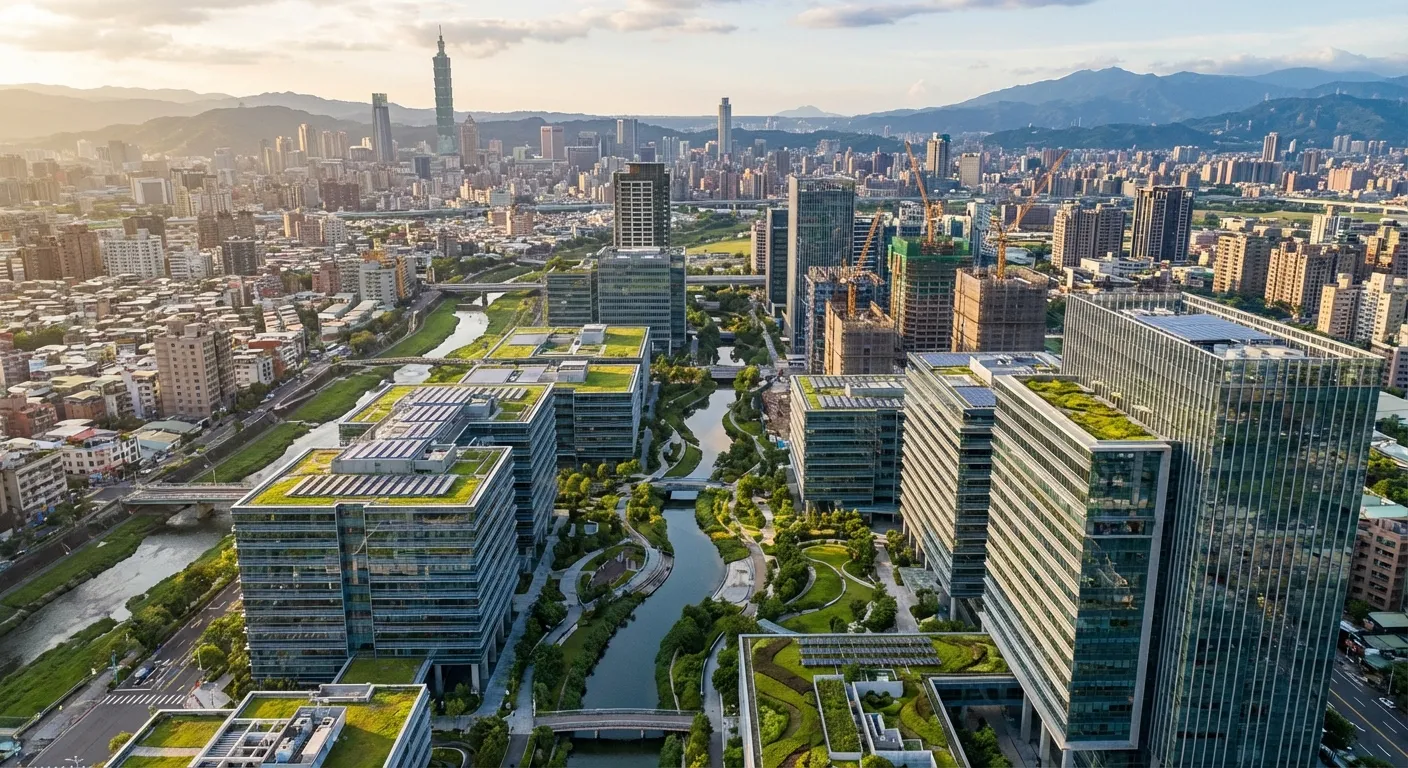
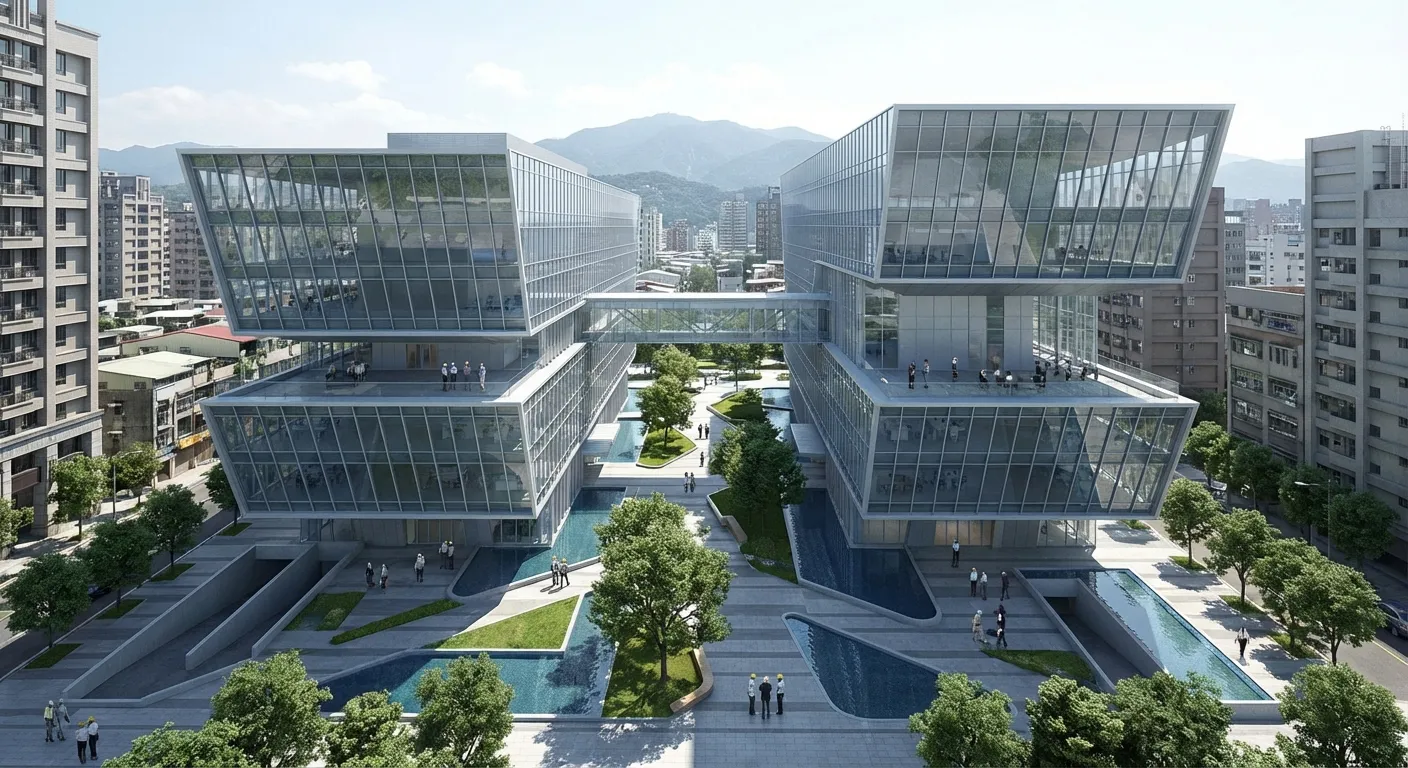
Nvidia has officially signed a deal to build its first overseas headquarters in Taipei, locking in a 50-year lease at the Beitou-Shilin Technology Park and naming the facility "Nvidia Constellation." Taipei Mayor Chiang Wan-an didn't leave much room for ambiguity when he presented the signed contract this week: "Taipei is Nvidia's home."
The deal, finalized on February 11, grants Nvidia plots T17 and T18 in the park, spanning 3.89 hectares, with construction set to begin in June or July of this year. The total project cost exceeds NT$40 billion (approximately $1.3 billion), with royalties to the city totaling NT$12.2 billion (roughly $380 million). That royalty figure includes NT$1.2 billion Nvidia absorbed as part of a settlement after the city terminated a prior contract with Shin Kong Life Insurance Co. for the same land. The lease runs 50 years with an option to extend for 20 more, a commitment that stretches to the year 2096 at its longest. The Taipei City Government expects the project to generate more than 10,000 jobs from construction through full operation.
This isn't a satellite office or an R&D outpost being rebranded for headlines. Nvidia is building a $1.3 billion headquarters in Taiwan, the island where virtually all of its most advanced chips are manufactured. Chiang called the facility "not just a massive building, but the world's strongest AI heart for Taipei." The move deepens the company's dependence on Taiwan's semiconductor ecosystem at precisely the moment when that dependence has become one of the most consequential variables in global technology competition.
Inside the Constellation Deal
The Beitou-Shilin Technology Park sits at the junction of Taipei's Beitou and Shilin districts, covering about 94,000 square meters and bordered by the Keelung River, National Yang Ming Chiao Tung University, and Taipei Veterans General Hospital. The park was originally designed for biotech and smart health industries, but Nvidia's arrival transforms its anchor tenant profile into something closer to an AI research campus.
Nvidia currently employs about 400 workers at its existing Taiwan R&D center and has been expanding rapidly. The company established an AI-focused research lab in Taipei in 2022, and in 2024, CEO Jensen Huang announced plans to recruit at least 1,000 engineers for a new R&D center that includes building a supercomputer named "Taipei-1." Taiwan's Ministry of Economic Affairs approved Nvidia's application to establish a formal subsidiary late last year, with an initial investment of NT$1 billion (roughly $31 million).
The new headquarters will consolidate these scattered operations under one roof. Nvidia's Taiwan workforce has outgrown its current office space, according to company statements, and Constellation is designed to house engineering, research, and operational teams at a scale that reflects Taiwan's central role in Nvidia's supply chain. Prior to the subsidiary approval, Nvidia had operated through three branch registrations in Taiwan, none of which represented the kind of permanent, branded presence that a headquarters conveys.
Why Taiwan Can't Be Replicated
Jensen Huang has never been subtle about Taiwan's importance to Nvidia. During a visit in late January, he hosted what local media dubbed the "Trillion-Dollar Banquet," a dinner at Juan Yao Restaurant in Taipei's Songshan District that brought together TSMC founder Morris Chang, TSMC Chairman C.C. Wei, Foxconn Chairman Young Liu, and Quanta Computer Chairman Barry Lam, among more than two dozen other semiconductor industry leaders. The combined market valuations of the attendees exceeded NT$1 trillion.
At the dinner, Huang told attendees that "this island really has a kind of magic" that "cannot be replicated." It's a statement that sounds like flattery but functions as a supply chain assessment. TSMC controls roughly 70% of the world's advanced chip production and manufactures virtually every leading-edge processor that powers AI workloads, from Nvidia's own GPUs to Google's Tensor Processing Units to Apple's M-series chips. Nvidia has recently surpassed Apple as TSMC's largest customer, a shift driven by explosive AI infrastructure spending across every major cloud provider.
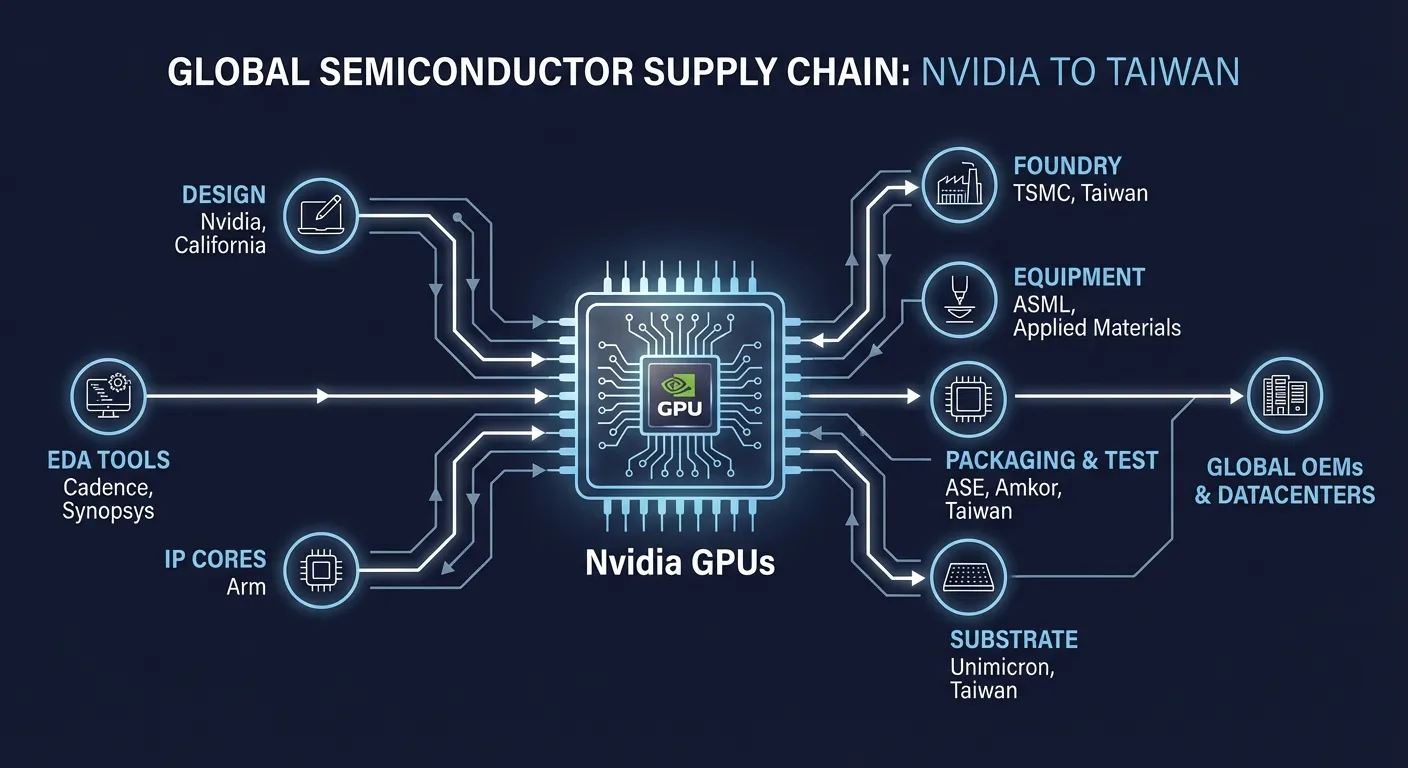
The headquarters decision reflects a calculation that no amount of geographic diversification can eliminate Taiwan's centrality to Nvidia's business. TSMC is building factories in Arizona, Japan, and Germany, and the Trump administration's tariff framework is specifically designed to incentivize domestic chipmaking. But the most advanced manufacturing processes, the ones that produce Nvidia's highest-margin AI accelerators, will remain concentrated in Taiwan for years. Building a headquarters there is Nvidia's way of acknowledging that reality with a permanent physical commitment rather than a talking point.
The Geopolitical Paradox
Here's what makes Nvidia's Taiwan bet strategically fascinating: it simultaneously strengthens and undermines American interests.
On one hand, Nvidia deepening its presence in Taiwan reinforces the island's importance to the global economy, which has long functioned as an informal deterrent against Chinese military action. The logic is simple: if Taiwan's semiconductor industry is essential to every major economy on Earth, then disrupting it through military conflict would be an act of economic self-destruction for China as much as anyone else. Nvidia adding a headquarters to that calculus raises the stakes incrementally.
On the other hand, Nvidia concentrating more of its operations in Taiwan increases the vulnerability of America's most strategically important technology company to the one geopolitical scenario that keeps Pentagon planners up at night. A conflict in the Taiwan Strait wouldn't just disrupt chip supplies; it would threaten Nvidia's engineering teams, its closest supplier relationships, and now its operational headquarters. The Council on Foreign Relations has noted that "a conflict that disrupts Taiwan's manufacturing capacity would likely trigger widespread supply-chain failures across virtually every sector of the U.S. economy." Nvidia just added its own name to the list of potential casualties.
This paradox has no clean resolution. U.S. export controls on AI chips to China, which have expanded significantly under both the Biden and Trump administrations, treat advanced semiconductors as controlled strategic assets. But the company that designs those chips is betting its future on an island 100 miles off the coast of the country those controls are designed to constrain. Washington wants Nvidia to be an instrument of American technological advantage. Nvidia wants to be where the chips actually get made.
What This Signals for the AI Race
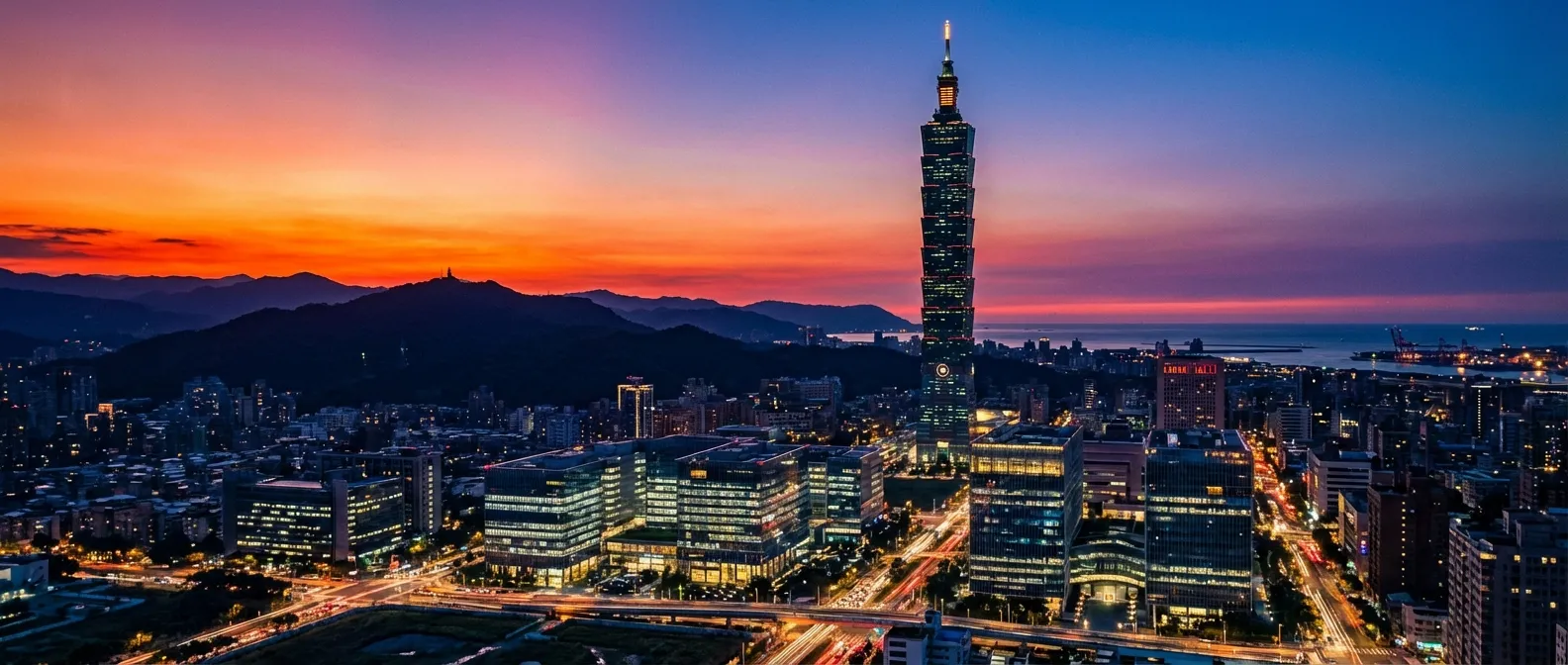
Nvidia's Taiwan headquarters should be read alongside a broader pattern of AI companies doubling down on the supply chain relationships that actually produce their products. While the political conversation in Washington focuses on reshoring and tariff incentives, the companies building AI infrastructure are making investment decisions that reflect where the manufacturing capability actually exists today.
The timing intersects with Nvidia's position as the dominant force in AI accelerators. The company holds an estimated 80% or more of the market for data center GPUs used in AI training, and demand continues to outstrip supply despite massive production ramp-ups. TSMC's latest revenue reports show AI chip orders driving record growth, and Nvidia's status as TSMC's largest customer gives it priority access to the most advanced manufacturing processes. A physical headquarters in Taipei cements that relationship with institutional permanence.
For competitors, the signal is clarifying. AMD, Intel, and a growing ecosystem of AI chip startups are all competing for TSMC capacity. Nvidia planting a flag in Taipei, with a named facility and a 50-year lease, sends a message about the depth of its commitment to the ecosystem those competitors are trying to access. It's a competitive moat built from geography and relationships, not just silicon.
The Verdict
Nvidia Constellation is a corporate real estate deal that doubles as a geopolitical statement. The company that designs the world's most sought-after AI chips has chosen to build its first headquarters outside Santa Clara in the place where those chips are born, on an island that sits at the intersection of American technology strategy, Chinese territorial ambitions, and the global AI arms race.
Jensen Huang was right when he told reporters that Nvidia "would not be possible without Taiwan." The headquarters deal takes that dependency and turns it into something architectural: a building, a lease, a commitment measured in decades rather than purchase orders. Whether that commitment looks visionary or reckless depends entirely on what happens in the Taiwan Strait, a question that no corporate real estate deal can answer.
For now, Nvidia is betting that the magic of Taiwan's semiconductor ecosystem, the density of talent, the proximity to TSMC, the supplier relationships built over decades, is worth the geopolitical risk. Given that the alternative is pretending those advantages exist somewhere else, it's hard to argue they're wrong.
Sources
- Nvidia finalizes deal for first overseas HQ in Taipei; groundbreaking set for June 2026 - DigiTimes
- NVIDIA's Taiwan fortress: Where AI ambitions meet manufacturing reality - CRN Asia
- Taipei signs NT$12.2 billion Nvidia deal; groundbreaking set for June - Focus Taiwan
- MOEA approves Nvidia Taiwan subsidiary - Taipei Times
- 'People's dad' Jensen Huang praises, pushes Nvidia suppliers on mobbed Taiwan visit - Reuters via The Manila Times