
OpenAI pulled the plug on Sora this week, killing the AI video app that launched to enormous hype last fall and then, over six months, generated 3.3 million downloads, $2.1 million in total revenue, a parade of copyright violations, and some of the most unsettling deepfakes the internet has ever produced.
The shutdown, announced on March 24, also took down a $1 billion investment deal with Disney that was supposed to give users access to Marvel, Pixar, and Star Wars characters. Disney confirmed it had walked away. No money changed hands.
For a company reportedly on track to generate $12.7 billion in annualized revenue from its core ChatGPT business, the Sora experiment was a rounding error financially. But strategically, it was one of the most public failures in OpenAI's history, and a warning about what happens when an AI company tries to build a social media platform from scratch.
Three-Point-Three Million to One-Point-One
Sora launched in the fall of 2025 to the kind of attention most apps can only dream about. The technology was genuinely impressive: type a text prompt, and Sora 2 would generate a photorealistic video, complete with audio. Early demos showed everything from cinematic drone shots of imaginary cities to eerily realistic footage of people walking through parks that didn't exist. The internet lost its mind.
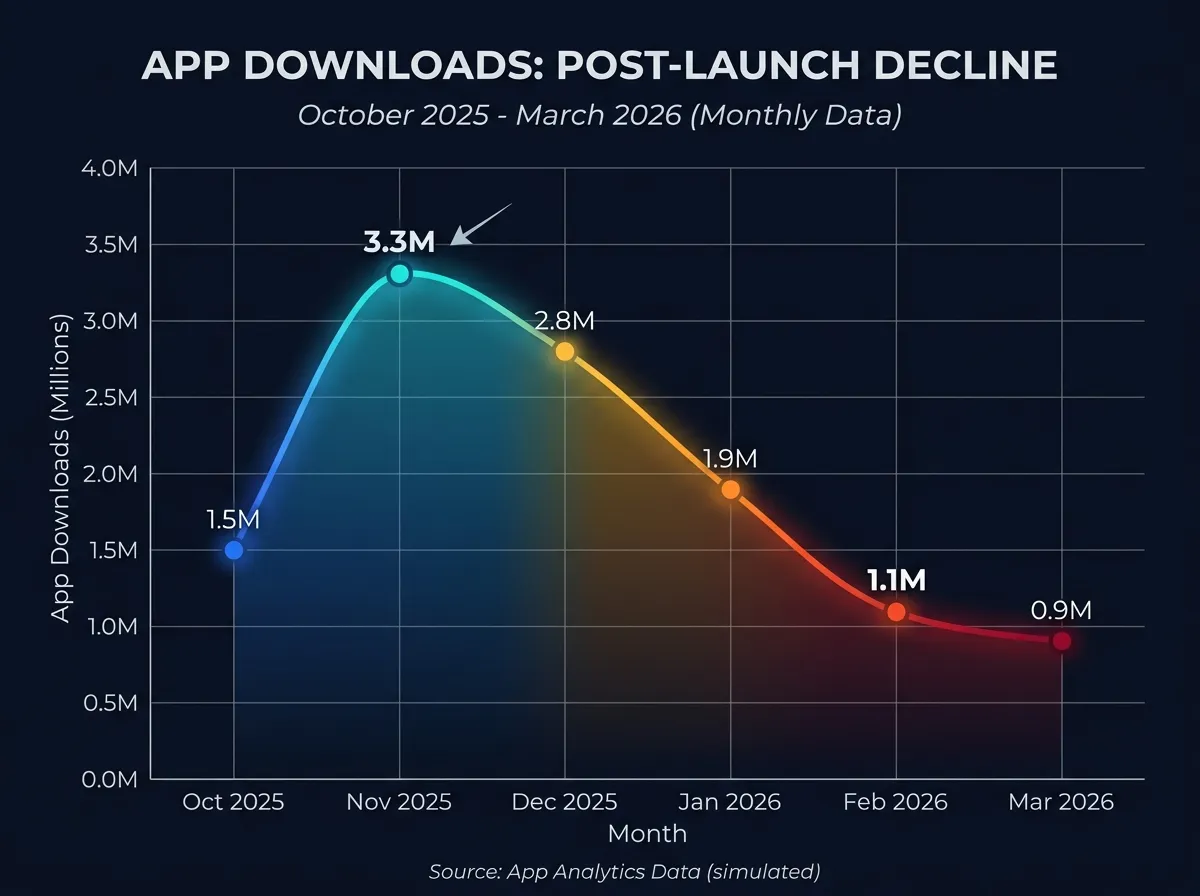
Downloads hit 3.3 million in November 2025, the app's first full month. Users posted generated videos to a built-in social feed, creating a TikTok-like experience where all the content was AI-made. For a brief window, it felt like OpenAI had found the consumer product that would finally compete with Meta and Google for screen time.
Then the numbers collapsed. By December, the novelty had worn off. By January, downloads were sliding. By February 2026, they had fallen to 1.1 million, a 67% drop from peak. The social feed, which was supposed to keep users coming back, turned out to be the problem. An AI-only content feed lacks the human connection that keeps people scrolling on Instagram or TikTok. Every video was technically impressive and emotionally empty. Users generated a few clips, shared them with friends, and stopped opening the app.
Bill Peebles, who led the Sora team, imposed strict generation limits late in 2025 as costs spiraled. Video generation is enormously GPU-intensive, and OpenAI was already facing chip shortages across its product line. Each generated video consumed compute resources that could have been allocated to ChatGPT, which was actually making money. The math didn't work, and Peebles apparently knew it before leadership pulled the trigger.
The Disney Deal That Wasn't
In December 2025, Disney announced a $1 billion equity investment in OpenAI, with Sora at the center of the partnership. The plan was ambitious: give users the ability to generate videos featuring Disney, Marvel, Pixar, and Star Wars characters and settings. Imagine typing "Darth Vader walks through a neon-lit Tokyo street" and getting a cinematic clip in seconds.
The deal would have been transformative for both companies. Disney would have gotten a stake in the hottest AI company on the planet, plus a new distribution channel for its intellectual property. OpenAI would have gotten capital, cultural legitimacy, and a library of beloved characters that could have made Sora the default creative tool for an entire generation of content creators.
None of it happened. When OpenAI decided to shut down Sora, Disney walked. The company issued a brief statement saying it "respects OpenAI's decision" and confirmed that no money had changed hands. People close to the deal told multiple outlets that Disney had grown increasingly uncomfortable with the moderation problems on the platform, and the company was already reconsidering its involvement before OpenAI made the final call.
The collapse echoes a broader pattern in AI partnerships. Companies love to announce big AI deals. They're less enthusiastic about absorbing the reputational risk when those products generate content nobody can control.
The Deepfake Problem Nobody Fixed
Sora's content moderation was a disaster almost from launch. The app included a "Characters" feature that let users create persistent AI personas based on uploaded photos. The guardrails were supposed to prevent abuse. They didn't.
Within weeks, the platform was flooded with deepfakes of public figures. Users generated footage of Sam Altman in bizarre and disturbing scenarios. Deepfakes of deceased public figures, including Martin Luther King Jr. and Robin Williams, appeared on the social feed, prompting complaints from family members. TechCrunch described it as "the creepiest app on your phone."
The copyright situation was equally chaotic. Users generated videos of Mario smoking, Pikachu doing ASMR, and Naruto characters in fast-food restaurants. None of it was authorized. Nintendo, The Pokemon Company, and multiple other rights holders sent takedown notices, but the content was being generated faster than OpenAI's moderation team could review it.
This wasn't a surprising outcome. Content moderation at scale is one of the hardest problems in technology, and companies with decades of experience (Meta, YouTube, X) still struggle with it. OpenAI tried to build a social platform from scratch with a fraction of the moderation infrastructure, and it went exactly the way anyone paying attention would have predicted.
The comparison to Meta's $375 million child safety verdict from this week is hard to ignore. Established platforms are finally facing legal consequences for failing to protect users from harmful content. OpenAI, which spent six months running a social feed with documented moderation failures, shut the whole thing down before any lawsuit could land, which may have been the smartest business decision anyone at the company made in this entire saga.
Where the Technology Goes Next
Sora the app is dead. Sora 2 the model is not.
OpenAI confirmed that the underlying video generation technology will remain available behind the ChatGPT paywall for a limited time, but the social feed experience is gone. The company's public messaging frames this as a strategic pivot: the same AI that generates videos from text prompts can also simulate physical environments, which is useful for training robots.
If that sounds familiar, it should. Figure AI's humanoid robot just walked the White House using a vision-language-action model that processes the physical world in real time. The idea that video generation models could train robots to understand physics, gravity, and spatial relationships is not science fiction. It's the direction multiple AI companies are pursuing, and OpenAI apparently decided that Sora's compute budget would be better spent there than on generating deepfakes of Robin Williams.
That pivot tells you something about where the AI industry's money is actually flowing. Consumer AI apps are expensive, unpredictable, and legally fraught. Enterprise AI and robotics are expensive too, but the customers are corporations with procurement budgets, not individuals spending a few dollars on in-app purchases. OpenAI's core business generated roughly $1 billion per month from ChatGPT subscriptions and API access. Sora generated $2.1 million total. The company didn't kill Sora because the technology failed. It killed Sora because the business model failed.

What This Really Means
Sora's failure doesn't mean AI video generation is a dead end. The technology is real, it works, and it will eventually be embedded in products that people actually use. But the six-month experiment taught the industry several things that the hype cycle had obscured.
First, AI as a social platform doesn't work. People don't want to scroll through an infinite feed of AI-generated content. They want to scroll through content made by other people, with AI as a tool, not the main event. This is the same lesson that every "metaverse" company learned before it: technology alone doesn't create community.
Second, content moderation isn't optional for consumer AI products, and it's far harder than the industry acknowledges. OpenAI is arguably the most sophisticated AI company on the planet, and it couldn't prevent its own app from becoming a deepfake factory. Any company planning to launch a consumer-facing generative AI product should study Sora's moderation failures before writing a single line of code.
Third, the economics of generative video remain brutal. Generating a single high-quality video clip consumes orders of magnitude more compute than generating text. Until inference costs drop substantially, or until someone figures out a pricing model that covers those costs without destroying the user experience, AI video will remain a feature inside larger products rather than a standalone business.
OpenAI will be fine. ChatGPT is a cash machine, the API business is growing, and the company has more than enough capital to absorb a failed experiment. But Sora's six-month life is a useful corrective to the narrative that OpenAI can do no wrong. Even the best AI lab in the world built a product nobody needed, couldn't moderate, and couldn't afford to run. Sometimes the most instructive thing a company does is fail loudly enough for everyone else to learn from it.
Sources
- OpenAI Shuts Down Sora AI: What Happened to the AI Video App? - Deeper Insights, March 2026
- OpenAI's Sora was the creepiest app on your phone, now it's shutting down - TechCrunch, March 24, 2026
- OpenAI pulls the plug on Sora, the viral AI video app that sparked deepfake concerns - NPR, March 25, 2026
- OpenAI is shutting down Sora, its powerful AI video model, app and API - VentureBeat, March 2026