
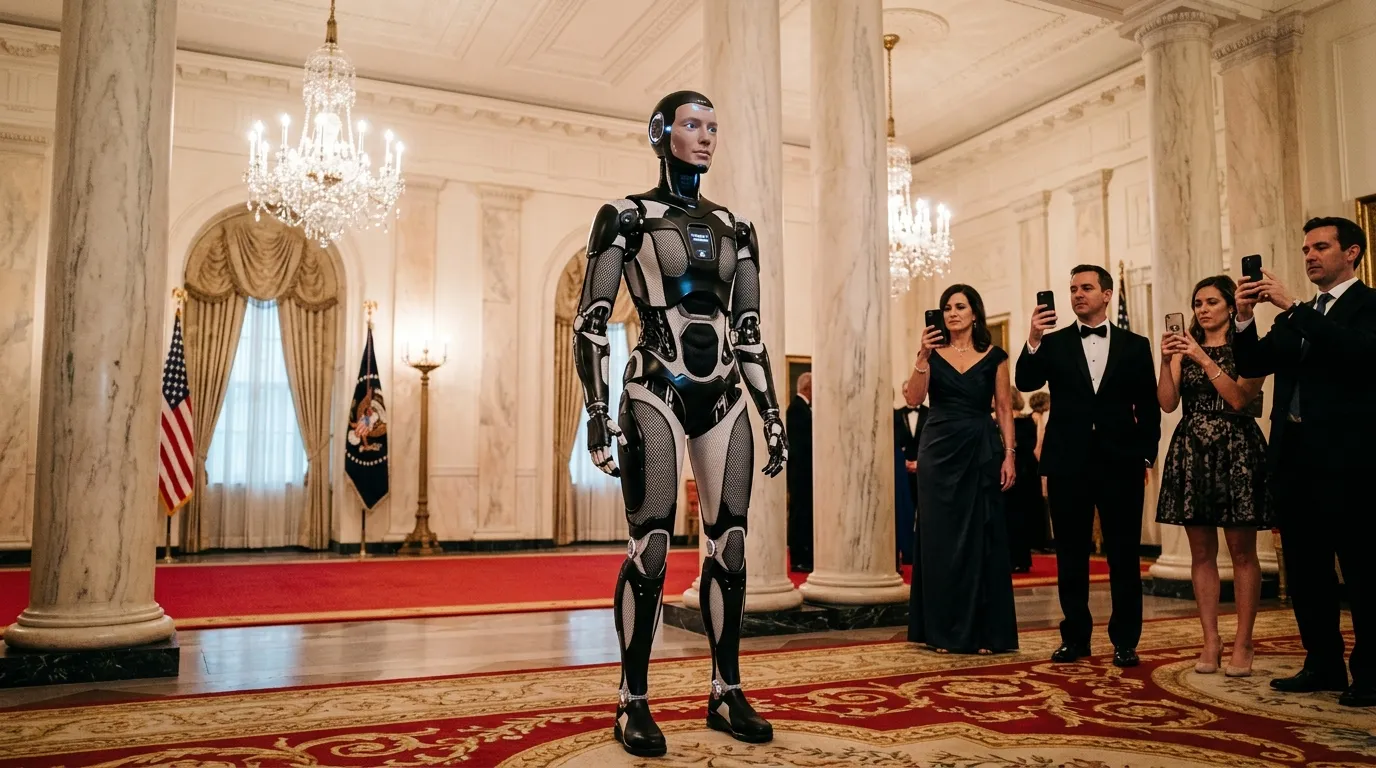
On Tuesday afternoon, a 5-foot-6, 135-pound humanoid robot named Figure 03 walked through the White House Cross Hall on two mechanical legs, stopped in front of representatives from 45 countries, and said hello in 11 languages. Then it waved.
The moment, which immediately went viral, happened during Day 2 of First Lady Melania Trump's "Fostering the Future Together" summit, a gathering focused on AI's role in children's education. The robot's appearance was unannounced. When Figure 03 stepped into the room, attendees went silent. Then came the phones.
This was the first time a humanoid robot has walked through the White House in any official capacity. Whether that fact is exciting or unsettling probably depends on how you feel about the trajectory of AI right now, and a lot of people are feeling both.
Eleven Languages and a Standing Silence
Figure 03 didn't just show up and stand there. The robot introduced itself, delivered programmed remarks about the summit's mission, and then cycled through greetings in English, Spanish, Mandarin, Arabic, French, Hindi, Portuguese, Russian, Japanese, German, and Swahili. By all accounts, the pronunciation was flawless.
It then walked back down the Cross Hall under its own power, a feat that sounds trivial but requires an extraordinary amount of real-time computation. Figure 03 runs on a vision-language-action model called Helix, which processes visual input, understands spoken commands, and coordinates full-body movement simultaneously. It's the first AI model to control an entire humanoid upper body, including individual fingers, in continuous real-time.
The attendees, many of whom were first spouses and senior government officials from around the globe, seemed genuinely caught off guard. Sara Netanyahu and Olena Zelenska were among those present, alongside representatives from Costa Rica, Poland, Romania, Slovenia, and Lithuania. Several later posted the moment on social media, with reactions ranging from awe to quiet alarm.
"Walking through those halls and greeting world leaders in their own languages, that was not scripted interaction in the traditional sense," said Brett Adcock, CEO of Figure AI, in a statement posted on the company's website. "Helix was processing and responding in real time."
What Figure 03 Can Actually Do
Behind the diplomatic theater, Figure 03 is a real product with real capabilities, even if you can't buy one yet.
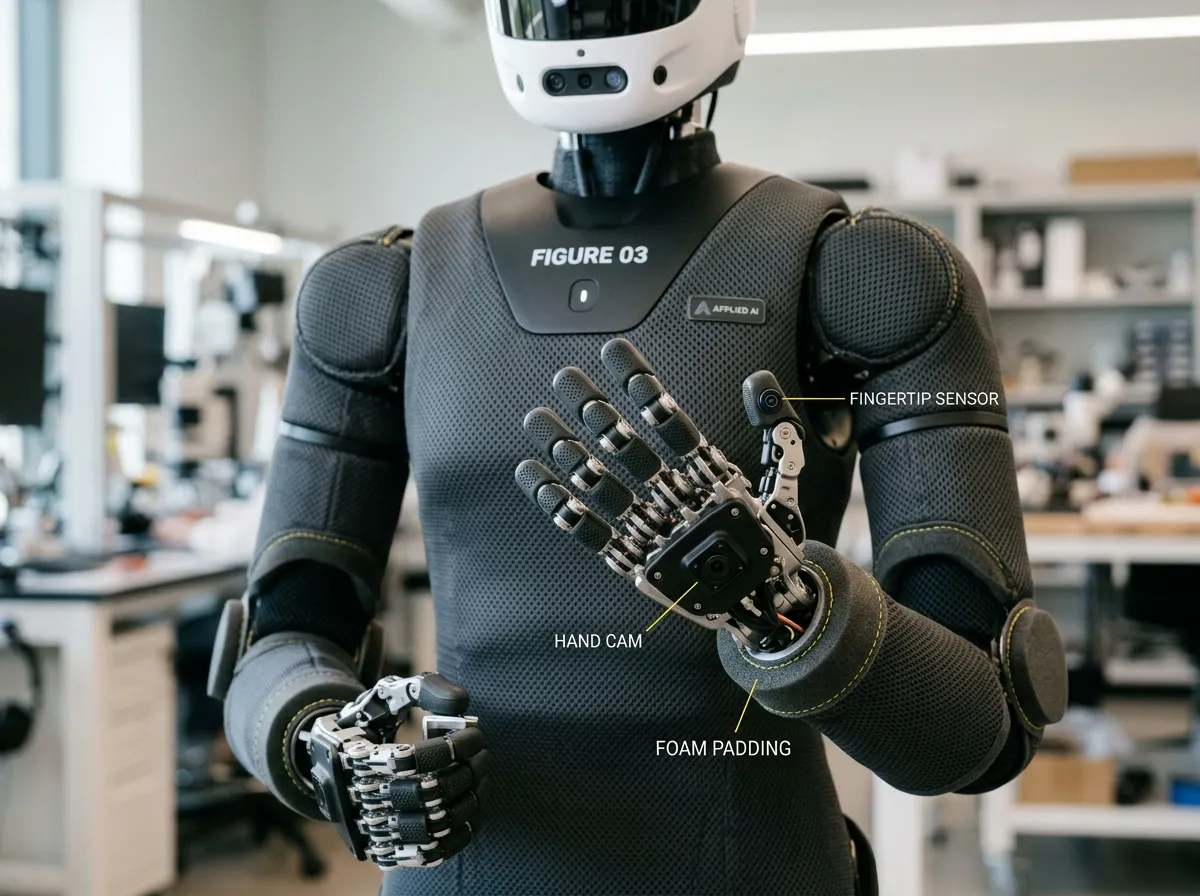
The robot weighs 61 kilograms and can carry a 20-kilogram payload. Its battery lasts about five hours on a single wireless charge, and it can top up by simply stepping onto a charging mat. Each of its fingertips contains sensors that detect forces as small as three grams (the weight of a single paperclip), allowing it to distinguish between a firm grip and an impending slip before the object actually falls.
Figure AI, the Sunnyvale-based company behind the robot, has raised more than $1 billion from investors including Nvidia and LG Technology Ventures. The company positions Figure 03 as a solution to labor shortages in manufacturing, warehousing, and eventually home care. In demonstrations, it has loaded dishwashers, folded laundry, cleared tables, and navigated rooms while responding to voice commands. Its next-generation camera system delivers twice the frame rate and 60% wider field of view compared to its predecessor, Figure 02, while the robot itself is 9% lighter.
The target consumer price is approximately $20,000, though availability isn't expected until late 2026 at the earliest. For context, that's roughly what you'd pay for a used Honda Civic. Whether that comparison is reassuring or alarming depends on your perspective.
It's worth noting that this same week, a survey of 750 CFOs revealed that AI-related job losses could reach 502,000 in 2026, up from 55,000 last year. The timing of a humanoid robot greeting world leaders at the White House, while that number circulates through boardrooms, was not lost on critics.
Melania's Pitch: Meet 'Plato'
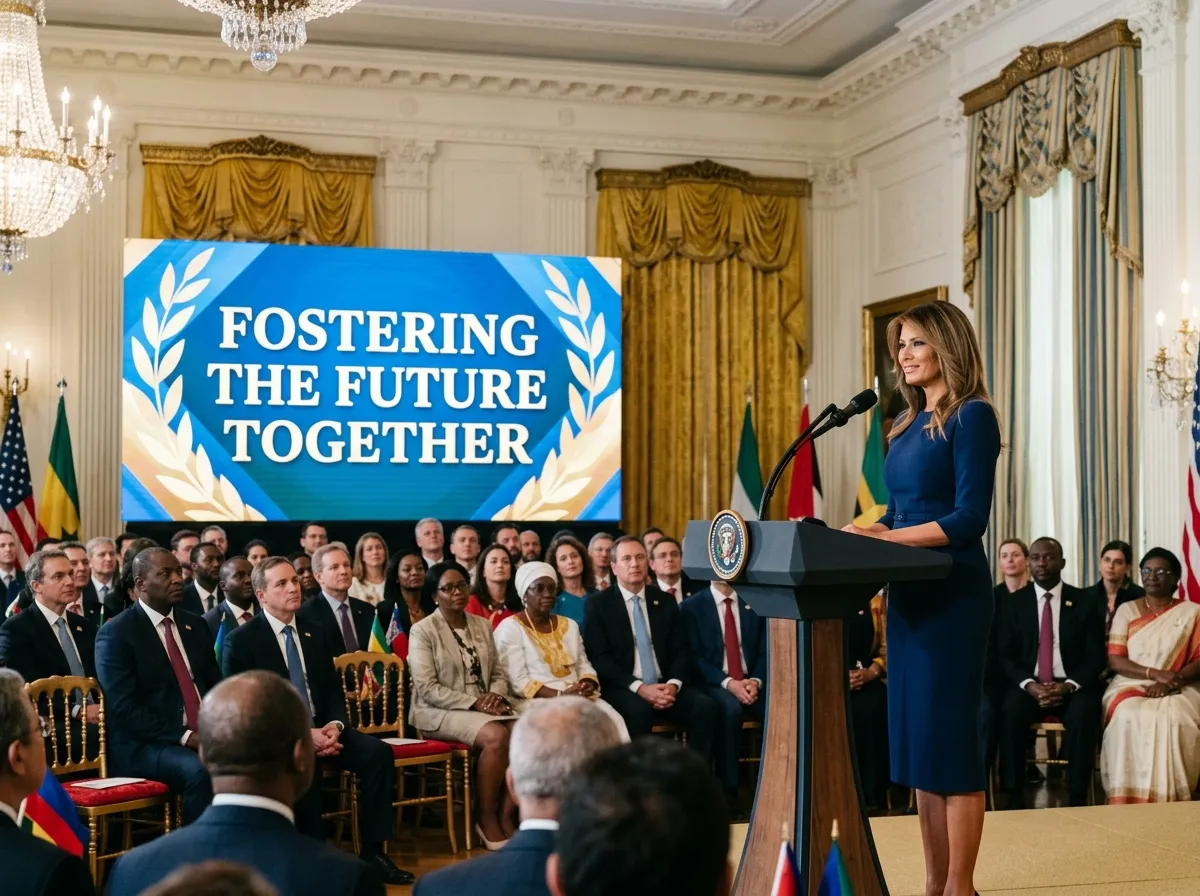
The summit itself, officially titled the "Fostering the Future Together Global Coalition Summit," brought together first spouses and senior officials from 38 countries along with 28 technology companies. Its stated goal was exploring how AI can benefit children's education and digital safety.
Melania Trump framed the robot's appearance as a preview of what classrooms could look like within a decade. "Imagine a humanoid educator named 'Plato,'" the First Lady told the assembled delegates. "Access to the classical studies is now instantaneous: literature, science, art, philosophy, mathematics, and history." She added that "artificial intelligence will move from our mobile phones to humanoids that deliver utility."
It's an ambitious vision, and not an entirely new one. Education technology companies have been promising AI tutors for years. But there's a significant difference between an AI chatbot on a screen and a physical robot that walks into a classroom, sits down, and teaches. Whether that difference is progress or overreach is an open question.
The summit drew mixed reviews for other reasons. On Day 1, the First Lady arrived at 10:01 a.m., spoke to the assembled representatives, and departed by 10:08 a.m. The seven-minute appearance drew immediate criticism on social media, where clips of her brief address circulated widely. Supporters countered that the multi-day summit continued productively beyond her remarks and that Figure 03's Day 2 debut was always meant to be the centerpiece.
Meanwhile, 61,000 TSA Workers Haven't Been Paid
Here's what makes the Figure 03 moment hard to evaluate in isolation: it happened during a partial government shutdown.
The Department of Homeland Security has been unfunded since February 14. As of this week, roughly 61,000 TSA officers are working without pay. More than 450 have quit since the shutdown began. Some airports are reporting security wait times exceeding four hours, and TSA leadership has warned that smaller airports may have to close entirely if the standoff continues.
Against that backdrop, a humanoid robot greeting world leaders in the White House creates a jarring visual contrast. The federal government can't pay the people screening bags at airports, but it can host an event where a robot built by a company with over $1 billion in private funding says hello in Swahili. Whether or not that comparison is fair (the summit was organized by the First Lady's office, not the agencies affected by the shutdown), it's the comparison people are making.
The AI industry is navigating complicated waters right now. Elon Musk just announced a $25 billion semiconductor factory to build chips for Tesla, SpaceX, and xAI. NVIDIA's latest GPU pipeline is valued at over $1 trillion. The capital flowing into AI and robotics is staggering, and the gap between what these companies are building and what most Americans are currently experiencing continues to grow.
When Robots Walk the Halls of Power
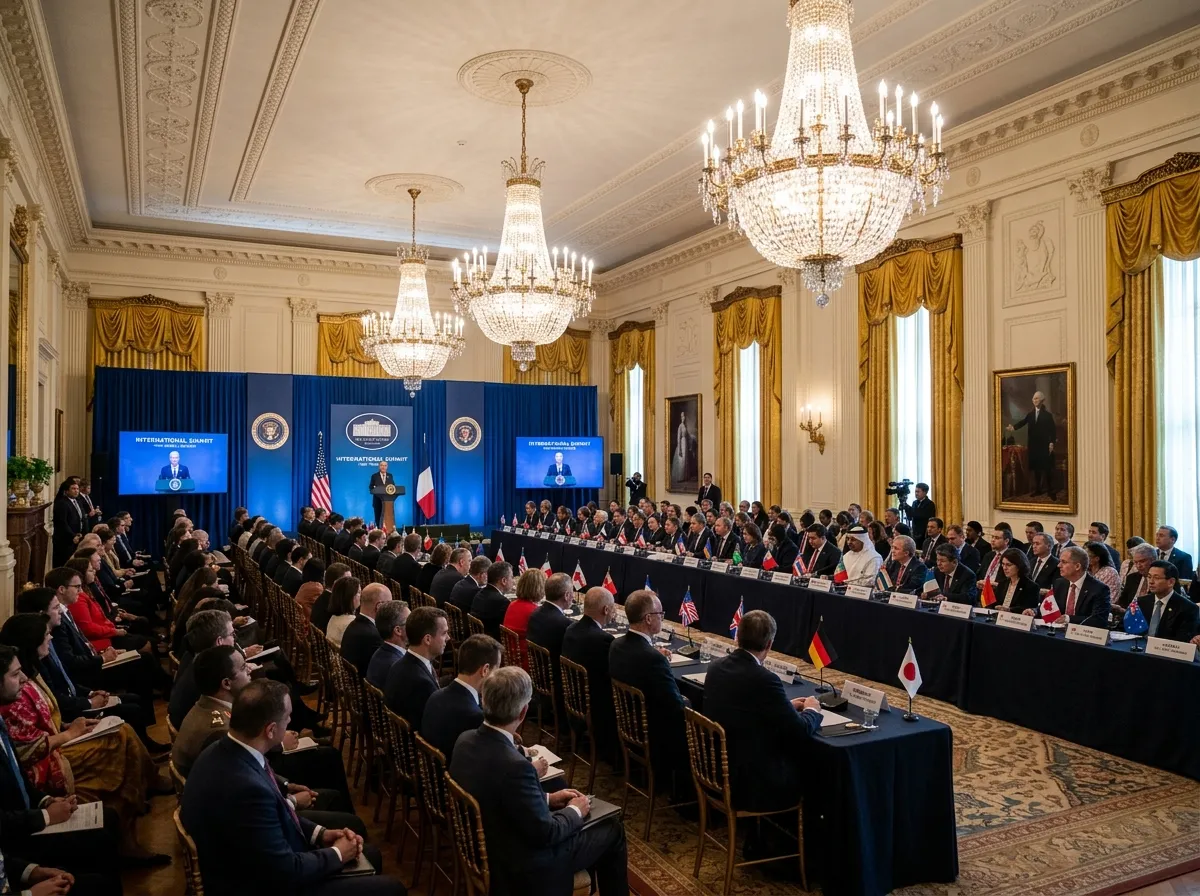
The most useful question about Tuesday isn't whether Figure 03 is impressive (it is) or whether the summit was meaningful (debatable). It's what the moment signals about where government-industry relationships on AI are heading.
Figure AI currently holds no federal contracts. Adcock has said the White House invitation came through the First Lady's office. But appearing at the White House, in front of 45 countries, is the kind of implicit endorsement that money can't easily buy. It positions Figure AI as the face of American humanoid robotics on the global stage, an enormous branding advantage that cost the company nothing but a robot's time and a plane ticket for its handlers.
For the broader AI industry, the optics carry more weight. This administration has taken a distinctly pro-AI posture, rolling back Biden-era executive orders on AI safety and fast-tracking deregulation. A humanoid robot walking the White House can be read as a statement of national priorities: America is open for AI business, and caution won't be the default setting.
That reading aligns with the investment data. According to Stanford's 2026 AI Index, global AI investment exceeded $200 billion in 2025, with the United States accounting for roughly 60% of that spending. The robotics sector specifically saw a 43% year-over-year increase in venture funding, driven largely by advances in foundation models that allow robots to generalize across tasks rather than being programmed for a single function.
But investment enthusiasm and regulatory readiness aren't the same thing. The Federal Trade Commission has yet to issue guidance on humanoid robotics in consumer settings. OSHA has no framework for workplaces where humans and humanoid robots share the same space. The Department of Education has not weighed in on Melania's "Plato" concept or anything resembling it. The technology is sprinting. The policy is walking, slowly, when it's moving at all.
That tension is baked into Tuesday's moment. Figure 03 is remarkable. The technology works. The future it hints at, where humanoid machines assist in education, elder care, manufacturing, and household labor, is probably arriving whether the regulatory infrastructure is ready or not. The question has never been whether it's possible. The question is whether the guardrails get built before or after the robots are already in the room.
The Verdict
Figure 03's White House debut was a genuine engineering milestone wrapped in complicated politics. The robot walks, talks, and processes language across 11 languages with a fluency most humans can't match. Figure AI has built something real, and the fact that it performed flawlessly in the most scrutinized building on Earth is a legitimate achievement.
But milestones don't exist in vacuums. This one landed during a government shutdown, amid rising anxiety about AI-driven job displacement, and at a summit whose host spent seven minutes with representatives from 45 nations before leaving. The robot stayed longer than the First Lady did.
If you're bullish on AI, Tuesday was a preview of American-built humanoids leading the world in capability. If you're concerned about deployment outpacing policy, it was a reminder that the demo reel is moving faster than the rulebook. Both readings are correct. And that's exactly why the image of a robot walking the White House is going to be difficult to shake.
Sources
- Melania Trump walks side by side with humanoid robot at White House summit - NBC News, March 26, 2026
- First Lady Melania Trump Convenes Record 45 Nations at the White House and Introduces American-Built Humanoid - The White House, March 2026
- Introducing Figure 03 - Figure AI
- Helix: A Vision-Language-Action Model for Generalist Humanoid Control - Figure AI