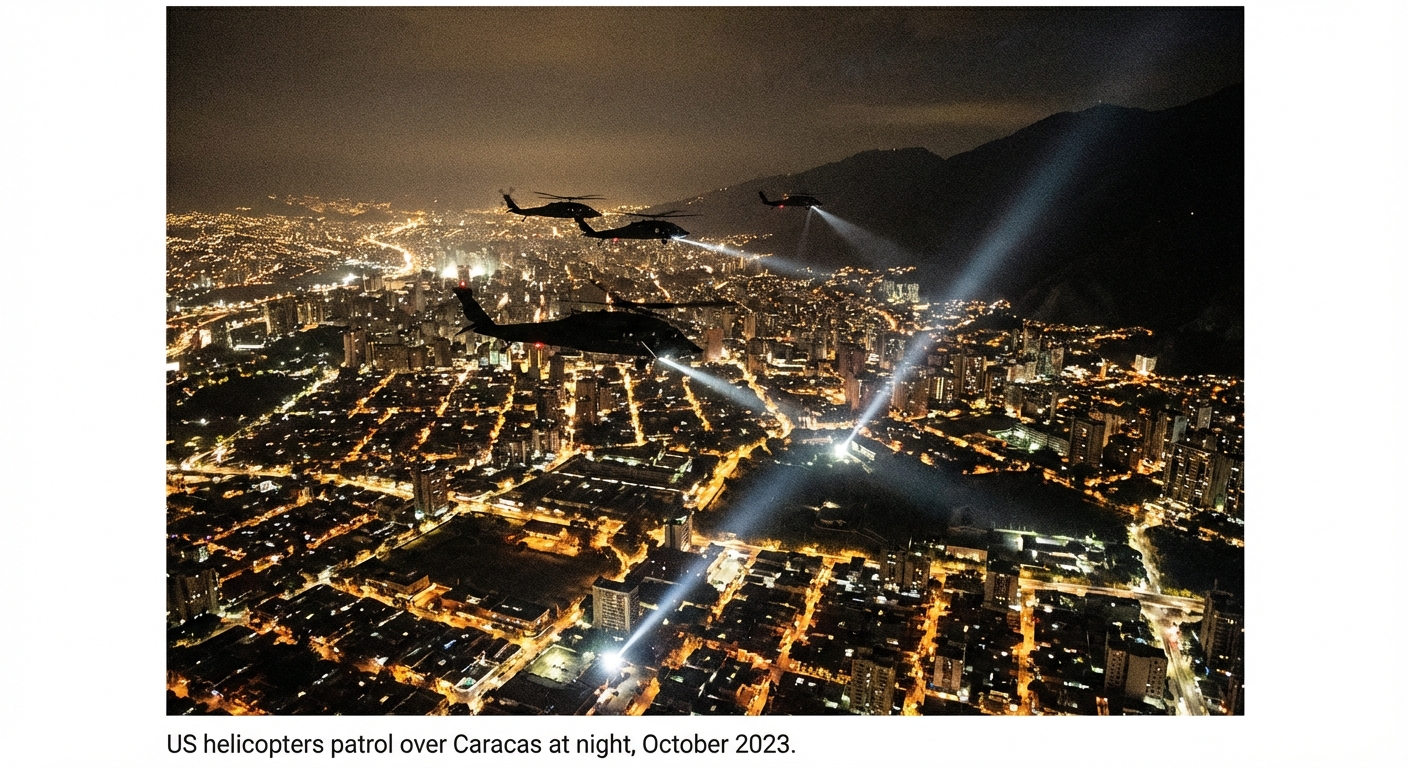
At 2:01 AM local time on Saturday, January 3rd, US helicopters touched down at Venezuelan President Nicolás Maduro’s compound in Caracas. Less than 30 minutes later, the man who had ruled Venezuela for over a decade was in American custody, en route to a federal courtroom in Manhattan. By Monday morning, he’ll face charges of narcoterrorism, drug trafficking, and weapons offenses in a US court.
The operation, codenamed “Absolute Resolve,” represents the most dramatic use of American military force in Latin America since the 1989 invasion of Panama that captured Manuel Noriega. It has sparked international outrage, emergency UN sessions, and a geopolitical crisis that’s still unfolding. Here’s everything you need to know about what happened, why it matters, and what comes next.
The Operation: 150 Aircraft, 30 Minutes, One Target
The planning for Absolute Resolve began months before President Trump gave the final green light on Christmas Eve. According to General Dan Caine, chairman of the Joint Chiefs of Staff, US forces rehearsed the extraction repeatedly on a replica of Maduro’s residence, complete with the same steel reinforcements that protected his compound.
The intelligence effort was equally meticulous. A CIA source operating within the Venezuelan government provided real-time tracking of Maduro’s movements. In the months leading up to the raid, US intelligence agencies built what officials described as a “granular portrait” of the president’s daily life, tracking everything from his travel patterns to what he ate and wore.
At 11:46 PM local time on Friday, January 2nd, Trump authorized the strike. About 150 aircraft launched from 20 airbases across the region. Helicopters carrying Delta Force operators and federal law enforcement flew at just 100 feet above the water to avoid radar detection, while strike aircraft disabled Venezuela’s air defense systems.
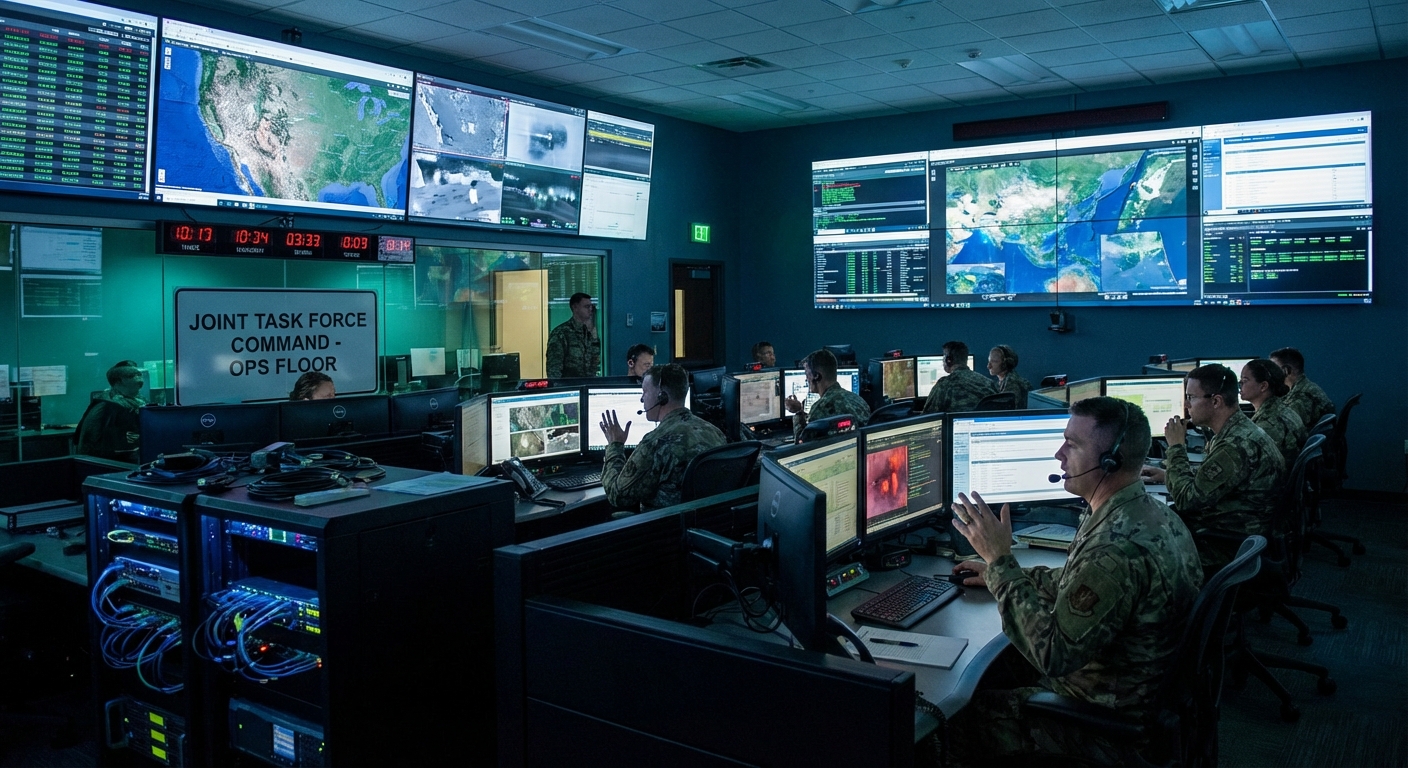
Defense Secretary Pete Hegseth described what came next as a “massive joint military and law enforcement raid” lasting less than half an hour. When Delta Force breached Maduro’s residence, he and his wife Cilia Flores were, according to officials, “taken completely by surprise.” The extraction team came under fire and responded with what the Pentagon called “overwhelming force.” One helicopter was hit but remained flyable.
By 4:29 AM, just two and a half hours after the green light, Maduro was aboard a US aircraft carrier headed for New York.
Why Now? The Narcoterrorism Case Against Maduro
The Trump administration has framed the operation not as regime change but as law enforcement. Maduro faces federal indictments dating back to 2020, when the Department of Justice charged him with narcoterrorism conspiracy, cocaine importation, and weapons offenses. Prosecutors allege he worked with Colombian FARC rebels to flood the United States with cocaine, using drug profits to maintain his grip on power.
The charges carry potential sentences of up to life in prison. For years, these indictments existed largely as symbolic gestures since actually arresting a sitting head of state seemed impossible. Saturday’s operation changed that calculation dramatically.
The timing connects to broader patterns in Trump’s second term. The administration has taken an increasingly aggressive posture toward what it calls “hostile regimes” in the Western Hemisphere. Just weeks ago, US airstrikes targeted ISIS-linked militants in Nigeria, signaling a willingness to use military force more freely than previous administrations.
The International Backlash: “A Dangerous Precedent”
The global response has been swift and largely negative, even from US allies. A spokesperson for UN Secretary General António Guterres called the operation “a dangerous precedent” that raises fundamental questions about sovereignty and international law.
Brazil, Spain, Colombia, Mexico, Uruguay, and Chile issued a joint statement condemning the US action. French officials said the operation was “contrary to international law.” Chinese Foreign Minister Wang Yi delivered Beijing’s most pointed criticism of US foreign policy in years, declaring that China has “never shared the view that any country can play the role of a global gendarme or present itself as an international judge.”
The UN Security Council is holding an emergency meeting today to address the situation. Russia has requested the session and is expected to introduce a resolution condemning the US action, though any such measure would face an American veto.
International law experts have largely agreed that the operation violated the UN Charter, regardless of the criminal charges against Maduro. The principle of sovereign immunity generally protects sitting heads of state from arrest by foreign powers. The Trump administration’s counterargument, that the president has “inherent constitutional authority” to conduct law enforcement operations abroad, represents a significant expansion of executive power claims.
What’s Happening in Venezuela Now
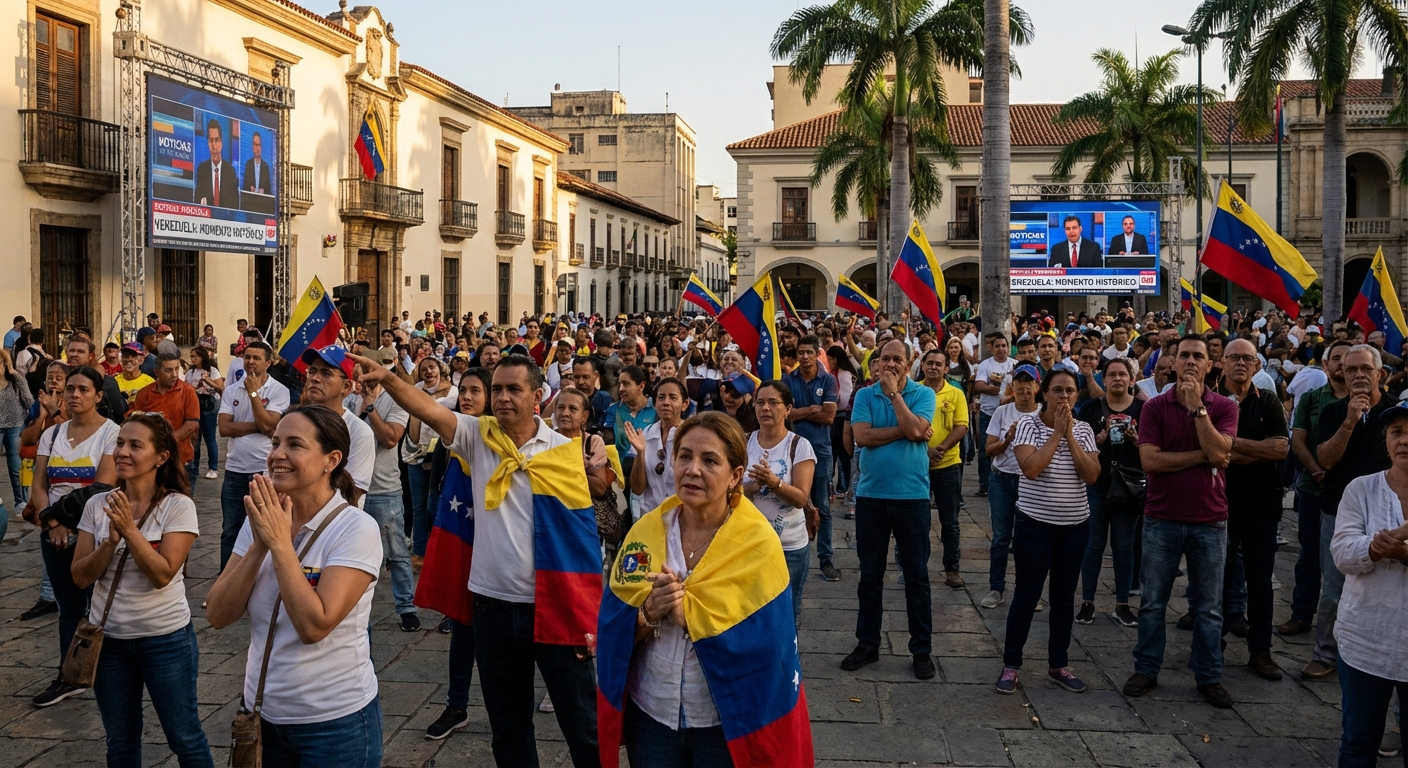
Back in Caracas, the situation remains fluid. The Constitutional Chamber of Venezuela’s Supreme Court ordered Vice President Delcy Rodríguez to assume the role of acting president. Rodríguez, a longtime Maduro loyalist, appeared on state television Sunday to denounce the “imperialist aggression” and vow that the government would continue.
The Venezuelan military has not attempted any retaliatory action, and there are reports of some officers quietly welcoming Maduro’s removal. The opposition, led by figures who have long claimed Maduro stole the 2018 and 2024 elections, faces a complicated situation. Many opposition leaders oppose Maduro but also oppose the manner of his removal, fearing it undermines their democratic legitimacy.
The broader question is whether this creates an opening for political transition or simply entrenches the remaining chavista leadership. Venezuela’s economy has been in freefall for years, with hyperinflation, shortages of basic goods, and a refugee crisis that has sent millions fleeing to neighboring countries. The removal of Maduro alone doesn’t solve any of these underlying problems.
The Domestic Political Dimension
In the United States, reaction has split largely along partisan lines, though with some notable exceptions. Republican leaders have praised the operation as decisive action against a dictator and drug trafficker. “Maduro has terrorized his people and poisoned ours with cocaine for too long,” said Senator Marco Rubio of Florida, whose state has a large Venezuelan-American population.
Democratic criticism has focused less on Maduro himself, whom few defend, than on the process and precedent. Senator Chris Murphy of Connecticut called it “a dramatic escalation that bypassed Congress entirely,” noting that the administration did not seek authorization under the War Powers Act. Legal scholars have raised questions about whether the operation constitutes an act of war requiring congressional approval.
The political dynamics connect to Trump’s broader approach to executive power, which has emphasized presidential authority over congressional oversight across multiple policy areas. The Venezuela operation represents perhaps the most dramatic test of this approach to date.
What Happens Monday
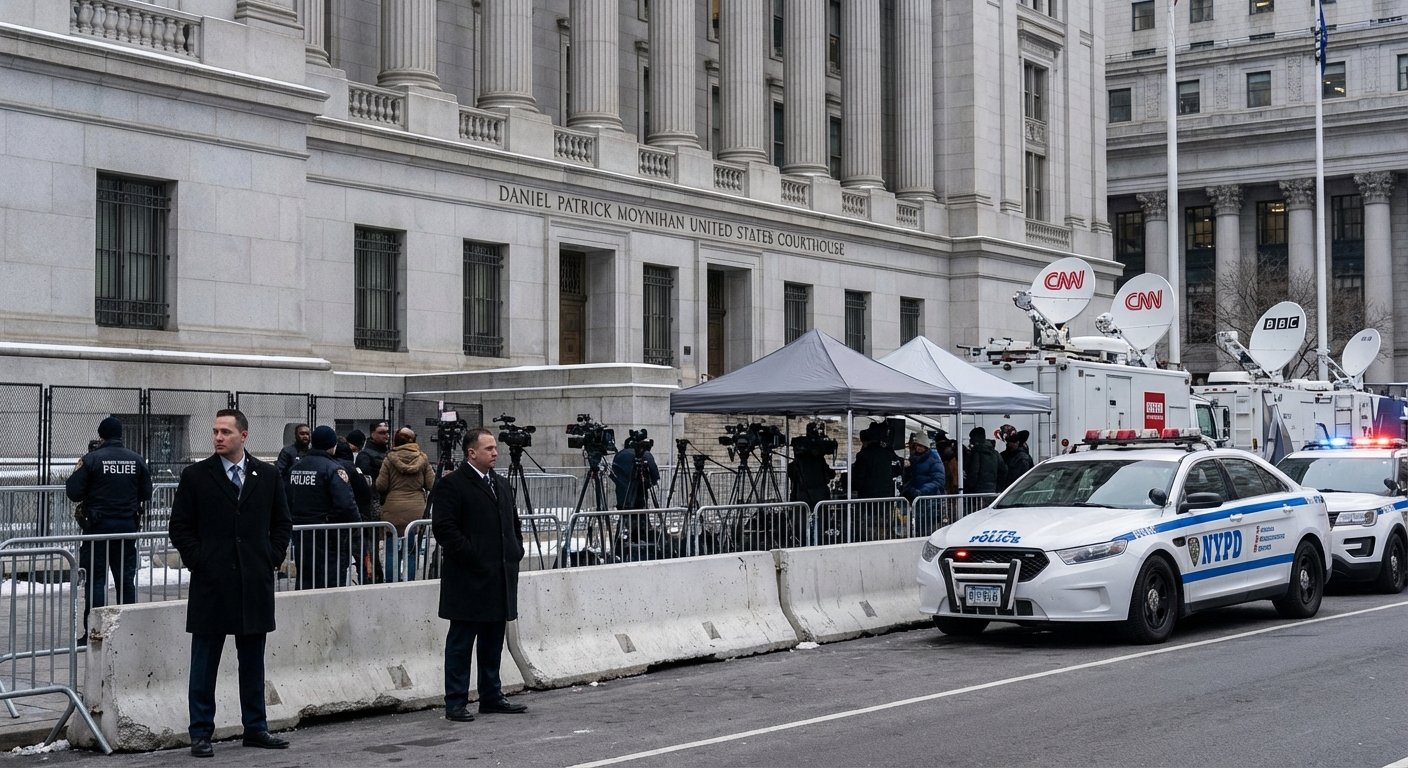
Maduro is expected to appear for arraignment in Manhattan federal court today. The proceeding will be heavily secured, with federal marshals and Secret Service establishing a perimeter around the Daniel Patrick Moynihan Courthouse. Legal experts expect him to be held without bail given flight risk concerns and the severity of the charges.
The trial itself, if it proceeds, would be unprecedented. No sitting or former head of state has ever faced criminal prosecution in a US court. The legal questions are genuinely novel: Can Maduro claim sovereign immunity for actions taken as president? How do US courts handle evidence gathered through military operations? What rights does a captured foreign leader have under American law?
Venezuelan authorities have retained American defense lawyers and are expected to mount aggressive challenges on jurisdiction and due process grounds. The case could take years to resolve and may ultimately reach the Supreme Court.
The Bigger Picture
Saturday’s operation will reshape discussions about American power, international law, and the limits of sovereignty for years to come. Supporters see it as accountability for a dictator who destroyed his country and enabled drug trafficking. Critics see it as a dangerous precedent that any powerful nation can now invoke to justify capturing foreign leaders it dislikes.
The regional implications are significant. Other Latin American leaders, even those who opposed Maduro, are now calculating whether they could face similar treatment. The Thailand-Cambodia border tensions that escalated last month show how regional conflicts can spiral quickly. The Venezuela situation adds another variable to an already unstable hemisphere.
For ordinary Venezuelans, the most important question remains unanswered: Will this change anything? Maduro’s removal doesn’t restore the economy, return the millions who fled, or automatically create democratic governance. The chavista movement still controls the military, the courts, and the state apparatus. Whether this moment becomes a turning point or just another chapter in Venezuela’s long crisis depends on what happens in the weeks and months ahead.
The world will be watching that Manhattan courtroom today. But the more important drama is playing out 2,000 miles south, where a traumatized nation wonders what comes next.