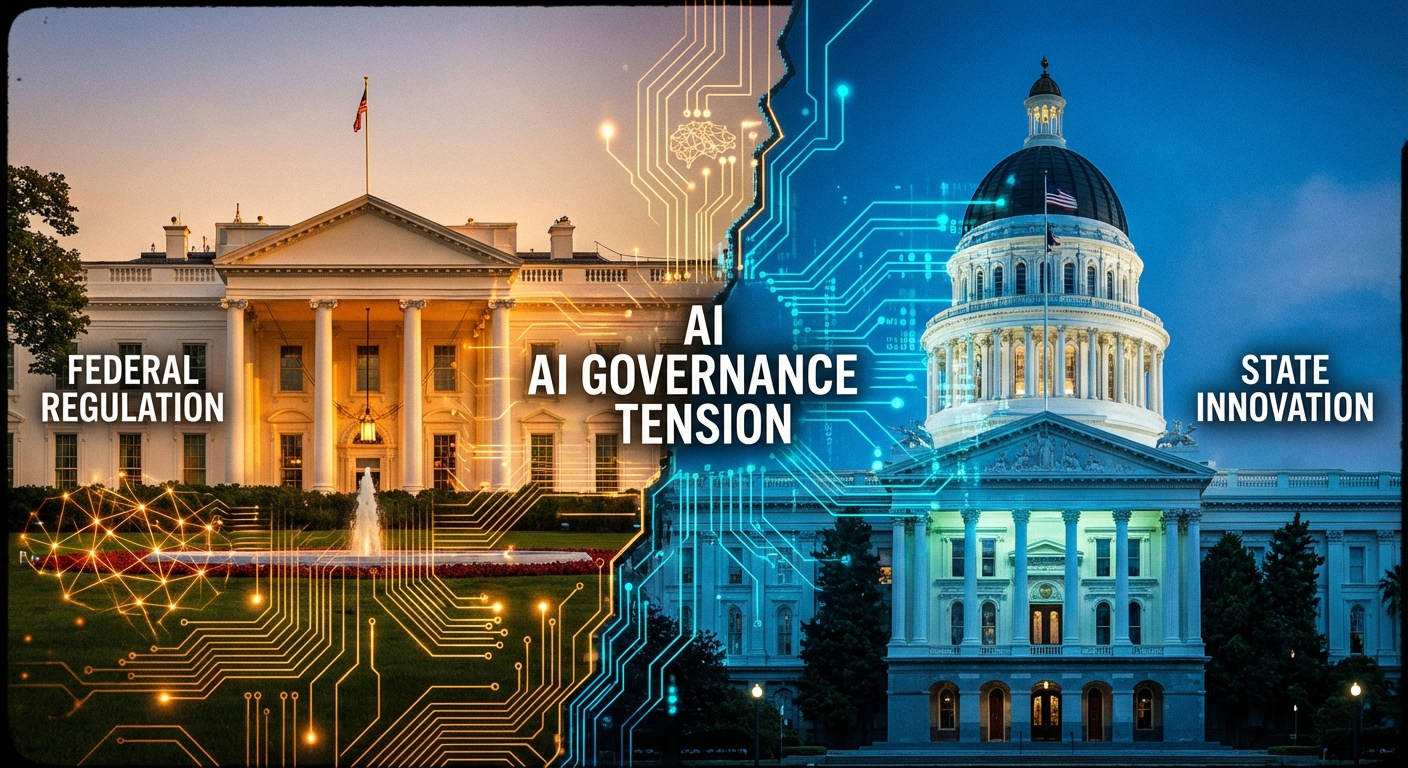
President Trump just tried to do something he’s been unable to get Congress to do twice: override state artificial intelligence regulations with a single stroke of the pen. The executive order signed Thursday evening aims to create a “single national framework” for AI and block states like California and New York from enforcing their own rules. There’s just one problem, according to legal experts: presidents can’t actually preempt state law through executive action.
The order, signed on the same day TIME named the “Architects of AI” its 2025 Person of the Year, represents the Trump administration’s most aggressive move yet in its campaign to create a regulatory environment friendly to American AI companies. But it also reveals a stark reality: despite White House AI czar David Sacks’ lobbying efforts and intense pressure from the tech industry, Congress has rejected federal AI preemption not once, but twice this year, including a 99-1 vote in the Senate to strip similar language from the budget bill.
What the Executive Order Actually Does
The order doesn’t just state the administration’s preference for light-touch AI regulation. It creates an entirely new enforcement mechanism designed to actively challenge state laws in court. According to CNBC’s reporting, the order directs Attorney General Pam Bondi to establish an “AI Litigation Task Force” within 30 days. This team’s sole responsibility will be to identify and challenge state AI laws that conflict with the Trump administration’s regulatory vision.
The scope is significant. The administration is particularly focused on states that have passed comprehensive AI safety requirements, with California’s legislation serving as the primary target. Tech companies have long argued that a patchwork of state regulations creates compliance nightmares and puts American AI development at a competitive disadvantage against China, which operates under a single national framework.
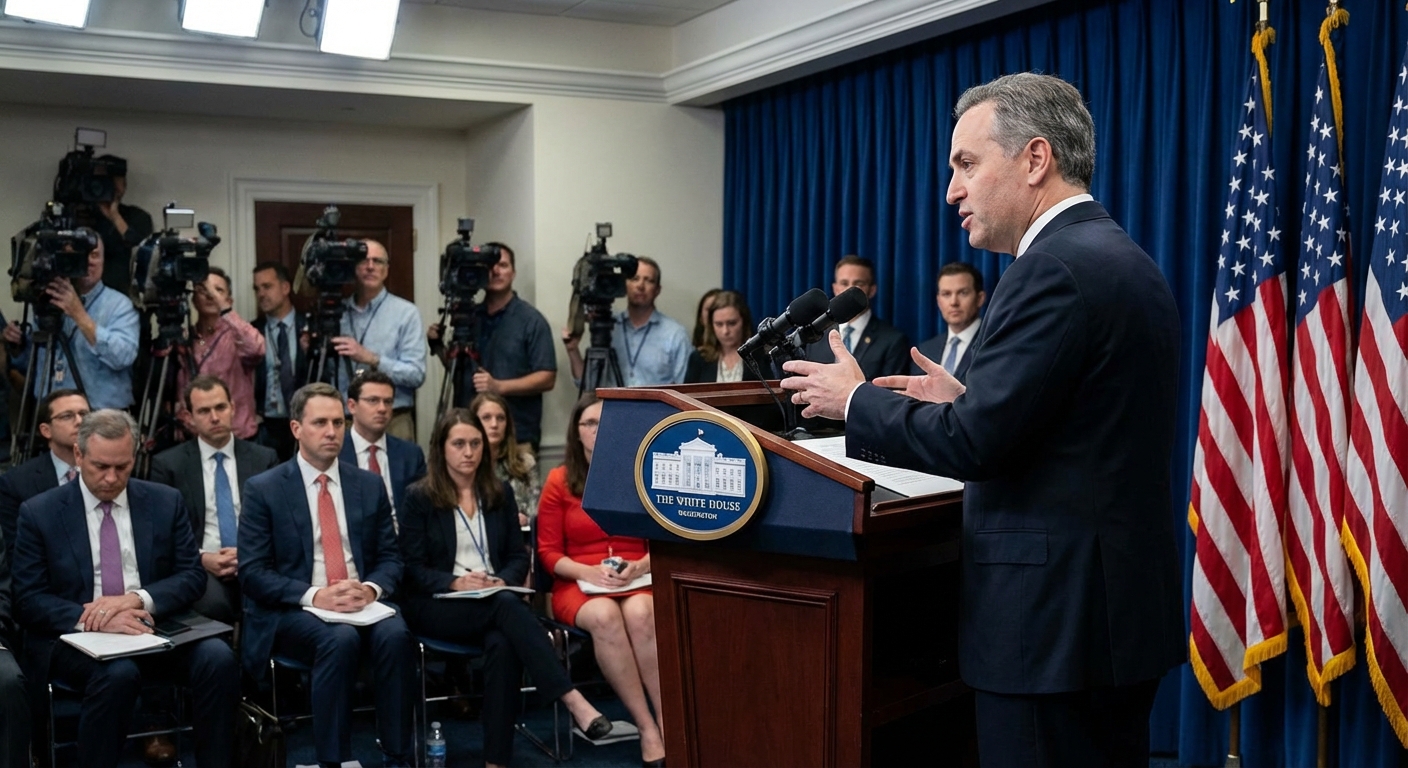
But the order goes beyond litigation. It also directs Commerce Secretary Howard Lutnick to study whether federal rural broadband funding can be withheld from states with AI laws the administration finds “cumbersome.” This funding mechanism could give the administration significant leverage even if courts ultimately reject federal preemption authority.
The Legal Reality Check
Here’s where things get complicated for the White House. Constitutional law is clear on one point: executive orders cannot preempt state law. That authority belongs exclusively to Congress. As NPR reported, tech policy researchers say the Trump administration’s approach “may not be legal” without congressional action.
The order acknowledges this limitation, at least implicitly. It directs Sacks and Office of Science and Technology Policy director Michael Kratsios to develop recommendations for federal legislation that would formally preempt state AI laws. In other words, the executive order is partly a placeholder, establishing the administration’s position while it continues pushing Congress for the authority it actually needs.
That congressional path hasn’t gone well. The administration’s first attempt failed when senators stripped preemption language from this year’s budget bill in an overwhelming bipartisan rebuke. The second attempt, to include preemption in the annual defense policy bill, also collapsed despite intense White House lobbying. The coalition opposing preemption includes an unusual alliance: Democratic state attorneys general defending their regulatory authority, and MAGA conservatives who view the approach as a giveaway to big tech at the expense of states’ rights.
Former Trump adviser Steve Bannon captured the conservative skepticism in characteristically blunt terms, telling Axios that “David Sacks having face-planted twice on jamming AI Amnesty into must-pass legislation now completely misleads the President on preemption.”
What’s Actually at Stake
The policy battle matters enormously for how artificial intelligence develops in America. California alone represents the world’s fifth-largest economy, and its AI regulations effectively set standards for companies operating nationwide. When California passed its comprehensive AI safety framework, it included requirements for testing dangerous capabilities, mandatory “kill switch” mechanisms for the most powerful systems, and disclosure requirements about training data.
Tech industry leaders argue these requirements slow innovation and impose costs that benefit Chinese competitors operating without such restrictions, the same competitors who are training a million AI-robotics specialists through dedicated university programs. They point to studies showing compliance with multiple state frameworks can consume 15-20% of an AI company’s engineering resources. For startups especially, navigating 50 different regulatory environments is impractical, potentially pushing AI development overseas.

Consumer advocates and AI safety researchers counter that the federal government has shown little appetite for meaningful oversight, making state experimentation essential. This mirrors earlier debates over antitrust enforcement against Big Tech, where state attorneys general stepped in when federal action stalled. They note that California’s AI safety requirements emerged after years of documented harms, from discriminatory hiring algorithms to AI systems that spread misinformation. Without state-level protections, critics argue, Americans would have virtually no guardrails against AI risks.
The executive order does carve out some exceptions. State laws related to child safety protections, data center infrastructure, and state procurement of AI systems are explicitly exempt from the administration’s preemption push. These carve-outs suggest the White House recognizes some state regulation as legitimate, even while challenging broader safety frameworks.
What Happens Next
The executive order is almost certain to face immediate legal challenges. State attorneys general in California, New York, and other states with AI regulations are expected to sue, arguing the administration lacks constitutional authority to preempt their laws. Those challenges could take years to resolve, creating prolonged uncertainty for companies trying to navigate the regulatory landscape.
Meanwhile, the administration will continue its congressional push. The AI Litigation Task Force created by the order will begin identifying state laws to challenge, potentially creating a series of legal conflicts that could pressure Congress to act. The funding leverage over rural broadband programs gives the administration another pressure point, particularly in states where those programs are popular.
For AI companies, the order provides rhetorical ammunition but little practical relief. Until courts rule or Congress acts, state laws remain enforceable. The smart money says companies will continue compliance efforts while lobbying continues in Washington. The alternative, ignoring state requirements and betting on federal preemption, carries risks few public companies are willing to take.
The Bottom Line
Trump’s executive order represents the most aggressive federal challenge to state AI regulation yet, but it may prove more symbolic than substantive. The constitutional authority to preempt state law lies with Congress, not the president, and Congress has twice rejected this approach by overwhelming margins. The order creates new tools for challenging state laws, but those challenges face steep legal hurdles.
What the order does accomplish is clarifying the battle lines. The Trump administration has made its position unambiguous: it wants a light-touch federal framework that prevents states from imposing meaningful oversight on AI development. Whether that vision prevails depends on courts, Congress, and ultimately voters deciding how much AI regulation they want, and who should provide it.
For now, the patchwork remains. Companies must still comply with California’s requirements, New York’s disclosure rules, and the growing list of state AI laws. The executive order promises to change that, but promises from the executive branch require congressional follow-through to become reality.
Sources: The White House, CNBC, NPR, Axios.