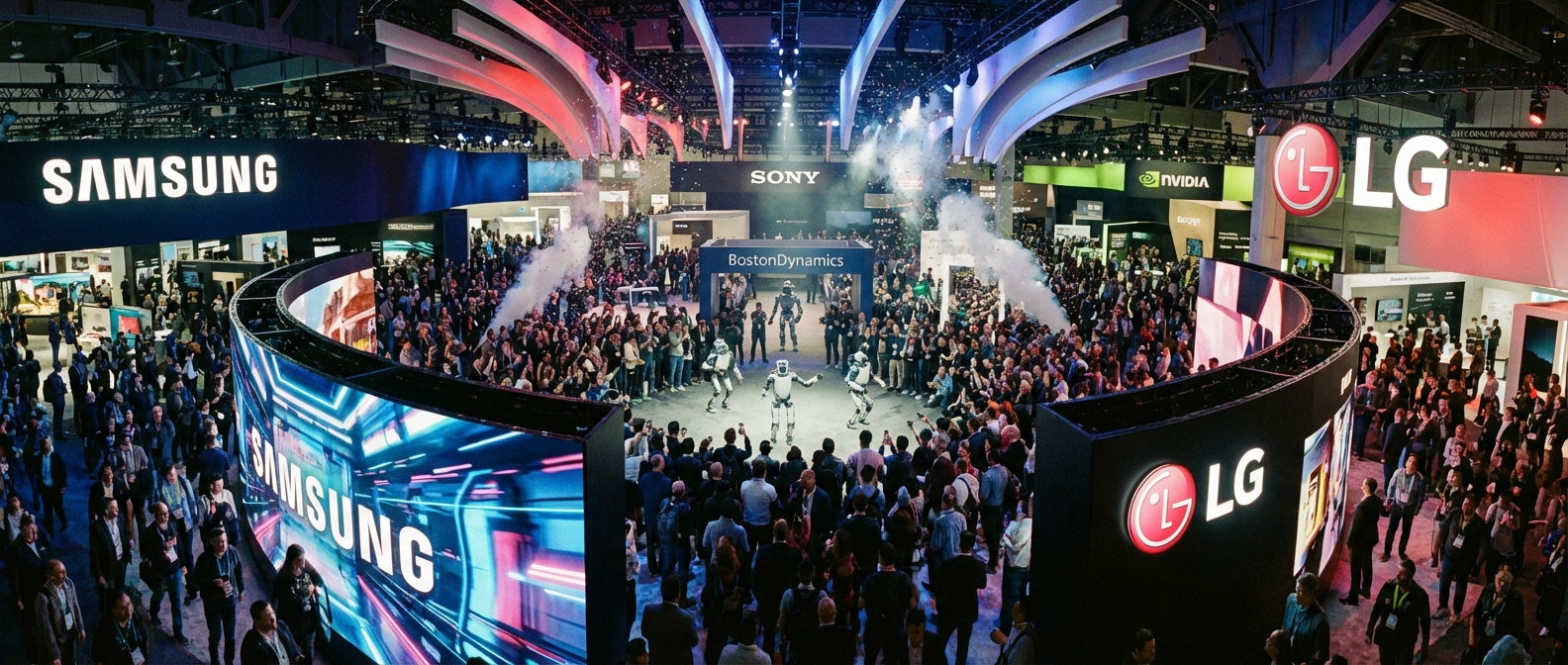
Your next TV might have 336 billion pixels per inch. Your next phone might fold three different ways. And your next coworker might be a robot trained on physics simulations generated by artificial intelligence. Welcome to CES 2026, where the tech industry’s biggest annual gathering has delivered announcements that feel less like incremental updates and more like glimpses of a genuinely different future.
The Consumer Electronics Show officially opened this week in Las Vegas, sprawling across 2.6 million square feet and 13 venues with over 4,500 exhibitors. While Nvidia’s Jensen Huang keynote grabbed headlines with AI infrastructure announcements, the show floor has been dominated by three themes that will actually affect consumers in 2026: a generational leap in TV display technology, the first wave of genuinely useful humanoid robots, and foldable phones that finally make sense. Here’s what you need to know.
Micro RGB: The Next Generation of TV Displays
The biggest story in home entertainment at CES 2026 isn’t OLED or Mini LED. It’s a technology called Micro RGB that both Samsung and LG have positioned as the future of premium televisions. If the demonstrations are any indication, they might be right.
Samsung brought a 130-inch Micro RGB concept model to Las Vegas that stopped attendees in their tracks. The technology uses microscopic red, green, and blue LEDs in the backlight plane rather than the white LEDs and color filters found in traditional LCD displays. According to Samsung’s technical briefing, this approach delivers a wider color gamut and more precise local luminance than anything currently on the market.
The practical impact is immediately visible. Colors pop with an intensity that makes even premium OLED sets look slightly muted by comparison. Black levels approach true darkness thanks to precise local dimming that can control thousands of individual zones. And brightness levels exceed 4,000 nits in some measurements, roughly double what flagship OLEDs achieve today.
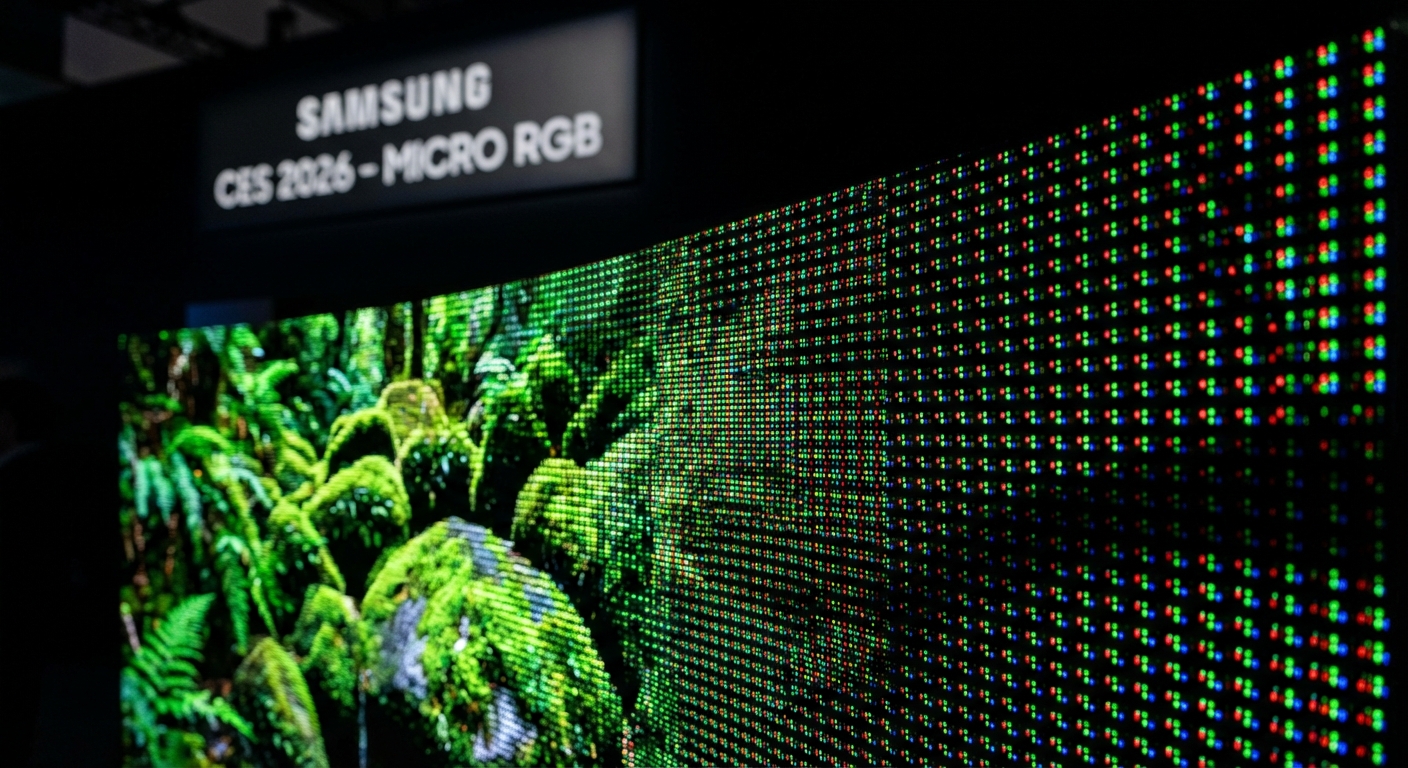
Samsung has already been selling Micro RGB TVs since August when it launched a 115-inch model for $29,999. But CES 2026 reveals where the technology is heading. The company announced it will offer Micro RGB sets in 55, 65, and 75-inch sizes later this year, bringing the technology into size ranges that more consumers might actually consider. Pricing remains steep, but Samsung executives suggested that costs will decline faster than OLED did in its early years because the manufacturing process is less complex.
LG responded with its own Micro RGB evo lineup, featuring sets certified for full coverage of BT.2020, DCI-P3, and Adobe RGB color spaces. The company’s 100-inch demonstration unit at CES featured what LG calls Micro Dimming Ultra, delivering over 1,000 local dimming zones. LG has been fighting Samsung for display supremacy for years, and Micro RGB represents the latest front in that battle.
For consumers, the practical question is whether Micro RGB TVs will be affordable enough to matter. The technology needs to reach the $2,000 to $3,000 price range where most premium TV purchases happen before it transforms the market. Samsung’s roadmap suggests that could happen by 2028, with more accessible models arriving sooner for buyers willing to stretch their budgets.
OLED Isn’t Going Anywhere
Even as Micro RGB steals attention, the major manufacturers haven’t abandoned OLED technology. LG announced its flagship G6 OLED evo with a 20% brightness improvement over last year’s G5, thanks to a new Primary RGB Tandem 2.0 display panel. The G6 will also be the world’s first TV with native 120Hz cloud gaming and ultra-low latency Bluetooth controller support, positioning it for gaming audiences who want OLED’s response times without the input lag that has traditionally plagued wireless controllers.
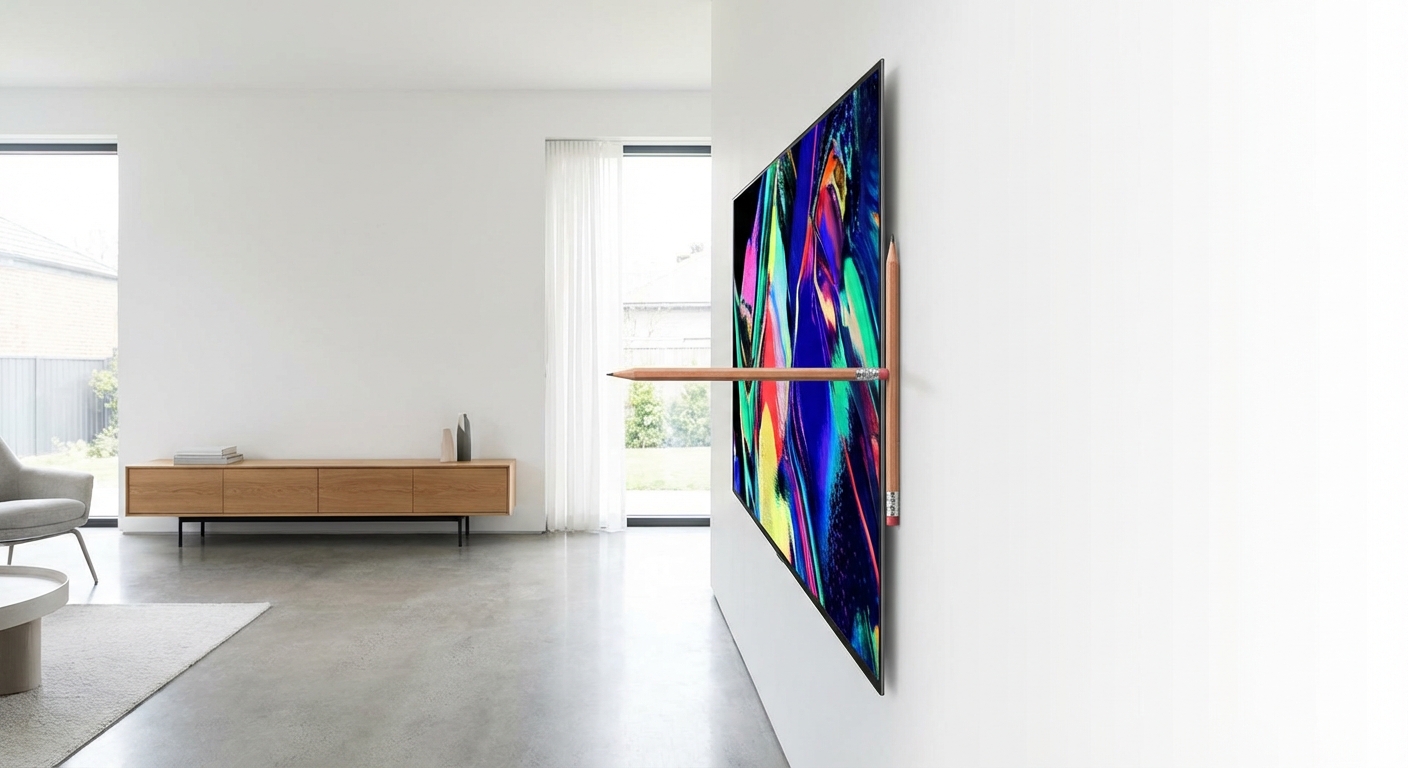
The most visually striking announcement came from LG’s Wallpaper TV revival. The W6 combines LG’s best OLED technology with wireless connectivity and a profile about as thin as a pencil. It includes Hyper Radiant Color for improved black levels, Brightness Booster Ultra that cranks luminance 3.9 times higher than conventional OLEDs, and a reflection-free screen material that addresses one of OLED’s persistent weaknesses in bright rooms.
Samsung Display raised the stakes further with a new QD-OLED panel capable of 4,500-nit peak brightness, up from approximately 3,000 nits in current models. The panel combines quantum dots with OLED technology to deliver color accuracy and brightness that rivals the best LCD displays while maintaining the deep blacks and perfect viewing angles that make OLED appealing.
The TV wars are entering a phase where different technologies excel at different things. Micro RGB offers the best overall picture quality but at premium prices. QD-OLED delivers the best combination of brightness and black levels for high-end buyers. Standard OLED remains the sweet spot for gamers and movie enthusiasts who prioritize response times and viewing angles. And Mini LED continues to offer excellent performance at mainstream prices. For consumers, this means more choices, which is exactly what a healthy market should provide.
Humanoid Robots Go Into Production
The robotics announcements at CES 2026 represent something genuinely new. After years of impressive demonstrations that never led to commercial products, two companies announced they’re actually shipping humanoid robots this year.
Boston Dynamics revealed that its Atlas robot is entering production, with all 2026 units already committed to customers. The production version features a reach of up to 7.5 feet, the ability to lift 110 pounds, and the capacity to operate in temperatures ranging from negative 4 to 104 degrees Fahrenheit. Boston Dynamics CEO Robert Playter called it “the best robot we have ever built,” which given the company’s history of viral demonstration videos, carries significant weight.
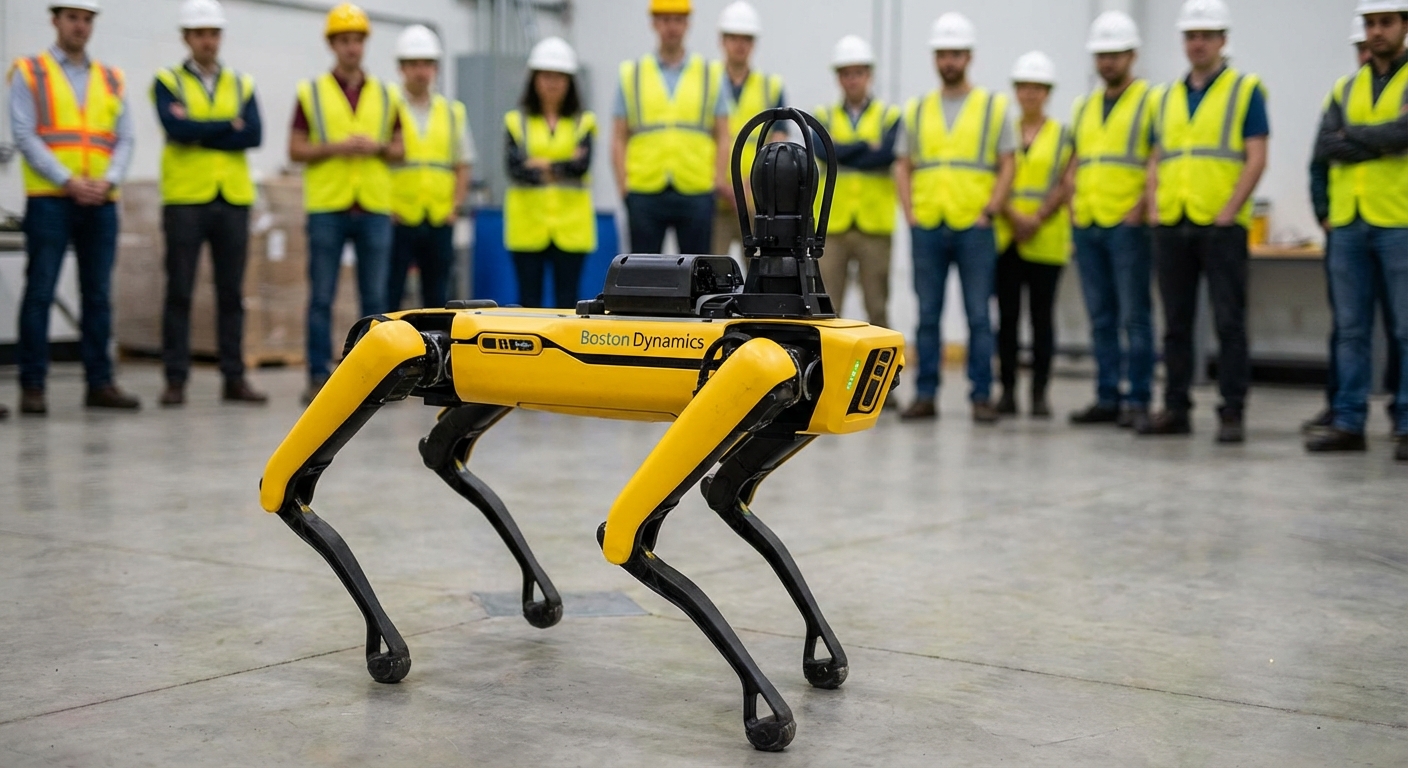
The bigger news is who’s buying these robots and what they’re doing with them. Hyundai, which owns Boston Dynamics, plans to deploy Atlas in its car manufacturing plants by 2028, focusing initially on parts sequencing. By 2030, the automaker hopes to expand the robot’s responsibilities to component assembly and tasks involving repetitive motions, heavy loads, and complex operations. Hyundai also announced a $26 billion investment in US operations, including a new robotics factory capable of producing 30,000 robots per year.
Perhaps more significantly, Boston Dynamics announced a partnership with Google DeepMind to integrate advanced AI foundation models into Atlas robots. Carolina Parada, senior director of robotics at Google DeepMind, stated that the partnership aims to develop “the world’s most advanced robot foundation model.” Google previously owned Boston Dynamics from 2013 until selling it to SoftBank in 2017, making this partnership something of a reunion.
LG also revealed a humanoid robot designed for household tasks, though the company provided fewer specifics about production timelines. The robot demonstrated folding laundry and fetching items during LG’s presentation, tasks that require the kind of dexterous manipulation that has historically been difficult for robots. LG’s approach relies on simulation training, using virtual environments to teach robots how to handle objects before they encounter them in the real world.
The Nvidia Cosmos AI platform, announced during Jensen Huang’s keynote, plays a role in this robotics surge. Cosmos can generate physically accurate simulations from 3D models, creating synthetic training data that grounds robot AI in actual physics. Two demonstration robots powered by Cosmos appeared on stage during Nvidia’s presentation, operating autonomously and navigating around obstacles without human intervention.
For consumers, household robots remain years away from mainstream adoption. But the manufacturing deployments happening in 2026 will determine whether humanoid robots become economically viable. If Hyundai’s plant deployments succeed, expect the technology to spread rapidly. If they fail, the humanoid robot dream may retreat to research labs for another generation.
Foldable Phones Finally Make Sense
Samsung and Motorola both unveiled foldable phones at CES 2026 that address the biggest criticism of previous generations: why fold a phone in half when the folded version is just as big as a regular phone?
Samsung’s Galaxy Z TriFold answers that question by folding twice, creating a device that expands to a 10-inch display when fully opened while remaining reasonably compact when closed. Priced around $2,500 in Korea, the TriFold targets users who want a tablet-sized screen without carrying a separate device. The price is steep, but Samsung is betting that the category will follow the same trajectory as previous foldables, with costs declining as manufacturing scales.
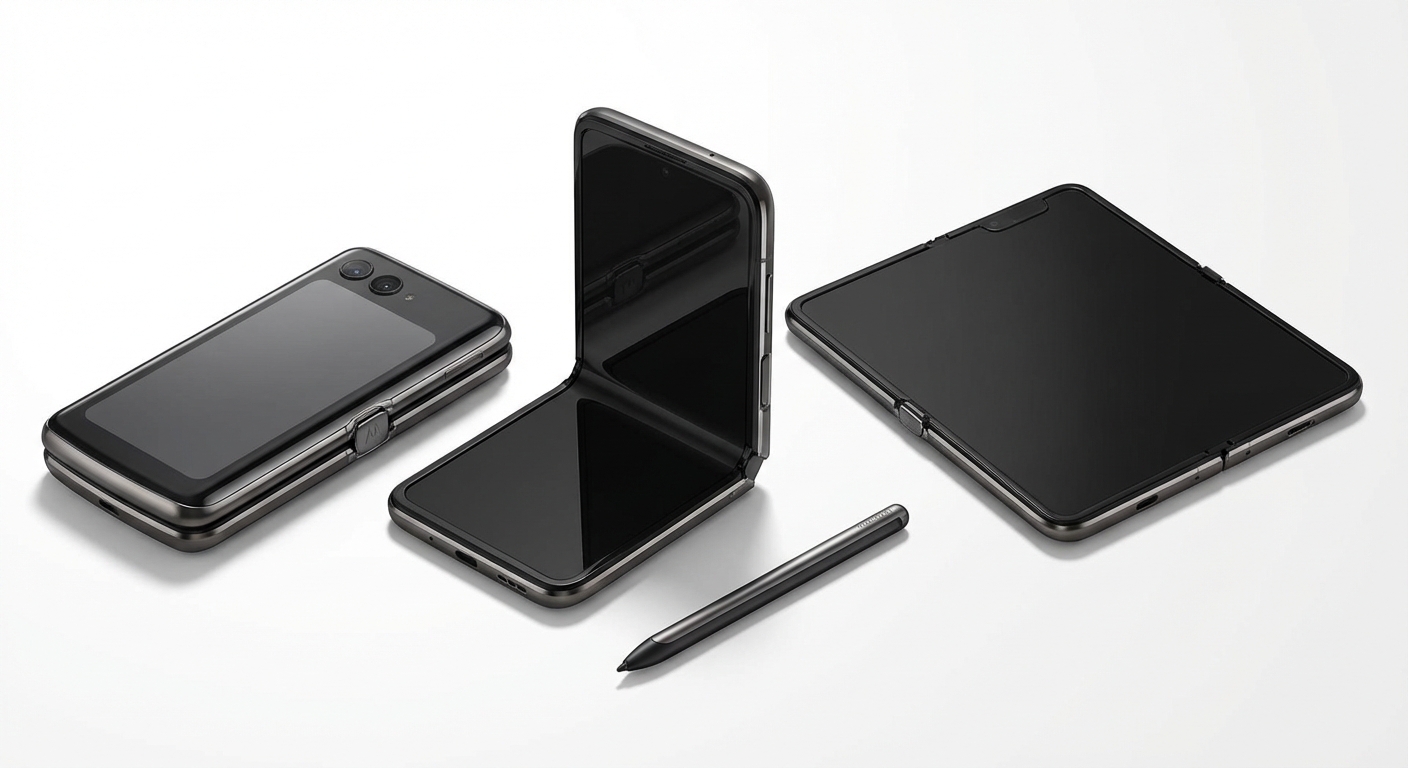
Motorola took a different approach with its first side-folding phone, the Razr Fold. Unlike Samsung’s book-style foldables, the Razr Fold features a 6.6-inch external screen that’s fully functional without unfolding the device, plus an 8.1-inch main display that emerges when you need more space. Stylus support adds a productivity dimension that could appeal to business users who want to sketch or annotate on a larger screen.
The foldable market has been searching for its killer use case since Samsung launched the original Galaxy Fold in 2019. Early models felt like compromises: thicker than regular phones, fragile where they folded, and expensive without offering compelling benefits. The 2026 crop suggests manufacturers are finally figuring out what foldables should be. The answer isn’t just a phone that bends in half but rather a device that offers genuinely different experiences depending on how you configure it.
What Else Caught Our Eye
Beyond the major categories, several announcements deserve mention. Amazon entered the art TV market with the Ember Artline, a 4K OLED that integrates with Amazon Photos and offers 2,000 free art pieces. Lenovo unveiled smartglasses that look like ordinary eyewear while providing touch and voice control plus teleprompter software. LEGO announced Smart Brick technology that brings interactivity to its building sets. Sony and Honda showed the latest version of their Afeela electric vehicle, which now supports PS5 remote play while parked.
Intel’s Panther Lake chips represent the company’s continued effort to compete in mobile processors, while AMD’s Lisa Su announced new Ryzen AI processors alongside the Ryzen 7 9850X3D for gaming. The chip wars continue unabated, with each company trying to carve out advantages in AI acceleration, power efficiency, and raw performance.
The Bottom Line
CES 2026 delivers what the show has always promised: a preview of technology that will trickle into everyday life over the coming years. The Micro RGB TVs you saw demonstrated this week will hang in living rooms by 2028. The humanoid robots being tested now will work in factories by 2030. The foldable phone form factors being refined today will become standard options when you upgrade your device.
What’s different this year is the sense that several technologies have crossed thresholds from impressive demos to commercially viable products. Boston Dynamics isn’t just showing robots; it’s shipping them. Samsung isn’t just demonstrating Micro RGB; it’s selling sets in multiple sizes. The gap between what’s possible and what’s available is narrowing, and CES 2026 shows just how quickly that gap is closing.
Sources: Engadget, Tom’s Guide, TechRadar, Boston Dynamics, Yahoo Finance.