
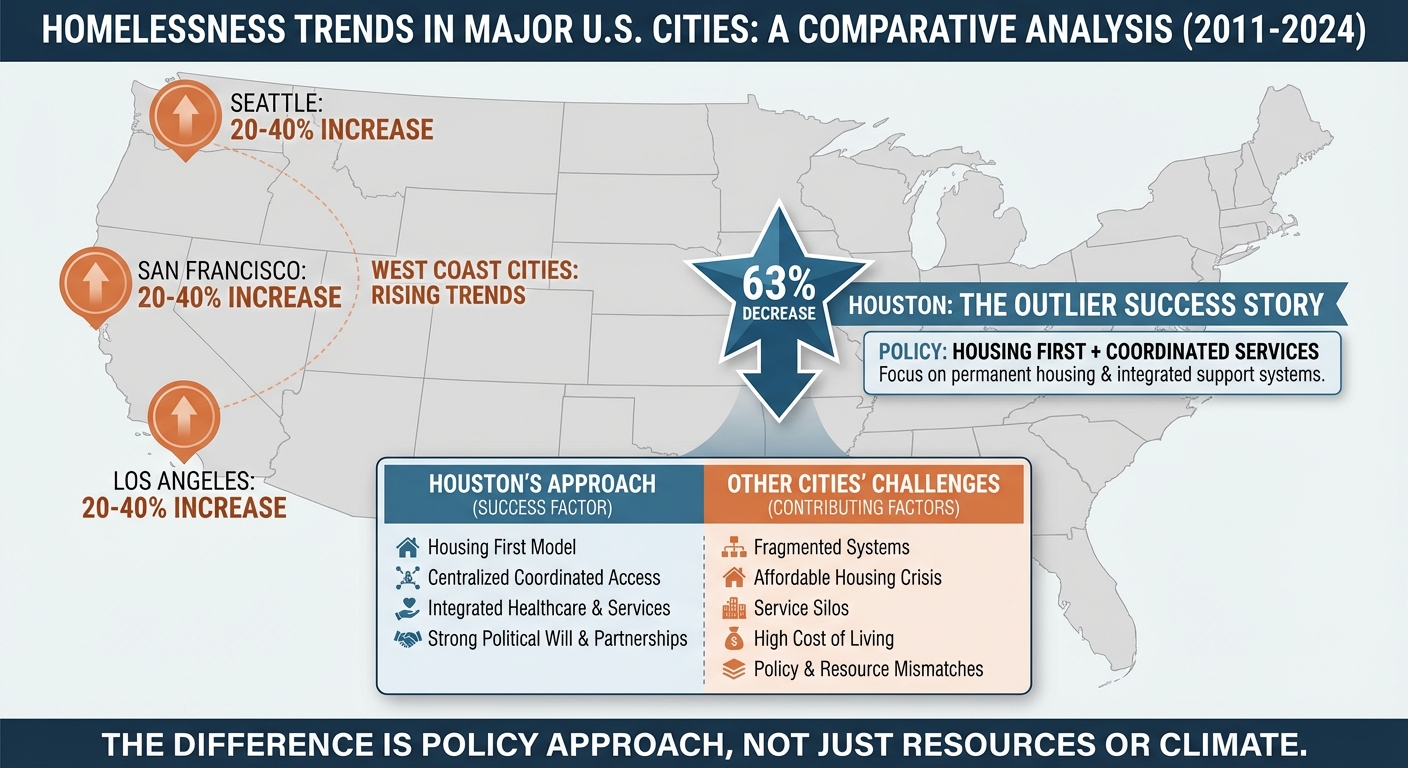
While Los Angeles, San Francisco, and Seattle see homelessness increasing 20-40% despite spending billions, Houston decreased its homeless population by 63% over the past decade. Houston isn’t richer than these cities, doesn’t have better weather, and doesn’t have stricter laws. It succeeded by adopting a radically simple approach that contradicts conventional wisdom: Housing First.
Instead of requiring people to get sober, find a job, or comply with shelter rules before receiving housing, Houston gives them the apartment first. The logic is that stable housing is a prerequisite for solving addiction or mental health issues, not a reward for solving them. Turns out expecting someone to recover from trauma while living on the street is a setup for failure.
The Economic Case
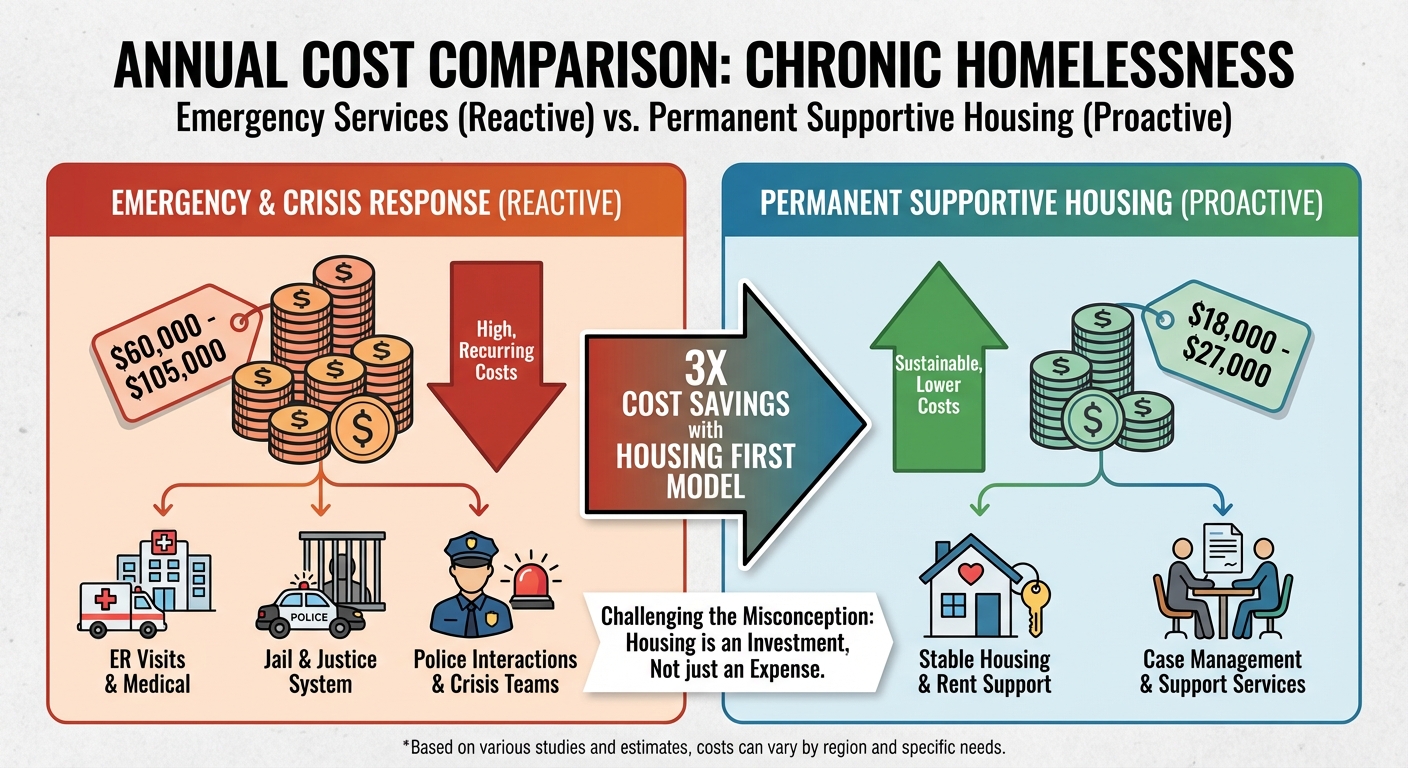
The most common objection to Housing First is cost, but the data shows the opposite. A chronically homeless person costs the city $60,000-$105,000 annually in emergency room visits, jail stays, and police interventions. Providing permanent supportive housing with case management costs about $18,000-$27,000 per year.
The math is undeniable: it’s three times cheaper to give someone a home than leave them on the street. The “we can’t afford housing” argument is backward. Cities can’t afford not to provide housing given the exorbitant cost of the emergency-response alternative.
Why Houston Succeeded
Houston’s success wasn’t just philosophy, it was execution. The city moved all service providers, government agencies, nonprofits, and faith groups, under a single coordinated umbrella. Instead of competing for funding or operating in silos, everyone worked from the same list of names. They used data to track outcomes and hold providers accountable.
Crucially, they engaged private landlords. Rather than fighting NIMBY battles to build new shelters, they convinced existing landlords to rent to homeless individuals by guaranteeing rent and providing case management support. This allowed rapid scaling, moving people into apartments in days rather than months.
Why Other Cities Struggle
If Housing First works and costs less, why don’t all cities do it? The barriers are largely political and ideological. Many voters resist “free housing” for those they perceive as not earning it. NIMBY opposition blocks supportive housing developments. Entrenched interests in the shelter industry resist changes to their funding models.
Houston overcame these barriers through strong political leadership prioritizing results over optics. Other cities often choose policies that feel “tough,” criminalizing homelessness or mandating treatment, even though those policies consistently fail and cost more. Houston proves homelessness is solvable if a city has the will to follow the evidence.
The Bottom Line
Houston’s Housing First model demonstrates that homelessness isn’t an unsolvable crisis. It’s a policy choice. By coordinating services, engaging private landlords, and prioritizing permanent housing over emergency responses, Houston achieved what coastal cities spending far more couldn’t. The lesson is clear: evidence-based policy focused on outcomes beats ideology-driven policy focused on punishment. Other cities are starting to notice. For more examples of policy innovation at the local level, see participatory budgeting. And for another case of red states adopting pragmatic solutions, check out how climate policy is evolving.
Sources: Houston housing data, Housing First research, urban policy analysis.