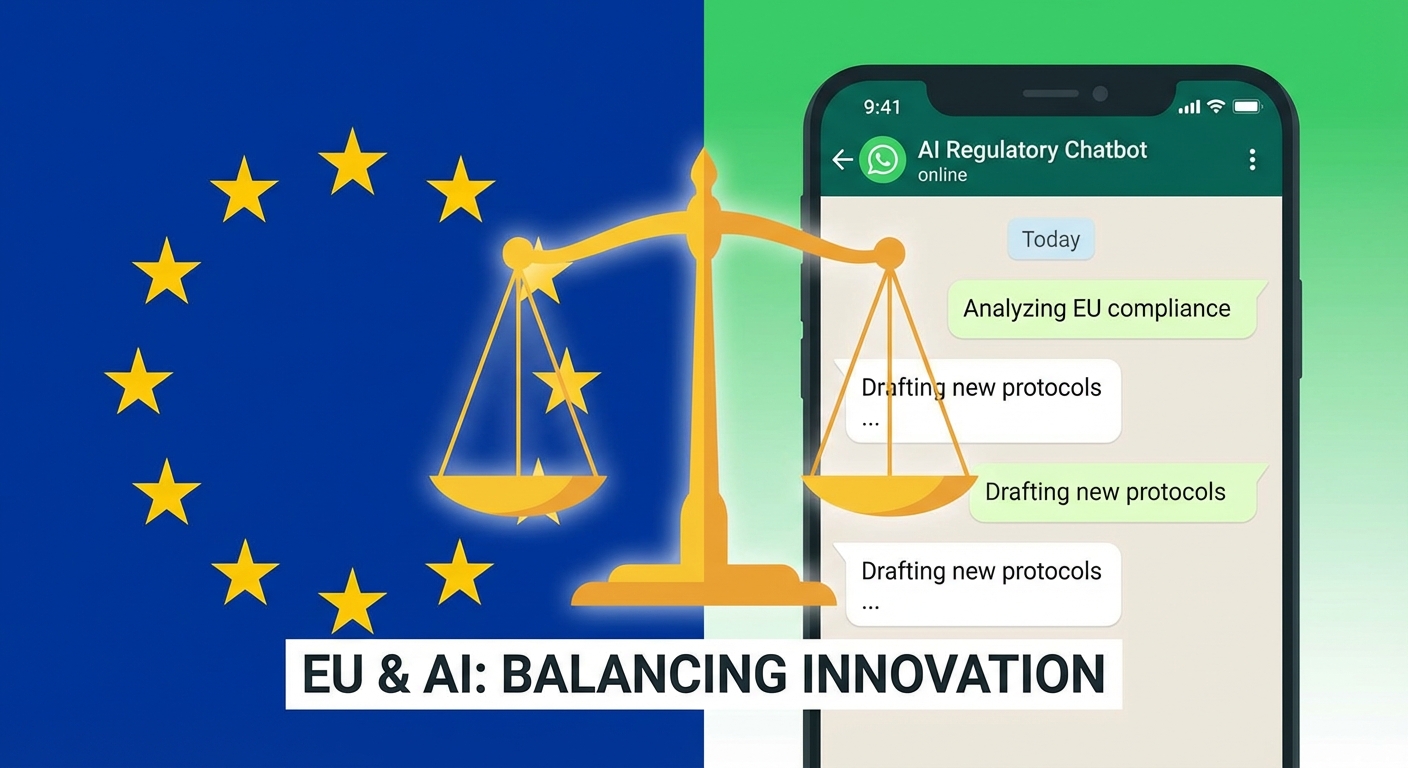
The European Union has launched an antitrust investigation into Meta’s new policy governing how AI providers can access WhatsApp. Regulators warn the rules could shut out rival AI services from the messaging platform and distort competition in Europe’s fast-growing AI market.
The investigation adds to Meta’s growing list of regulatory troubles in Europe, where the company already faces scrutiny over data practices, advertising models, and content moderation. But this case is different: it’s about how AI competition will work in a world where messaging platforms control access to billions of users.
What Meta’s Policy Does
WhatsApp recently introduced rules allowing businesses to integrate AI assistants into their customer service workflows. The catch is that Meta’s own AI tools, built on its Llama models, receive preferential access compared to competitors like OpenAI, Google, or smaller providers.
Under the new policy, third-party AI providers face additional technical requirements, data sharing restrictions, and approval processes that Meta’s own AI doesn’t. Critics describe it as creating a two-tier system where Meta’s AI gets the fast lane while competitors navigate bureaucratic obstacles.
Meta defends the policy as necessary for user privacy and platform security. Allowing unrestricted AI access to WhatsApp conversations would create risks, the company argues, and some level of oversight is appropriate. The question is whether that oversight is applied fairly or designed to advantage Meta’s own products.

The Competitive Stakes
WhatsApp has over 2 billion users globally, with particularly strong penetration in Europe, Latin America, and Asia. For AI companies trying to reach consumers, WhatsApp represents one of the largest potential distribution channels in existence. The Australia social media ban shows how messaging platforms are increasingly in regulators’ crosshairs.
If Meta can effectively require businesses to use Meta AI for WhatsApp integrations, it gains an enormous advantage in the enterprise AI market. Companies that want AI-powered customer service on WhatsApp would face pressure to use Meta’s tools rather than competitors, regardless of which AI might be better for their needs.
This matters because the AI market is still forming. Unlike search (Google), social networking (Meta), or mobile operating systems (Apple and Google), no company has established dominance in AI assistants for business applications. The decisions made now about platform access will shape competition for years.
The Google Precedent
European regulators are explicitly drawing parallels to the Google antitrust cases, where the search giant was found to have leveraged its dominance in one market to gain advantages in others.
The private equity-style corporate strategies has increasingly focused on how platforms can extend power from established businesses into emerging markets. Regulators worry that if they don’t act early, the same patterns that created current tech giants will repeat with AI.
The Google cases took years to resolve and resulted in billions in fines plus behavioral remedies. Meta clearly wants to avoid that path, but may have limited options once an investigation formally begins.
Meta’s Defense
Meta argues its policy is fundamentally about protecting users. WhatsApp’s end-to-end encryption is a core feature, and allowing arbitrary AI access could undermine privacy guarantees that users depend on. There’s some validity to this: AI systems that process message content raise genuine privacy questions.
The company also points out that it doesn’t prohibit third-party AI entirely. Competitors can access WhatsApp under the established rules. The question is whether those rules are reasonable requirements or pretextual barriers designed to disadvantage rivals.
This framing battle will matter. If Meta can convince regulators that the restrictions serve legitimate purposes, it may escape with minor adjustments. If regulators conclude the restrictions are primarily anticompetitive, Meta faces potential fines of up to 10% of global revenue.
What Happens Next
EU investigations typically take 12-18 months, though complex cases can extend longer. During that period, regulators will examine internal Meta documents, interview competitors, and analyze the technical details of the access policies.
Meta has options. It could modify the policy preemptively to address regulatory concerns, potentially avoiding formal findings. It could defend the current approach and fight through the full process. Or it could negotiate a settlement that changes some practices while avoiding admission of wrongdoing.
The outcome matters beyond Europe. EU antitrust decisions increasingly influence global tech regulation, as companies find it easier to adopt worldwide policies than maintain different rules for different markets. Whatever Meta agrees to in Brussels will likely affect WhatsApp AI access everywhere.
Sources: European Commission, Financial Times, Reuters, The Verge.