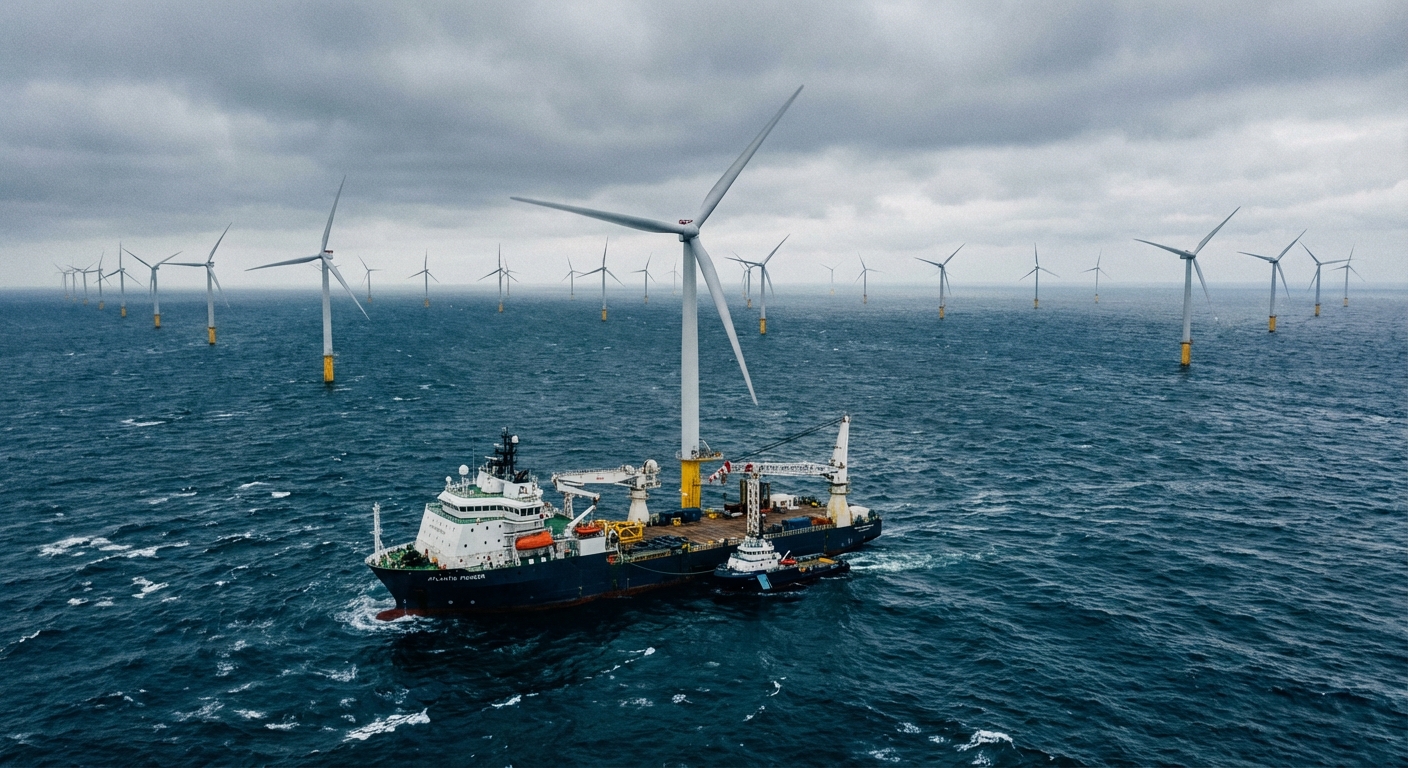
If you’ve been following the construction of massive offshore wind farms along the East Coast, Monday brought bad news. The Trump administration suspended five of the largest projects currently under development, including one that was months away from becoming the biggest offshore wind installation in the United States.
The administration claims the turbines pose national security risks, specifically that they interfere with military radar systems and could obscure threats to coastal population centers. It’s the latest in a series of moves targeting the offshore wind industry, and it comes just two weeks after a federal judge struck down an earlier executive order blocking wind projects as unlawful.
The timing is notable: these projects have been in development for years, have already received permits after extensive Pentagon review, and represent billions of dollars in sunk investment. Whether the suspension holds up to legal scrutiny remains to be seen, but the immediate effect is that construction work has stopped on some of the most ambitious clean energy projects in American history.
Which Projects Are Affected
The Department of the Interior announced Monday that leases are suspended for five major offshore wind developments, all in Atlantic waters along the East Coast.
The biggest target is Coastal Virginia Offshore Wind (CVOW), a Dominion Energy project that was on track to become the largest offshore wind farm in the nation. Set for completion by the end of 2026, CVOW would have generated 2.6 gigawatts of electricity, enough to power roughly 660,000 homes. Virginia, notably, is home to the world’s largest cluster of power-hungry data centers, and CVOW was expected to help meet their enormous electricity demands. Those data centers are already driving tech companies to explore nuclear power as an alternative energy source.
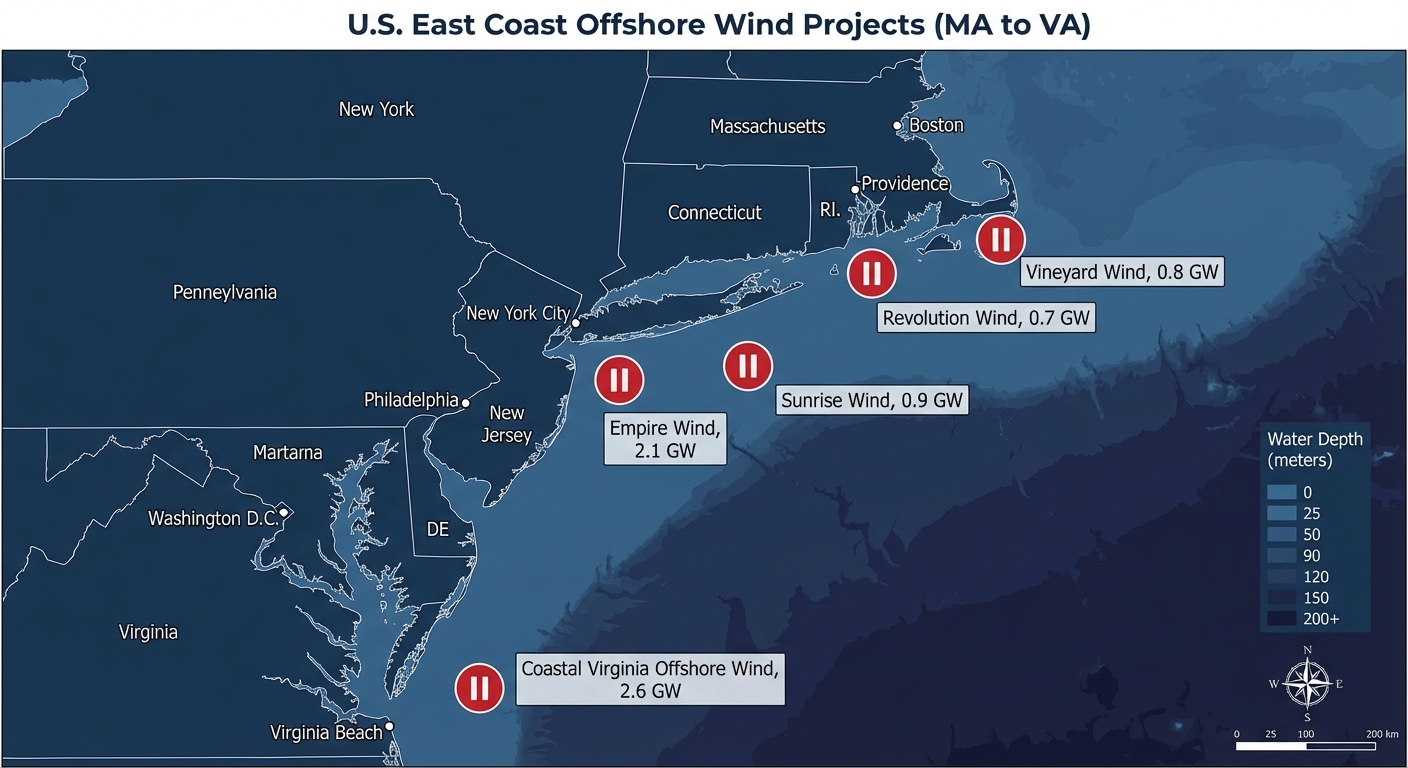
The other suspended projects include:
- Vineyard Wind (Massachusetts): Already under construction, this 800-megawatt project was the first commercial-scale offshore wind farm in the United States
- Revolution Wind (Rhode Island/Connecticut): A 700-megawatt project that had secured all necessary federal approvals
- Empire Wind (New York): Planned 810-megawatt capacity off Long Island
- Sunrise Wind (New York): Another 924-megawatt New York project in development
Together, these five projects represent nearly six gigawatts of planned electricity generation, roughly equivalent to six nuclear power plants. CNBC reported that Dominion Energy’s stock dropped 4% on the news.
The National Security Argument
Interior Secretary Doug Burgum framed the suspension as essential to protecting Americans. “The prime duty of the United States government is to protect the American people,” Burgum stated in the department’s press release. “Today’s action addresses emerging national security risks, including the rapid evolution of relevant adversary technologies, and the vulnerabilities created by large-scale offshore wind projects with proximity near our east coast population centers.”
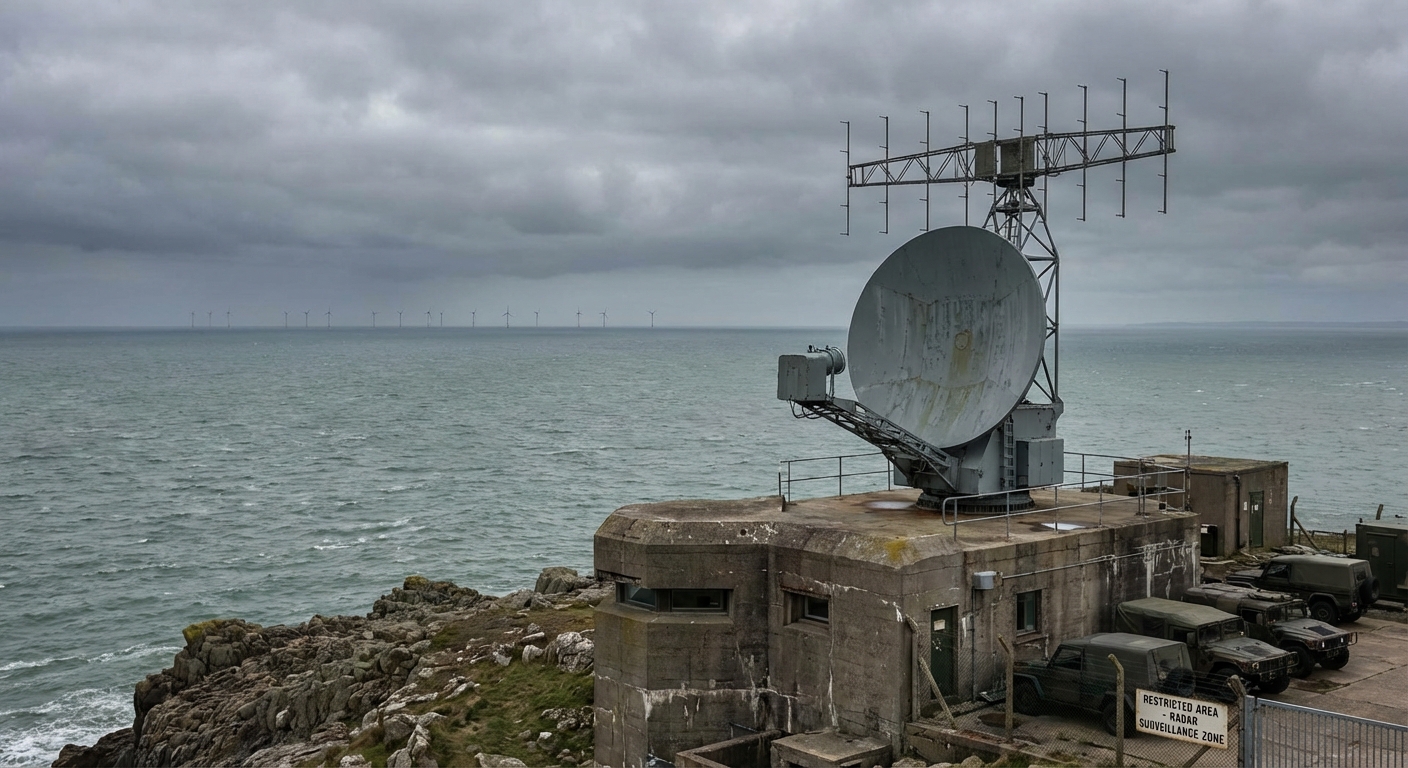
The specific concern, according to the Department of Interior, is radar clutter. “The clutter caused by offshore wind projects obscures legitimate moving targets and generates false targets in the vicinity of the wind projects,” the department stated. In theory, this could make it harder for the military to detect incoming aircraft, missiles, or ships approaching the coast.
The argument isn’t entirely new. The Pentagon has raised concerns about wind turbines and radar interference for years, and similar issues have affected some onshore wind projects near military installations. What’s new is treating this as an emergency requiring immediate suspension of projects that have already been through extensive review.
The Other Side of the Story
Critics of the suspension point out that these projects weren’t approved in a vacuum. NPR’s reporting quotes Kirk Lippold, a national security expert and former Commander of the USS Cole, noting that the projects “were awarded permits following years of review by state and federal agencies,” including the Coast Guard, the Naval Undersea Warfare Center, the Air Force, and others.
“The record of decisions all show that the Department of Defense was consulted at every stage of the permitting process,” Lippold said. If the Pentagon had serious national security objections, the argument goes, those should have been raised years ago when the projects were being evaluated, not after billions of dollars had already been invested in construction.
The suspension also comes in a specific political context. The Trump administration has made no secret of its opposition to wind energy generally, with the president repeatedly claiming (without evidence) that wind turbines cause cancer and kill birds in massive numbers. The administration has already attempted to block offshore wind through executive order, only to have that order struck down by a federal judge two weeks ago. This pattern of using executive authority to override established processes echoes the administration’s recent executive order on AI regulation, which also faced immediate legal challenges.
CNN reported that the suspension “could impact billions of dollars of investment and stall nearly six gigawatts of new electricity set to come online in the next few years.” The economic stakes extend beyond the direct investment: thousands of jobs are tied to these projects, and supply chains have been built around the expectation that construction would continue.
What Happens Now
The legal path forward is unclear. The administration’s earlier attempt to block offshore wind through executive order was rejected by a federal court, and this new suspension operates through a different mechanism by invoking national security concerns and pausing leases rather than outright canceling projects.
Environmental groups and affected states are expected to challenge the suspension in court. The core legal question will likely be whether the administration can retroactively invoke national security concerns for projects that already received Pentagon approval during the permitting process. That’s a novel argument, and courts may be skeptical. Meanwhile, some Republican-led states have been quietly advancing their own climate and energy policies based on economic necessity rather than federal direction.
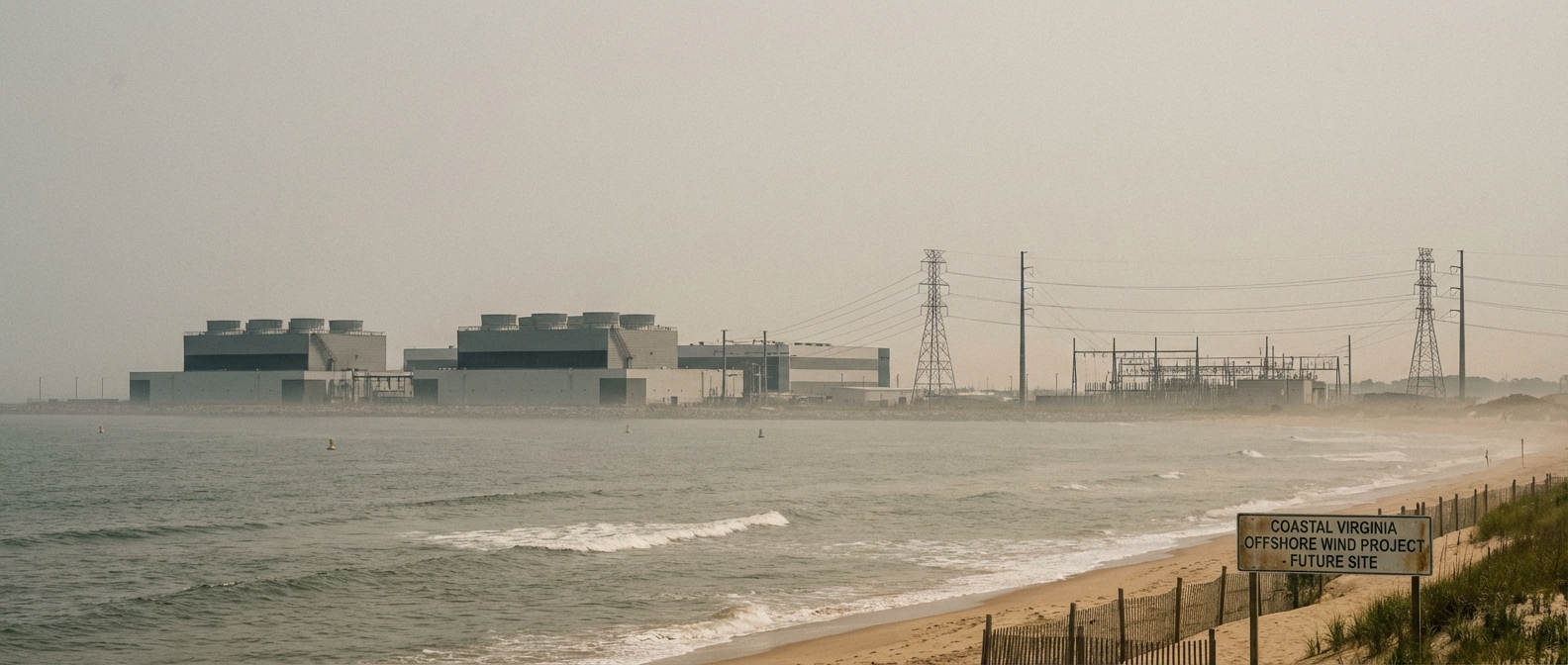
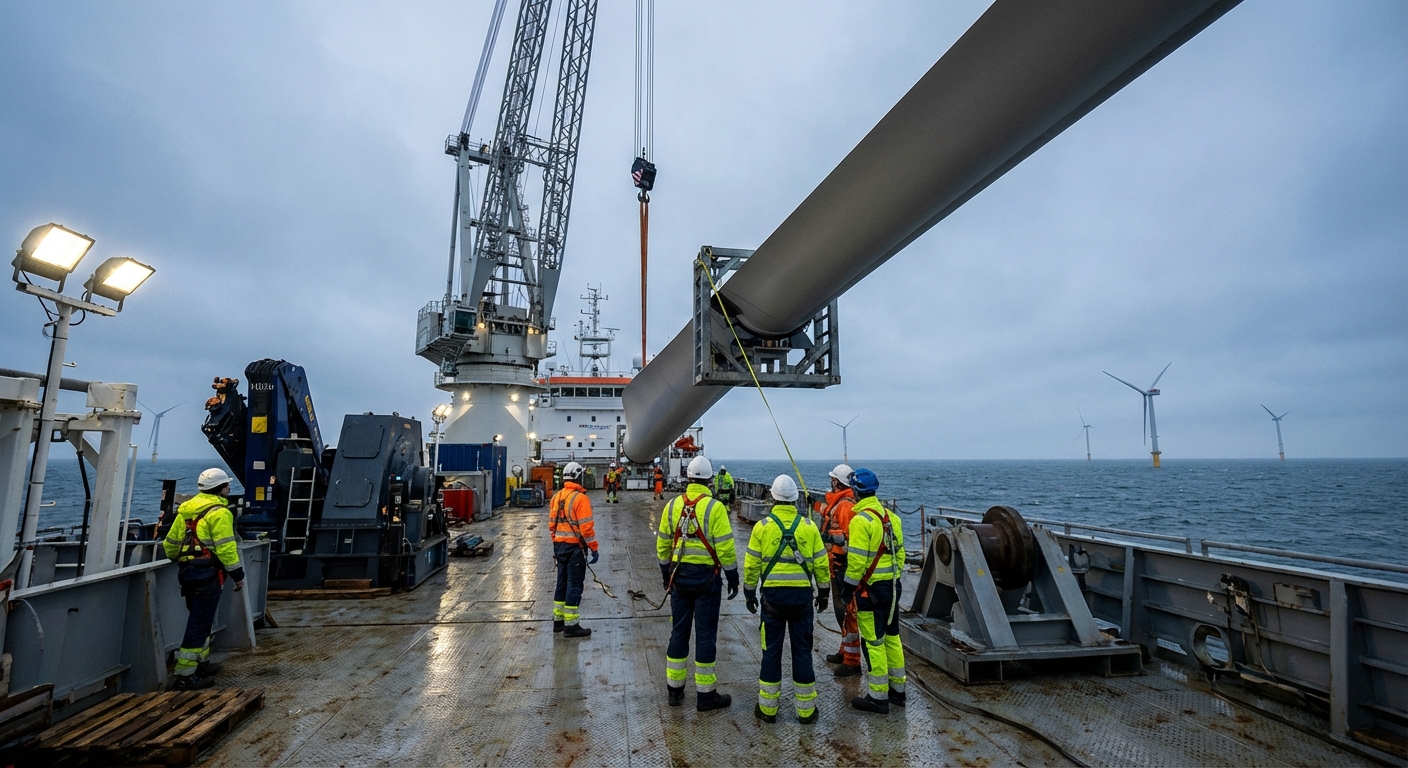
For the companies involved, the suspension creates immediate financial pain and long-term uncertainty. Dominion Energy has already sunk significant capital into CVOW construction. Vineyard Wind, the Massachusetts project, has turbines already in the water and was actively generating power before the suspension. Stopping construction mid-project doesn’t just pause investment; it can damage equipment, break contracts, and scatter specialized workforces that are difficult to reassemble.
The broader energy implications are also significant. The East Coast, particularly Virginia’s data center corridor, faces growing electricity demand that existing infrastructure struggles to meet. Data centers are extraordinarily power-hungry, and tech companies have been investing in renewable energy partnerships partly to meet sustainability commitments and partly because they need massive amounts of electricity that has to come from somewhere.
The Bottom Line
The Trump administration just hit pause on nearly six gigawatts of clean energy that was supposed to come online within the next few years, citing national security concerns that weren’t apparently urgent enough to raise during the years of Pentagon review these projects already went through. Whether the suspension survives legal challenge remains to be seen, but the immediate effect is that billions of dollars in investment are frozen and thousands of jobs are in limbo.
The national security argument may or may not hold up in court. What’s harder to argue is that this is a well-timed intervention to protect Americans from genuine threats. These projects were reviewed extensively by military agencies and received approval. The suspension comes from an administration that has openly opposed wind energy from the start and just had its previous attempt to block these projects thrown out by a federal judge.
For coastal residents who were expecting lower electricity bills and cleaner energy, for workers who were building the turbines, and for companies that invested billions based on government approvals, Monday’s announcement transforms what was supposed to be a renewable energy boom into an expensive legal fight with no clear end date. The only certainty is that the offshore wind projects that were supposed to be generating power by 2026 won’t be, at least not on schedule.
Sources: Washington Post, NPR, CNN, CNBC, Department of Interior, PBS News.